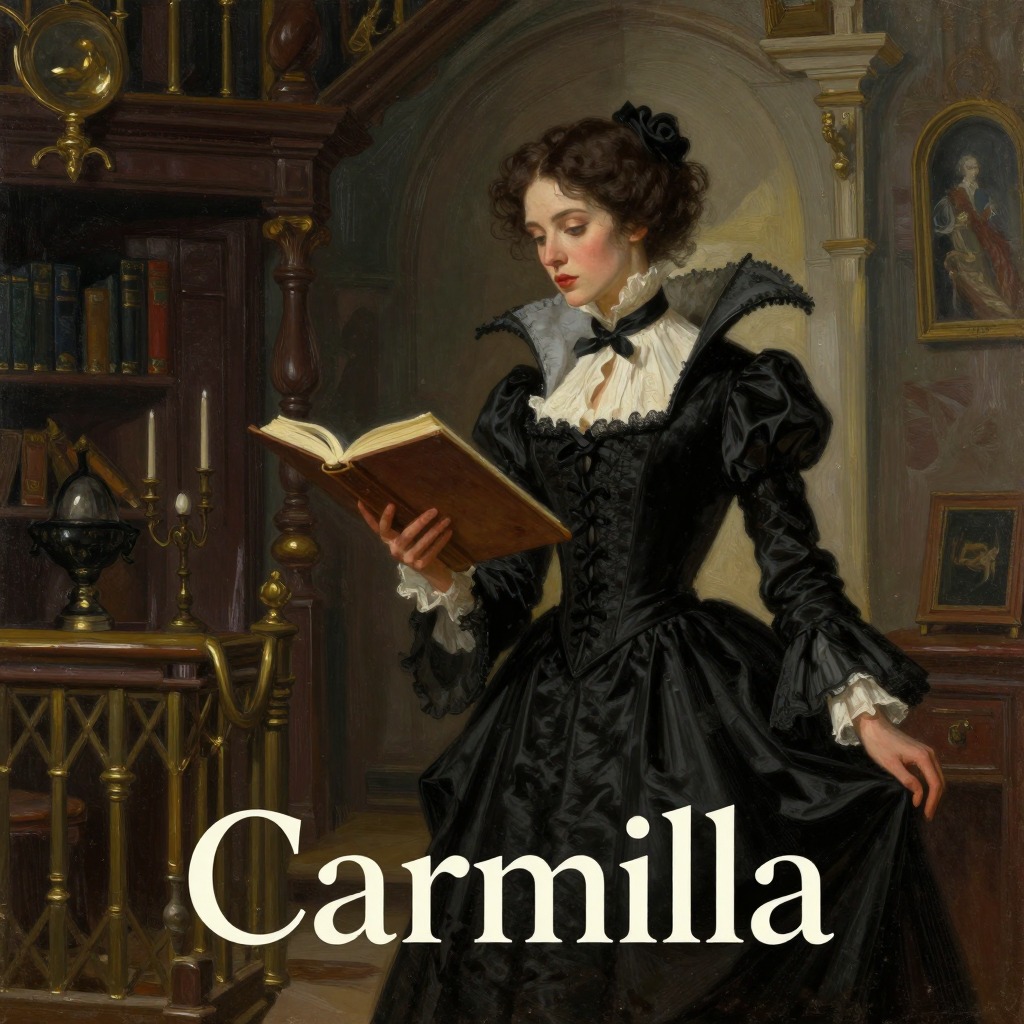
Traveling carriage of the lady in black velvet
CarmillaThe traveling carriage of the lady in black velvet is the vehicle that delivers Carmilla into Laura's life through a violent accident, and later carries the lady herself away with theatrical haste, marking the story's threshold between the mundane and the monstrous. Its appearance on a moonlit road, its near-destruction at the ancient stone cross, and its swift departure all establish the carriage as an object of mystery, danger, and aristocratic power—a mobile stage for the first act of the vampire's infiltration.
Arrival and Accident
On a soft summer evening, as Laura and her father stood with the governesses admiring the moonlight, the unwonted sound of carriage wheels and many hoofs on the road arrested their attention. The equipage emerged from the high ground overlooking the bridge: two horsemen first crossed, then a carriage drawn by four horses, with two men riding behind. It seemed the traveling carriage of a person of rank. Just as the carriage passed the summit of the steep Gothic bridge, one of the leaders took fright, communicated his panic to the rest, and after a plunge or two the whole team broke into a wild gallop, dashing between the horsemen and thundering along the road toward the schloss with the speed of a hurricane. The excitement was made more painful by clear, long-drawn screams of a female voice from the carriage window. Just before the castle drawbridge, on the route they were coming, a magnificent lime tree stood by the roadside, and on the other side an ancient stone cross; at sight of these the horses, now going at a perfectly frightful pace, swerved so as to bring the wheel over the projecting roots of the tree. Laura covered her eyes, unable to see it out. When she looked again, two horses were on the ground, the carriage lay upon its side with two wheels in the air, and the men were busy removing the traces.
The Lady and Her Daughter
From the wreckage emerged the lady in black velvet, a tall, fine-looking woman dressed in black, with a proud and commanding countenance, though agitated strangely. Through the carriage door was lifted a young lady who appeared lifeless—Carmilla. The lady declared herself Carmilla's mother and spoke distractedly of a journey of life and death, insisting she could not delay. Laura's father offered hospitality, and after a brief, earnest conversation with the lady—conducted out of hearing, with a fixed and stern countenance—he agreed to take charge of the young lady. The carriage was soon replaced in its upright position, the horses tractable again in the traces. The lady knelt beside her daughter for a moment, whispered what seemed a benediction, then hastily kissed her and stepped into the carriage. The door was closed, the footmen in stately liveries jumped up behind, the outriders spurred on, the postilions cracked their whips, and the horses plunged and broke suddenly into a furious canter that threatened soon again to become a gallop. The carriage whirled away, followed at the same rapid pace by the two horsemen in the rear, and was swiftly lost to sight in the misty wood.
The Carriage at the Masked Ball
Months later, General Spielsdorf's narrative reveals that the same carriage—or one identical in appearance—figured in the catastrophe that killed his ward, Bertha Rheinfeldt. At the magnificent masquerade at Count Carlsfeld's schloss, the lady in black velvet appeared with her daughter, whom she called Millarca. After a brief conversation with a pale gentleman in black, the lady announced she must depart immediately on a mission of life and death. The General saw a handsome old-fashioned carriage, with a troop of couriers and footmen, waiting at the hall door. The slim figure of the pale gentleman in black held a thick velvet cloak and placed it about her shoulders, throwing the hood over her head. She nodded to him, just touched his hand with hers, and as the door closed, the carriage began to move. This departure, like the one at the schloss, was marked by secrecy, urgency, and the abandonment of a daughter to unsuspecting hosts.
Significance
The traveling carriage functions as a threshold object—it brings the vampire into the domestic sphere under the guise of a noble traveler in distress, and it removes the vampire's accomplice before the truth can be uncovered. Its repeated association with life-and-death missions, its near-destruction at a stone cross (a symbol of Christian protection), and its swift, almost theatrical departures all reinforce the carriage's role as a vehicle of deception and predation, carrying the supernatural into the heart of the ordinary world.