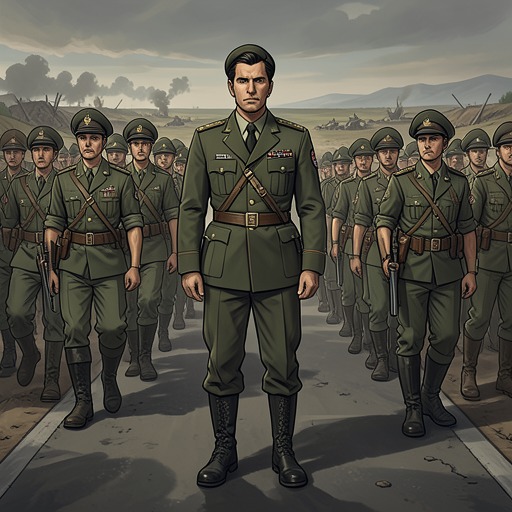
L’armée faisait semblant d’être l’armée
CherryL’armée faisait semblant d’être l’armée names the narrator’s suspicion that the military’s authority and discipline could become performances, detached from the realities they claimed to master. The expression first emerges amid recruitment and training, where the rituals of becoming a soldier seem both coercive and absurd; its force deepens when battlefield mistakes and losses show that the consequences are anything but pretend.
Origin in Recruitment and Training
The phrase comes at the end of a scene at a firing range. The narrator has disclosed that he is red-green color-blind; a sergeant responds by hitting his helmet with a brass rifle-cleaning rod. Afterward, recruits are searched under the rule that there must be no brass and no ammunition. The recruiter Cole also hits the narrator in the groin without explanation. The narrator says the recruits endure it because they tell themselves that the whole arrangement is fabricated: “Les sergents recruteurs faisaient juste semblant d’être des sergents recruteurs. Nous faisions semblant d’être des soldats. L’armée faisait semblant d’être l’armée.” The repetition makes the claim collective: the recruiters perform their roles, the recruits perform soldierhood, and the institution itself seems to perform being an army.
The account of recruitment complicates that cynicism. Kelly presents military service through concrete benefits, including a government car, housing allowance, and health coverage, and is excited when the narrator scores in the 85th percentile on a practice test. The narrator understands that recruiters are struggling to find recruits as news reports describe young people being killed or mutilated in the field. His father, meanwhile, asks whether there is anything else he would rather do; the narrator explains that he expects to remain near Ohio and notes the 300,000-dollar life-insurance supplement. The enlistment pitch joins the ordinary calculations of benefits and placement to an institution demanding discipline and sacrifice. The phrase captures the suspicion that these promises and roles do not add up to the reality awaiting recruits.
The Performance Meets Its Consequences
The narrator’s color blindness does not prevent him from pursuing the medical specialty he wants: he is told that 91W is one of the few Army specialties open to someone color-blind, with the joke that medics already know what color blood is. At Fort Hood, he initially enters the medical section of a mixed battalion, but finds its older members’ jargon alienating and asks to join a combat company. He is assigned to Echo Company and becomes infantry. The transition matters to the expression because soldierhood is no longer only an identity enacted in tests and training; it places him in situations where performance cannot control the outcome.
During the treatment of a wounded Hadji, the narrator packs the abdominal wound with gauze, covers it with plastic and tape, and searches for an exit wound that he cannot find. In retrospect, he recognizes that he should have used much more gauze and positioned the wounded man on his side. He also recalls trying to start an IV despite the man’s flat veins. The expression’s irony sharpens here: the narrator has been made to enact military discipline, yet in a real emergency he is unsure what to do, and the patient’s injury is not a drill. The gap is not merely between a uniform and an authentic identity; it is between rehearsed competence and the irreversible stakes of care.
Grief, Responsibility, and the Limits of the Phrase
After the Hadji dies, an older woman tries to reach the body bag. Soldiers push her back; she falls to her knees, throws dirt over her head, and beats her face against the ground. A pregnant young woman joins her, while two boys scream. As soldiers carry the body away, the older woman follows and tries to seize the bag. The narrator recalls being close to tears, then hearing three long automatic bursts of AK-47 fire and taking cover as the infantry returns fire. Later, Sullivan tells him that the older woman was struck by their own fire that morning. The narrator trusts Sullivan’s account. Whatever the narrator calls the army’s performance, the family’s grief and the possibility of friendly fire make clear that the harm is real.
The same tension appears when the narrator confronts a lieutenant over warnings he believes were ignored. He accuses the officer of getting four men killed, then revises his own accusation: the men were acquaintances rather than friends, the lieutenant did not literally kill them, and the narrator believes that without getting bogged down they would have been killed themselves. This correction exposes the strain between a forceful accusation and the narrator’s more complicated understanding of events. L’armée faisait semblant d’être l’armée therefore works as a bitter diagnosis, not a literal claim that nothing matters. The rituals can feel staged; the bodies, failures of care, grief, and consequences they surround cannot.