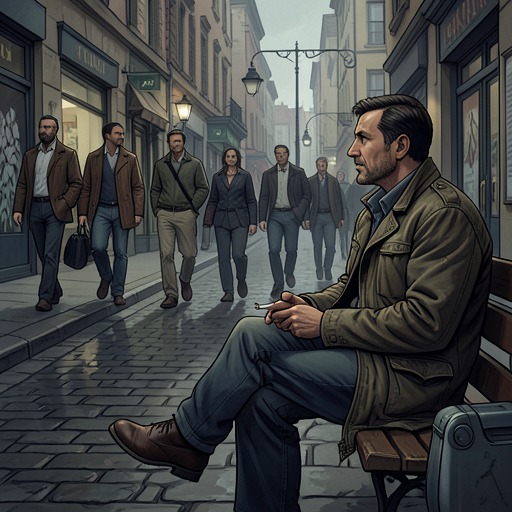
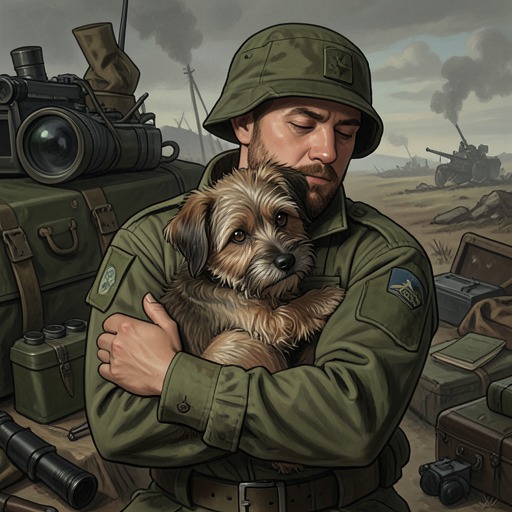
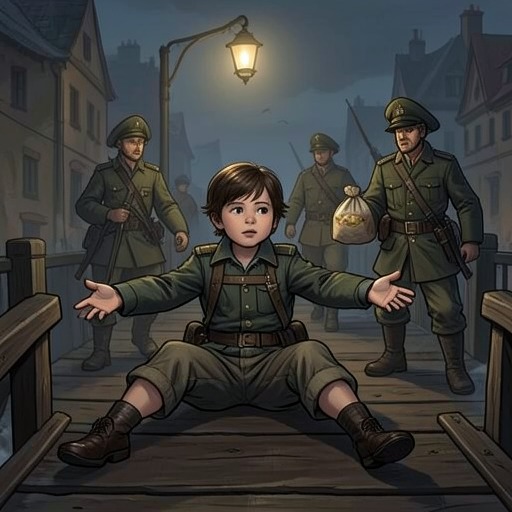
Event 1
Narrator's heroin overdose and rescue
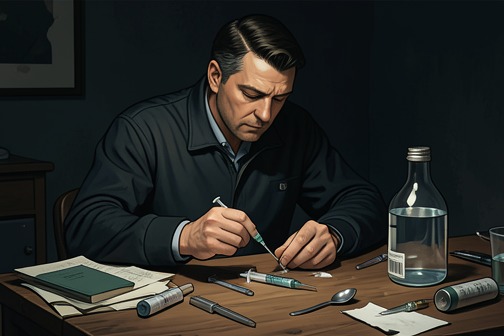
The narrator’s heroin overdose and rescue is a near-fatal episode in which the intimate routine of using with [Emily](entity:character-recall-character-emily-79a1b5f3c22d) and [Black](entity:character-recall-character-black-9a228068f885) gives way to bodily collapse, then resumes with unsettling speed. The narrator experiences the drug’s effects as a sudden reversal from warmth and apparent good fortune to a conviction of death; Emily’s fear makes the danger unmistakable, even as the couple’s next practical concern is getting to college. The aftermath also exposes a promise already broken: they had agreed to stop using when they got a dog, but the dog joined a household in which both remained addicted.
## Preparation and shared routine
The episode begins with the narrator preparing heroin to share with Emily. After Black arrives, Emily is called downstairs to use with the others. The narrator divides the heroin in half, sets out two clean spoons, and prepares water with a syringe. Before drawing up more water, the narrator forcefully ejects some through the needle to clear any blood clot that might obstruct it. Emily’s arrival, her greeting to Black, and the narrator’s instruction that her portion is on the counter place the injection within a familiar domestic routine rather than a private or exceptional act.
The narrator injects first. Emily questions whether that is sensible, and the narrator answers that it will be fine, adding that if more heroin cannot be obtained soon, it hardly matters. The needle is blunt, which can make locating a vein more difficult, but the narrator finds one without trouble. This success is taken as a favorable sign, as though the ordinary mechanics of injection were offering reassurance. The account establishes how the immediate logistics of using—the shared portions, prepared spoons, syringe, and vein—frame risk as something manageable just before that confidence fails.
## The overdose and Emily’s response
At first, the injection seems to proceed as expected: taste comes first, then the flash, then warmth spreading through the narrator. The reversal arrives through the same sense. The taste grows far stronger than usual and becomes nauseating; the narrator recognizes what is happening through that altered sensation and experiences the conviction that, during the interval, death has already occurred. The ears ring. The next concrete image is the narrator on the kitchen floor, with the testicles cold. The account moves abruptly from the felt progression of the high to the body’s position on the floor, marking the collapse without explaining its medical mechanism.
Emily is above the narrator. When the narrator manages to raise his head, he looks at Emily and then at Black, who is leaning against the counter. The narrator wants to laugh at Black but cannot. The disjointed effort to respond sits beside evidence of how serious the episode appeared to Emily: the narrator’s pants are undone, and ice cubes are in the underwear. Asked about them, Emily explains that she thought the narrator was going to die. She is on the verge of tears. Her fear supplies the clearest measure of the danger, while the narrator’s bleakly casual response—that the day is only beginning—sets his manner against the distress visible in her face.
## Return to routine and the broken promise
Black leaves the kitchen. Emily checks whether the narrator is all right, and the narrator says yes, then turns the immediate attention toward Emily’s own injection. She is due to be driven to college, and it is nearly nine o’clock. That quick change of focus does not establish that the danger has passed through any particular treatment; it shows instead how abruptly the household returns to its schedule. The narrator gathers the ice trays scattered across the floor, identifies three kinds—green, blue, and white—fills them at the sink, and puts them back in the freezer. An episode Emily understood as potentially fatal is followed by the restoration of an ordinary kitchen task.
The narrator’s later guilt about the dog widens the scene beyond the immediate overdose. The couple had agreed that they would get a dog and stop using drugs; they did get the dog, but did not stop. The narrator describes the result as being addicts with a dog. That contrast gives the episode its domestic significance: a shared promise and a new responsibility have not displaced the shared addiction. The overdose briefly makes the risk visible to both partners, especially through Emily’s belief that the narrator might die, but the return to preparing her injection and to the morning’s plans shows no corresponding break in their pattern.
Event 2
Narrator's bank robbery and escape
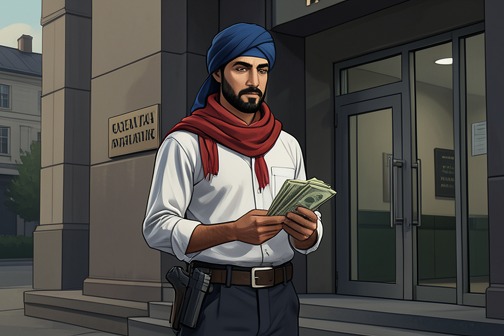
The narrator's bank robbery and escape is an improvised crime carried out with practiced restraint: he enters openly armed, takes cash from a teller, and tries to walk away without drawing attention. Its decisive turn comes after the bank, when [Black](entity:character-recall-character-black-9a228068f885) is missing from the rendezvous and the narrator must conceal both a loaded gun and money spilling from his pockets. Sirens approach before the account confirms whether he gets away; what it does confirm is that, at the sound of them, he feels at peace.
## The Disguise and the Threat
The narrator waits outside wearing an Indians cap, a red scarf, a blue hood, a buttoned white shirt, ordinary jeans, and white Adidas shoes. The gun is at his waist. He pulls the scarf over the lower half of his face as he passes the cash machines, though he doubts the gesture can do much: he has been robbing banks long enough that people know his face. When a man leaves the branch, the narrator goes to the door, enters without apparent anxiety, and draws the gun so everyone can see it.
His announcement that he is wanted and will be killed is, he explains, a joke, and he thinks the people inside understand that. The joke does not make the robbery less real: he still needs money before leaving. The narrator approaches the counter with the pistol held at arm’s length and pointed at the floor, judging that there is no need to make the threat more aggressive than it already is. The contrast between the visible weapon and its deliberately lowered aim establishes the scene’s method: intimidation, but with an effort to keep the encounter from escalating.
## The Teller and the Cash
The narrator describes bank robberies through his own cynical generalizations about tellers. In his account, most are women, and he estimates that roughly 80 percent respond calmly if the robber is not rude; the remaining 20 percent react badly. He recalls one teller who resembled Janet Reno and refused to hand over more than $1,800, apparently convinced that the bank was entitled to withhold the rest even if people were shot. The story presents this as an exception to the narrator’s usual experience, not as a rule about how every teller responds.
He says that tellers usually pass him a message or are told directly that the visit is a robbery, then open the cash drawers and set money on the counter. To him, the exchange can feel almost civil, like a silent joke shared between robber and teller. He believes people do not expect him to do anything serious if the situation worsens, so he makes a point of trying to look at least somewhat deranged. He thinks his visible sadness otherwise makes him look weak; the performance risks making him appear both crazy and cowardly. His concern even extends to the teller’s possible consequences at work: he imagines her manager blaming her for handing over the money and firing her, with the loss reaching her family at [Christmas](entity:time-recall-time-0cffe7da2c4d).
At this branch, the teller and narrator recognize one another. About a month earlier, during another robbery in Lakewood on the West Side, a different teller had put $1,400 on the counter and claimed there was nothing more. The narrator recognized from her voice that she was lying, but says he did not care: he did not want all the money in the branch, only enough to get by immediately. The woman now present had been there for that earlier robbery, making the encounter less anonymous than the narrator’s routine might suggest. When she asks his name, he answers by calling her Vanessa. She quickly empties the cash drawers, and he takes the piles from the counter and stuffs them into his pockets.
## A Walk Meant to Look Ordinary
The narrator knows there is a police station about four hundred metres away and does not intend to linger. He treats the robbery like breaking a shop window or pickpocketing: the important thing is getting away, and getting away depends on moving quickly. Yet once outside, he does not run immediately. He rounds the corner by the cash machines, passes behind the bank, goes by a dumpster and the base of a building where he once lived, then descends the stairs behind a nearly vegetarian restaurant toward a fence and a parking lot.
Black is not there. The narrator says he is not surprised, dismissing the absence as typical dealer behavior. His car is parked a street away, so he decides he can reach it on foot. The parking lot is exposed on three sides to walls full of windows, and he has to manage the gun as well as his appearance. He removes his cap and puts the heavy, fully loaded weapon inside it, an awkward arrangement he accepts because he does not want the gun dragging his trousers down while he walks away. As he crosses the lot, he carries the cap in his left hand and removes his scarf, rolling it up and laying it over the gun to conceal it better.
The disguise is now imperfect in another way: cash protrudes from his pockets, and he has to take care not to drop any. He turns onto Hampshire Road and continues toward his car, aware that police may arrive from Mayfield and that being caught would leave him in serious trouble. An approaching man is dressed, in the narrator’s assessment, like an old man. He hopes this means the stranger will not care what he is doing. The immediate task is to pass without acting like someone who has just robbed a bank.
## Sirens and an Unresolved Escape
The escape is measured in distance and delay. The narrator has covered three quarters of the way and allows himself the possibility that he might get away. Then he hears sirens. They turn the corner and come closer, transforming the walk from a controlled attempt to appear ordinary into an encounter with the consequences he has been anticipating. The account does not establish whether he reaches the car or escapes arrest; it stops with the sirens audible.
The last reversal is emotional rather than practical. When the sirens sound, the narrator says he feels at peace. That calm follows the exposure of the robbery, the missing rendezvous, the clumsy concealment of the loaded gun, and the cash still bulging from his pockets. The scene therefore closes without resolving the chase: its final certainty is the narrator’s response to danger, not the outcome of the getaway.
Event 3
Narrator meets Emily and begins a relationship

The narrator meets [Emily](entity:character-recall-character-emily-79a1b5f3c22d) at eighteen, in an English class he keeps attending partly because she is there, and the attraction that begins between them develops into a first kiss and a relationship that later persists through addiction and criminal upheaval. Their beginning is neither a clean romantic choice nor a simple courtship: the narrator is shy, already attached to [Madison Kowalski](entity:character-recall-character-madison-kowalski-e9b6dde26baa), and drawn to Emily before he knows what to make of her. The book’s later scenes preserve that early tenderness while showing how much harder it becomes to separate care from danger.
## Meeting and first attraction
At the time, the narrator and Emily are both eighteen and have met at school. Emily first notices his gray wool cardigan, a three-button Gap sweater that she describes as an old, sad man’s garment. She tells him it was what caught her attention and prompted her to speak to him. The narrator, who spends seven dollars a day on cigarettes, remembers Emily as having money problems; the mismatch between her financial strain and his spending becomes one of the ordinary, concrete details through which their lives first come into view.
Emily’s presence unsettles him before they have properly begun to talk. She wears a white ribbon around her neck and speaks softly; he cannot decide whether her gentleness is a performance or simply who she is. He is intensely curious about her, but holds back because he has a girlfriend and is timid. That hesitation matters: the relationship does not start with an uncomplicated declaration of interest. Attraction arrives first as a question the narrator is reluctant to act on.
## Classmates, conversation, and divided loyalties
The English class gives their attraction a routine place to grow. The narrator sometimes misses college classes, but he never skips English, despite thinking the course is poor, because Emily is there. They sit beside one another, and that is how they first speak. His habit of returning to the class turns an otherwise unremarkable schoolroom into the setting of their beginning.
Their conversations open onto Emily’s tastes and history. She likes Modest Mouse and introduces him to Night on the Sun; she also has him read two plays by Edward Albee, whose work leaves the narrator wondering about both the playwright and Emily. He listens as she describes the place where she grew up: abandoned factories, a cemetery, and the spots where she scraped her knees. Her green eyes seem bright and kind, but not wholly innocent, and her voice is what finally wins him over. Her stories give their early connection a sense of place even before the narrator fully understands the person telling them.
Emily comes from [Elba](entity:location-recall-location-elba-bb57543d09e9), New York, which the narrator compares with [Cleveland](entity:location-recall-location-16ae08cc1a87) as a similar kind of lakeside town, though a little worse. She tells him she was educated by nuns and had never been in a class with boys, presenting herself as inexperienced around them; the narrator later qualifies that impression, without making it the defining fact about her. He is impressed by her account of his work selling drugs and working in a shoe store, and he likes her more than Madison Kowalski. Yet he remains emotionally divided: he still has feelings for Madison and even shows Emily a photograph of her. Emily responds by admiring Madison’s beauty. Their early closeness therefore includes an unusual frankness about the other relationship rather than a concealed, settled choice.
## First kiss and immediate consequence
A later encounter brings the attraction into physical intimacy. At a party in a brick house on Inverness Road, the narrator arrives with young people from Shaker after meeting them outside Russo’s on Fairmount Boulevard. Beneath a garden trellis strung with small lights, he sees Emily in a white summer dress, laughing. The scene’s recognition is mutual, and the surprise of seeing her again gives the meeting a different charge from their repeated proximity in class.
They continue together and reach the bedroom where they kiss for the first time. The account does not present this as a formal commitment or explain the relationship through a single promise; instead, the kiss marks a change in what had until then been curiosity, conversation, and hesitation. The next morning, the narrator is due at work in two hours. The shoe store calls to tell him he has been fired; he says he understands, hangs up, and goes back to bed with Emily. The sequence places a practical loss immediately beside the new intimacy, without claiming that one caused the other.
## A relationship carried into later crises
Later scenes show the relationship continuing beyond its beginning, now threaded through the narrator’s worsening circumstances. In one exchange, after the narrator apologizes for another man’s insulting way of speaking to Emily, she takes his hands and asks him to let it go. The gesture is small but distinct: she answers his anger not with an argument, but by holding his hands and trying to end the confrontation.
The contrast between the first schoolroom encounters and their later life is especially sharp around the university. While preparing to rob a downtown bank, the narrator speaks with Emily near the campus buildings. She tells him to be careful before returning to the university; he answers her affectionately. The same setting that first brought them together through an English class now places their tenderness beside his criminal plans.
In another later moment, the narrator explains that he needs to obtain heroin quickly and take it to Emily at the university because they are both beginning to feel ill. He has four hundred dollars, owes most of it to [Pistol](entity:character-recall-character-pistol-bcd98d617742), and is pressed for time. His account makes the relationship’s care inseparable from the practical demands of dependence: he is trying to get the drug to her while managing his own need and the money owed to someone else. The story does not erase the attraction, the hand-holding, or the early attention to Emily’s voice; it shows those beginnings continuing in a life where affection must compete with addiction and danger.
Event 4
Narrator joins the United States Army
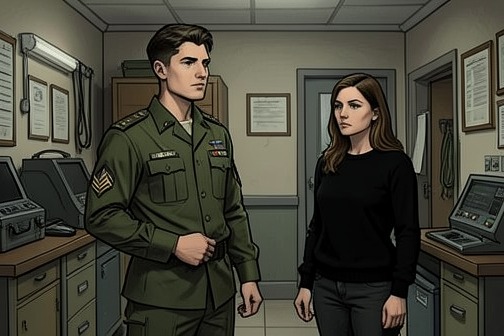
The narrator joins the [United States Army](entity:organization-recall-organization-united-states-ar-bc24e4a38db1) in the first week of [2005](entity:time-recall-time-2005-1e0735bddd1c), turning a recruitment-office decision into the defining transition between civilian life and combat. The enlistment is presented neither as an uncomplicated patriotic calling nor as a purely economic bargain: recruiters advertise security and benefits while casualties make it harder to attract young people, and the narrator’s eventual choice of combat duty carries consequences far beyond the promises made at the recruiting center.
## Recruitment and the decision to enlist
The recruiting process begins with an encounter with Kelly, a senior noncommissioned officer whose black sweater, green trousers, polished leather shoes, and deathlike face make the office feel less like a sales floor than an examination room. Urine-sample cups fill a desk drawer; after the narrator’s sample tests clean, Kelly discusses his Korean wife, government car, housing allowance, and health coverage as attractive features of Army life. The narrator must also demonstrate basic fitness, completing twenty push-ups and twenty sit-ups before running two kilometers on a treadmill. His Vans and slipping trousers do not prevent him from managing the tests.
Kelly then gives him a practice aptitude test to make sure he is not below average. The narrator scores in the eighty-fifth percentile, and Kelly explains that a strong result on the official test could let him choose his military specialty. His excitement is framed against the recruiting climate: news reports have been describing young people killed or mutilated in the field, and recruiters are struggling to find enough applicants. The narrator’s willingness to enlist therefore appears to Kelly as an unexpected success. Kelly brings him to his superior, Adjutant Space, and reports that the recruit wants the medical specialty 91W and wants to leave as soon as possible.
The decision also creates immediate strain in the narrator’s personal life. After a fight with a friend over the enlistment, he calls [Emily](entity:character-recall-character-emily-79a1b5f3c22d) hoping she will affirm that he is a good person or thank him. Instead, she says she thought he was bluffing. He had warned her he intended to do it, but her response makes clear that the announcement had not seemed real to her. The next evening, his parents regard his Army plans as foolish, though they accept that they are his decision. Their new, spacious house offers a domestic future he does not want to join. He tells them that physical and other tests are scheduled for Thursday and that, if they go well, he expects to begin training within two weeks.
## Testing, oath, and departure from civilian life
The expected tests become a bodily ordeal as well as a qualification process. The narrator learns that he is color-blind, but this does not disqualify him from 91W, one of the few specialties available to color-blind recruits. The Army’s explanation is blunt: medics already know what color blood is. The examination includes long queues, a circuit walked in underwear, and an invasive inspection. The crowded room exposes a collection of young bodies that the narrator describes as physically and emotionally unready for military life; he includes himself among the thin and unfit rather than presenting himself as an exceptional recruit.
By three o’clock that afternoon, the Army has accepted him: he signs a contract and takes the oath. The formal acts make the decision official, but the narrator’s understanding of what he has promised remains bound up with practical expectations. Adjutant Space has told him he will list preferred duty locations and that most recruits receive one of their top three choices. He assumes this makes it highly likely he will remain near [Ohio](entity:location-recall-location-4c66c89ead05) and be able to come home often. He also tells his parents that life insurance could amount to $300,000 if he selects the supplemental payment. The appeal of the enlistment thus includes the possibility of proximity to home and financial protection, not only the prospect of serving in uniform.
## The route from medical specialty to infantry
[Roy](entity:character-recall-character-roy-930e89321f14) collects the narrator from the recruiting center and drives him to [Elba](entity:location-recall-location-elba-bb57543d09e9) so he can spend his last two weeks as a civilian with Emily. [Joe](entity:character-recall-character-joe-9b197d8c56ff) is also in the car. Snow falls as they pass Erie; by the time they reach the Jamestown exit, it is dark, and traffic on Interstate 90 is caught in a severe storm. Semitrailers crowd around Roy’s car, swaying in the wind and threatening to drift into their lane. Yet the travelers do not believe they will be among those killed on the road. The narrator recalls the car, cigarettes, heat, and music as ordinary protections that temporarily make danger feel distant. They reach Emily’s home at ten that night, and Roy and Joe turn back.
After training, the narrator is assigned to an armored battalion at [Fort Hood](entity:location-recall-location-fort-hood-2df3edd31842), which he remembers as a bleak landscape designed to produce a sense of fatalism in the young. The battalion combines armored, infantry, and maintenance companies with support and command elements; its medical section belongs to the command-and-logistics company. The narrator initially enters that section, consistent with his choice of 91W, but dislikes its older personnel and the specialized jargon he does not understand. He tells the section’s leader that he wants to serve in a company sent into combat. The leader assigns him to [Echo Company](entity:organization-recall-organization-echo-77d202678a6e), and the recruit who had asked for a medical specialty becomes an infantryman.
## Consequences of the enlistment
The choice to enter infantry does not erase the narrator’s medical role; it places that role directly inside violence. During a later patrol, he is responsible for treating a wounded young man after the unit opens fire. He packs gauze into the abdominal wound, covers it with a plastic bag and tape, searches for an exit wound, cuts away the man’s sweatpants, and tries unsuccessfully to start an IV because the veins are flat. Afterwards he repeatedly recognizes what he should have done differently: use more gauze, pack the wound completely, and position the casualty on his side. The memory turns the 91W training and the move into infantry into a painful conjunction of care and combat, rather than two separate military identities.
The aftermath extends beyond the casualty’s treatment. When the dead man’s body is placed in a body bag, an elderly woman and a pregnant young woman grieve beside two screaming boys. The older woman tries to reach the bag and is pushed back; she throws earth onto her head and strikes her face against the ground. As soldiers carry the body away, gunfire begins and the unit disperses. [Sullivan](entity:character-recall-character-sullivan-bf74bd08e1ea) later tells the narrator that the elderly woman was struck by friendly fire that morning. The narrator trusts Sullivan’s account because he believes Sullivan would not say it without certainty. The enlistment has led him into a position where he must treat the wounded, witness civilian grief, and absorb the knowledge that the unit’s own fire killed a bereaved woman. In retrospect, the enlistment’s decisive significance lies in that collision between the work of a medic and the obligations of an infantryman: the oath initiates a service whose costs cannot be contained by a promised specialty, insurance, or the hope of staying near home.
Event 5
Narrator and Emily marry in Elba
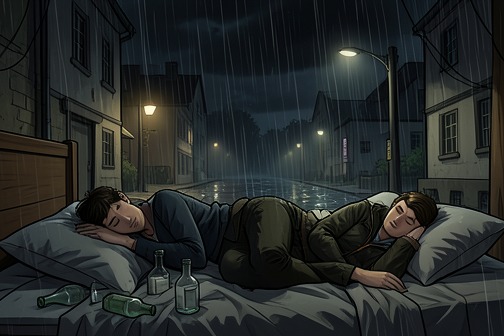
The narrator and [Emily](entity:character-recall-character-emily-79a1b5f3c22d) marry in [Elba](entity:location-recall-location-elba-bb57543d09e9) shortly before his deployment to [Iraq](entity:location-recall-location-iraq-57b030bc9041), turning a practical proposal and a private understanding of their uncertain future into a brief, emotionally overwhelming ceremony. Their wedding is both a commitment and a farewell: they marry in secret, without rings, and part in tears at the airport soon afterward.
## Background and Decision
By the autumn of the wedding, the couple had known each other for two years. They felt they had grown older and more self-sufficient: both had jobs and savings, and Emily would turn twenty-one the following month. During a rainy weekend in Elba, they spent the days lying down and sleeping, then drove at night through the dark autumn landscape. The narrator remembers the bare trees, black sky, and streetlights as beautiful in a way that hurt, giving the decision to marry an atmosphere of tenderness edged with sadness.
Emily proposed marriage this time, presenting it as a practical choice before the narrator left for Iraq. Marriage would mean better pay for him and health insurance coverage for her. He welcomed the practical reasoning, but also emphasized his desire to marry Emily. The decision carried its own qualification: Emily said they would divorce, and he agreed. The marriage therefore begins not with a promise of permanence but with both the urgency of imminent separation and an acknowledged limit on what they expect from the relationship.
## The Secret Ceremony
Emily and the narrator were married by a justice of the peace in Elba on the Tuesday after Veterans Day. The wedding had been kept from everyone; Emily did not want it known. On the preceding Friday evening, [Joe](entity:character-recall-character-joe-9b197d8c56ff) and [Roy](entity:character-recall-character-roy-930e89321f14) had driven from [Cleveland](entity:location-recall-location-16ae08cc1a87) to visit. Joe headbutted the narrator in the face, unaware of the planned marriage; the narrator describes the blow as friendly rather than hostile. By the time of the ceremony, his nose was broken and blood marked his windbreaker.
They had no wedding rings. Emily wore a blue mechanic’s jacket with the name MARIO on its front pocket. The narrator recalls looking at her as angelic and remembers that, for at least a few minutes, they felt like the two most beautiful people in the world. The image is intimate and makeshift rather than ceremonial: a bloodied groom, a work jacket, no rings, and a marriage known only to the couple. Its emotional force comes from their shared conviction in that moment, not from public recognition or elaborate ritual.
## Farewell and Significance
After the wedding, Emily drove the narrator to the airport. They stayed in her car in the parking lot, crying until it was time for him to leave. The sequence compresses marriage and separation into the same departure: the practical arrangement they had made before his deployment became real just as they had to say goodbye.
The scene’s tenderness is inseparable from its uncertainty. The couple’s happiness is described as absolute but fleeting, while their prior agreement to divorce prevents the wedding from being read as a simple assurance of lasting security. Secrecy, the absence of rings, and the airport farewell make the marriage feel less like a public beginning than a private interval before war. Its defining contradiction is that the narrator is about to leave Emily, yet is also, in his words, getting to marry her.
Event 6
Narrator's unit deploys to an Iraqi base
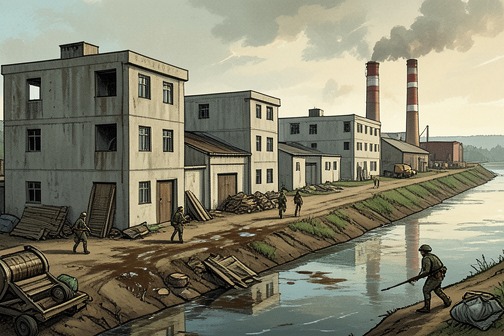
The event in which the narrator's unit deploys to an Iraqi base begins with arrival in December and the gradual assumption of a forward operating base from the Mississippi Rifles. The base is organized around a noisy, oil-fired power station beside a river: its buildings and oil-soaked surroundings shape both the geography of daily life and the unit's transition into its new operational role.
## Base and Relief
The forward operating base had been built around the power station, whose machinery made an unceasing range of noises and whose oil was everywhere, in the air and on the ground. The narrator's company lived near the northern entrance in the Russian village, a cluster of closely spaced concrete buildings that served as its sleeping and living quarters. [Delta Company](entity:organization-recall-organization-delta-d688981bf23d) was across the motor pool; the aid station stood on that side as well, near the landing zone. Farther east, beyond the power station and the local shops, the rest of the battalion occupied a tent village near the main entrance. The battalion tactical operations center was in the same area, facing the road along the base's northern wall. From the northern entrance, the road ran west, with the river to the left and [Route Martha](entity:location-recall-location-route-martha-fe36720023ae) cutting through fields and palm groves; its two lanes were barely paved.
The incoming unit took over from the Mississippi Rifles, nicknamed the Nasty Girls, in a handover marked by contempt rather than ceremony. The outgoing soldiers had assembled photographs of people they had killed into a PowerPoint presentation with a demeaning title. The two groups initially conducted mounted patrols together, pairing one soldier from each unit as the Mississippi Rifles gradually withdrew. By [Christmas](entity:time-recall-time-0cffe7da2c4d), the last of the outgoing soldiers had gone home, leaving the incoming unit on its own at the base.
## First Duties and Operational Readiness
The narrator served as the third section’s aid man while the section was assigned as Quick Reaction Force 1. Its work was to reinforce any incident in the battalion’s operational area: if a patrol came under attack or made contact with the enemy, the section would respond, and if explosive-ordnance personnel were called out, it would escort them. The assignment placed the unit on standby for other soldiers’ emergencies, rather than guaranteeing direct action of its own.
That distinction became clear when mortar rounds struck the battalion tactical operations center. The attack left three people wounded, but the narrator’s section, positioned near the power station, could see nothing: buildings blocked the view even though they were only about two hundred meters from the impact site. The narrator remembers the failure to witness the event as disappointing, because the soldiers had arrived wanting to be at the center of the fighting.
The section’s readiness could also be diverted into tasks the narrator considered pointless. He objected to being sent to establish a security cordon while a sergeant from the command section flew a small Raptor remote-controlled aircraft outside the base. The contrast between the Quick Reaction Force’s stated purpose and this duty sharpened his sense that deployment did not necessarily mean meaningful engagement.
## The Medic’s Failure and Its Aftermath
During a later engagement, the narrator was assigned to treat a wounded man who had been shot by the soldiers. He could find no exit wound and could only estimate where the .556 round had gone; after cutting away the man’s tracksuit, he packed gauze into the entrance wound and covered it with a plastic bag taped down on three sides. The man’s eyes repeatedly rolled upward, and his veins were too flat for an intravenous line. The narrator later recognized what he had failed to do: use far more gauze to seal the wound and place the man on his wounded side. His talk of elevating the man’s feet was, by his own account, something to say when he did not know what else to do. The passage makes the medic’s role painfully concrete: he has the tools and responsibility to care for a stranger, but cannot turn uncertainty into effective treatment.
The wounded man died. As the narrator placed his naked body in a body bag, an old woman came out of a house screaming and tried to reach it. Soldiers pushed her back; she fell to her knees, threw handfuls of dirt over her head, and struck her face against the ground. A heavily pregnant young woman began to grieve in the same way, while two boys screamed. When four soldiers carried the body away, the old woman rose and followed, trying to pull the bag from them. The narrator recalls being close to tears and thinking of shooting himself when automatic fire erupted in three long bursts and ended the scene; the soldiers scattered and took cover as the infantry returned fire.
That night the unit went back to the area, and nothing happened. Later, [Sullivan](entity:character-recall-character-sullivan-bf74bd08e1ea) told the narrator that the old woman had been killed by their own fire that morning. The narrator believed him because Sullivan would not have said it unless he was sure. The delayed confirmation sharpens the episode’s moral consequence: the grief witnessed beside the body was not separate from the firefight, and the gunfire that broke it up had also killed one of the mourners.
Elsewhere in the deployment, the narrator’s anger at command surfaced in a confrontation with a lieutenant. He accused the officer of ignoring his warning not to drive into a soft field, where the vehicles became bogged down, and claimed that four soldiers had died as a result. He immediately qualified the accusation: the lieutenant had not killed them, and they were acquaintances rather than friends. He also acknowledged the bitter reversal that, had the vehicles not bogged down, the soldiers themselves would have been killed. The outburst therefore holds accusation and correction together: the narrator voices blame in the language of grief, then admits that the outcome he condemns may have saved the unit.
## Narrative Significance
The deployment’s account is shaped by repeated corrections to what the narrator first believes or says. The soldiers’ eagerness for combat gives way to the knowledge that proximity does not mean understanding; the narrator’s confidence in his treatment of the wounded man is replaced by a precise reckoning with what he omitted; and his accusation against the lieutenant is immediately qualified by the possibility that the very mistake he condemns kept the soldiers alive. Sullivan’s later report adds another belated revision, turning a witnessed act of mourning into evidence of a death caused by the unit’s own fire. The event’s significance lies in this unstable passage from action to knowledge: responsibility remains, even when certainty about cause, competence, and blame does not.
Event 7
Patrol encounters an improvised explosive device attack
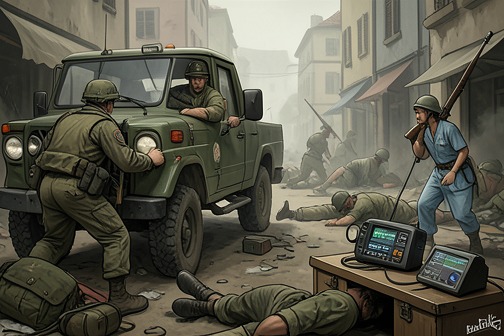
The attack on a Company Charlie patrol on [Route Polk](entity:location-recall-location-route-polk-24210ea3e181) exposes the cost of a delayed response and becomes a defining early encounter with battlefield death for the narrator, who serves as a medic in the quick reaction force. Sent to help the wounded, he confronts the distance between his assigned role and what he can actually save—and later carries the scene as a source of guilt and distress.
## The Delayed Response
The quick reaction force is supposed to reinforce patrols under attack and escort explosive-ordnance teams. Yet before the bombing, the narrator’s unit is deployed to establish a security cordon while a sergeant flies a small remote-controlled Raptor outside the base. The narrator objects to the mismatch between the force’s purpose and its task. When the battalion network reports that a Company Charlie patrol has been attacked on Route Polk, the unit must first cross back through the base’s main southeastern entrance and then travel toward the northern entrance. The detour turns what could have been a five-minute journey into a trip of nearly thirty minutes; half the battalion has already reached the scene by the time the narrator’s vehicle arrives.
The radio reports five casualties from the improvised explosive device: two dead and three wounded. Riding in Lieutenant Heyward’s truck, the narrator asks whether he should dismount to help because he is supposed to be a medic. Heyward orders [Sullivan](entity:character-recall-character-sullivan-bf74bd08e1ea) to accompany him. They find an armored Humvee overturned and burning in a bomb crater, with three wounded men on the road and two dead inside the vehicle. The wounded appear stable, with fractures, minor burns, and bruises. Company Charlie’s medics have already treated them, and medical personnel from the headquarters and logistics company are helping before the medical helicopter arrives.
The helicopter lands in a field beside the road. The narrator helps carry a wounded man on a stretcher over uneven ground toward the shade, crouching well before they reach the rotor blades. In the low light, he sees the man’s frightened, anguished expression. The narrator tells him that he will take care of him, then feels foolish for having said something so melodramatic. The reassurance is small, but the scene already places him between the injured man’s need and the uncertainty of what care can accomplish.
## Rumor, Death, and the First Wound of Witnessing
Back at the base, the soldiers waiting in the parking area press the narrator for details: what happened, who was killed, and what he saw. He is too shaken to tell them much, and instead goes to speak with [Shoo](entity:character-recall-character-shoo-58cda58412ec). Shoo treats the narrator’s reaction as comic, teasing him that he has been initiated—that he has lost his cherry. The crude joke recasts a violent first encounter as a rite of passage, offering the unit’s familiar language of bravado where the narrator has no adequate account of what he has just witnessed.
In the narrator’s room, [Burnes](entity:character-recall-character-burnes-4b6738a29fc8), [Yuri](entity:character-recall-character-yuri-097baa4d9efb), [Lessing](entity:character-recall-character-lessing-17a95438bb16), Fuentes, and Cheetah are waiting to hear what happened; Arnold is the only one absent. The narrator admits that he does not really know, but tells them what he can. Fuentes, assigned to the company tactical operations center radio watch, leaves the room with solemnity. When Arnold comes in, Fuentes has taken over the watch and reports that he heard over the radio that the three wounded men the narrator helped load onto the helicopter have died. The news strikes the narrator hard: at the roadside, their injuries had seemed survivable, and he had not thought they were about to die. His distress turns immediately into a question about whether something had been missed.
The narrator asks Arnold’s superior, Sergeant Major Drummond, whether the men from the helicopter are dead. Drummond says they are not and asks who told him otherwise. When the narrator identifies Arnold as the source, the account remains unsettled in the available scene: the first report of death has been contradicted, but the narrator has already felt the shock of believing that the men he helped carry away did not survive. The episode leaves the medical task shadowed by uncertainty, and the narrator’s new exposure to casualties is measured not only by the bodies at the crater but by how quickly hope can turn into imagined failure.
## The Recurring Burden of Care
The narrator’s later treatment of a wounded Iraqi makes the limits exposed by the Route Polk response recur in a more intimate form. After the man is shot while fleeing, [Dallas](entity:character-recall-character-dallas-0eabdc62d971) runs after him and crosses the narrator’s line of fire; the narrator does not shoot, while the rest of the team opens fire. When they approach, the young man lies on his back, barefoot and bleeding through a white undershirt. The narrator is supposed to treat him, but cannot tell where the bullet has gone. He packs gauze into the wound, secures a plastic bag over it with tape, and asks Sullivan to hold the dressing while he searches for an exit wound. Finding none, he cuts away the man’s sweatpants and still cannot determine the bullet’s path.
Afterward, the narrator judges his own treatment as inadequate. He should have packed in much more gauze and sealed the wound completely; he should have turned the man onto his injured side. Instead, he forgets, tries unsuccessfully to start an IV because the man’s veins are flat, and reaches for explanations and actions while uncertain what to do. His claim that raising the man’s feet on his helmet might prevent shock is medically plausible, he admits, but he has said it partly because he needs something to say. The memory turns the medic’s role into an exacting measure of responsibility: not merely whether he was present, but whether he recognized and did everything the wounded man needed.
The man dies, and the narrator places his naked body in a mortuary bag. A woman from the house rushes out screaming and tries to reach the body; soldiers push her back, and she falls to her knees, scooping earth over her head and striking her face against the ground. A pregnant young woman and two boys also cry out. As soldiers carry the bag away, the older woman follows and tries to seize it. The narrator is close to breaking down when three long automatic bursts from AK-47s end the scene and send the soldiers scattering into cover. Sullivan later tells him that the woman was struck by their own fire that morning. The revelation makes the scene more than an episode of grief witnessed at a distance: the force meant to contain danger has also killed one of the bereaved civilians.
These moments do not alter the reported casualty count on Route Polk; they show how the narrator’s experience of that response belongs to a continuing exposure to wounded bodies, uncertain outcomes, and losses that arrive through delayed or contradictory information. In a later confrontation with a lieutenant, he erupts over having been ignored when warning that a field was too soft for vehicles. He invokes four men who died and accuses the lieutenant of killing his friends, then immediately qualifies the accusation: the lieutenant did not kill them, and they were acquaintances rather than friends. He also recognizes the counterfactual beneath his anger: had the unit not become bogged down, it would have been the men who were killed. The self-correction does not settle the blame; it reveals how combat losses keep returning as arguments about what could have been prevented, and how little certainty the narrator can claim even when he speaks with force.
## The Wreck and Its Spectators
When the narrator returns to the road, the Humvee has stopped burning, but the danger has not become safely past. A recovery vehicle is trying to pull the overturned wreck from the bomb crater while a crowd gathers to look at the bodies still inside. Sullivan remarks that the bodies’ bones were visible. The rescue scene thus gives way to another kind of exposure: the dead are no longer hidden by flame, and the soldiers’ work of recovering the vehicle unfolds before onlookers drawn to its human cost.
That aftermath sharpens the episode’s split between medical duty and the experience of witnessing. The narrator has helped carry the wounded toward evacuation, yet the roadside remains marked by the two dead inside the wreck and by the sight that follows when it is hauled out. The attack’s consequences do not end when the helicopter leaves; they persist in the recovery, the crowd’s gaze, and the narrator’s difficulty finding words for what happened.
Event 8
Three bomb-filled minibuses explode outside an Iraqi mosque
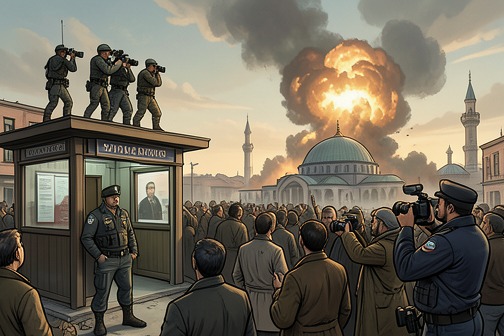
[Three bomb-filled minibuses explode outside an Iraqi mosque](entity:event-recall-event-7efb615eaba1) in a mass-casualty attack that kills more than 140 people. The narrator’s section is at the scene, near a police post, and the soldiers’ limited video footage becomes a measure of how little a recording can preserve of the event’s scale.
## The bombing and its setting
The explosions occur outside a mosque close to a police post. The account gives the death toll as more than 140, establishing the attack’s catastrophic human cost without identifying who carried it out or describing how the explosives were placed. Its proximity to the post puts the narrator’s unit directly in the vicinity when the minibuses detonate.
## Witnesses and the limits of the record
The first section is present when the minibuses explode. Some soldiers standing on the police-post roof film what they can with digital cameras. The narrator later watches their recordings, but says that little can be made out. The footage confirms the soldiers’ presence and their attempt to document the event, while its meagerness sharply contrasts with the scale of the deaths.
## From mass-casualty scene to military operations
The bombing is followed in the account by the section’s first raid, at an apartment residence north of the large Shiite city. The soldiers approach in triangular formation across open ground, watching the windows; it has rained, and the narrator thinks the exposed approach is a way to get shot. He has only a small 9 mm pistol while the others are properly armed. The sequence moves from a devastating attack witnessed but barely captured on camera into a raid marked by the soldiers’ own vulnerability. The narrative does not establish that the raid was a direct response to the bombing, but its placement brings the civilian death toll and the unit’s continuing operations into immediate proximity.
Event 9
Livingston kills an enemy combatant in a convoy ambush
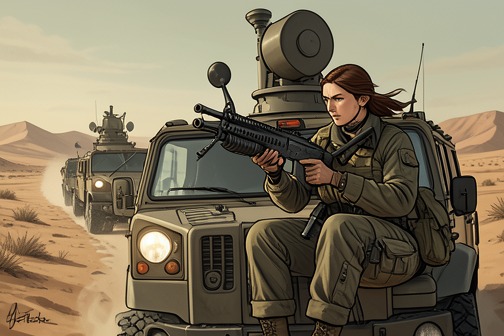
[Livingston kills an enemy combatant in a convoy ambush](entity:event-recall-event-d17962f4405b), an episode that makes a cook from the noncombatant staff the first person officially credited with killing an enemy. The event places her composure under fire beside the infantry’s scorn at the source of the achievement, exposing how the unit’s ideas about combat and gender shape its response to her action.
## Convoy and Assignment
Foxtrot was escorting a KBR convoy from Baghdad to install a dining hall at the forward operating base. Livingston rode in the turret of one of the Humvees, behind a heavy machine gun. The narrator notes the mismatch between her small frame—she weighed less than fifty kilograms—and the weapon and cumbersome turret. The account suggests that someone may have put her there as a joke, but gives no confirmed explanation for the assignment.
## The Ambush and Kill
The convoy encountered an improvised explosive device, followed by small-arms fire. Livingston did not lose her composure. The narrator allows that she may have spotted an enemy combatant in a palm grove before killing him; the qualification leaves the precise instant of recognition uncertain, but the account is clear that she killed him during the ambush. The episode is presented as the first officially recorded enemy kill by a member of the noncombatant staff.
## Infantry Reaction and Advancement
The infantrymen were disgusted when they heard what had happened. They treated the kill as a dishonor because its source was a woman in a support role, rather than an infantry soldier. That reaction turns Livingston’s achievement into a challenge to the unit’s assumptions about who counts as a combatant: the official record recognizes the act, while the infantry’s response tries to diminish it.
Livingston would ordinarily have been expected to receive a promotion, but her prospects were complicated by repeated incidents in which she was caught having sex for money. Later, an E-6 lost his rank after having sex with her in a guard tower; he was the radio-watch sergeant. The account thus places the consequences of the encounter on the soldier who outranked her, while describing Livingston through a crude, sexualized lens. Her kill earns official recognition, but the narrative of her status and advancement remains entangled with the same sexual double standard that fuels the infantry’s contempt.
Event 10
Ashura security duty and attempted breach
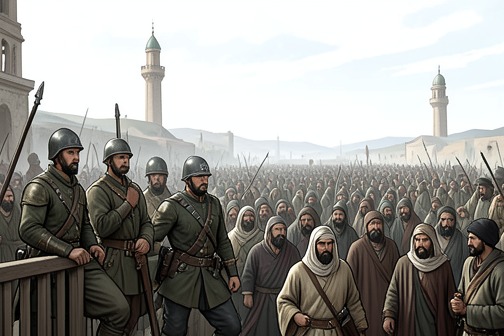
[Ashura security duty and attempted breach](entity:event-recall-event-361f94c5f9c7) places the narrator’s unit amid a vast religious gathering, where the spectacle of collective devotion is followed by a test of how far the soldiers will go to defend their post. The episode turns on a contrast between the pilgrims’ ritual observance and the unit’s own performance of security: when an attempted breach comes, the soldiers ultimately hold back from using lethal force.
## Security Duty and the Pilgrimage
The unit returned to a large Shiite city for [Ashura](entity:time-recall-time-41c6bede9b41), expecting attacks as at least one hundred thousand worshippers made the journey. The soldiers remained at the police station throughout the week, in a force roughly equivalent to a full section. Their assignment placed them inside a security perimeter while the pilgrimage unfolded beyond it, close enough to watch but not to share in its devotional life.
The narrator stood on top of a barricade as the pilgrims emerged beneath a white sky. An intelligence officer had explained that the imam was martyred at the site of the great mosque a thousand years earlier, and that the mosque bore his name. From the minaret came verses; slow, powerful percussion sounded as men struck themselves with knives in synchronized motions. The narrator saw a sea of black and clouds of dust rising and vanishing, a scene that seemed to him unchanged across a millennium.
## The Limits of Witness
The narrator’s vivid view from the barricade did not become a memory he could fully re-enter. Later, he could recall that verses sounded from the minaret and percussion marked the pilgrims’ synchronized movements, yet he could no longer recover those sensations or visualize the scene. He knew what it had looked and sounded like, but remained, in his own account, forever outside it. The gap between seeing and possessing the experience sharpens the earlier image of the pilgrimage: the narrator could watch the ritual unfold without sharing its meaning or retaining it as an inwardly available world.
That distance was also bound to the danger of being captured. He had carried no camera, partly because he did not believe in taking one with him and partly because he imagined that, if the pilgrims captured him alive, he would not want his own camera to record his beheading. The absent camera left no image to revisit; the scene endured instead as a memory whose sounds and sensations had already begun to escape him.
## Fractures in the Security Perimeter
During the week at the police station, the danger did not come only from outside the perimeter. Two plainclothes [Iraqi Police](entity:organization-recall-organization-6568c99fa198) officers burst into the courtyard fighting over a loaded 9 mm Glock, which had no safety. The narrator stayed where he was, unsure whether he was expected to shoot. Other officers rushed in to separate them; one combatant ran off, and someone threw a shoe. The sudden quarrel made the post’s armed security feel unstable from within, even as the unit prepared for attacks beyond it.
On the final night of Ashura, a pilgrim tried to slip inside the enclosure behind the police station. Sergeant [Bautista](entity:character-recall-character-bautista-7d67329f2d83) shot him in the buttocks with a tracer round, but the man escaped. The soldiers could have killed him with live ammunition, the narrator observes, and expected no one to hold it against them. They did not: they were pretending, and refrained. The episode makes the security operation’s contradiction explicit. The soldiers were armed and authorized to guard the post, but their restraint exposed how much of that defensive posture was performance rather than a commitment to lethal force.
## Ceremony and Return
The episode’s guarded distance from ritual resonates with the unit’s later encounters with military ceremony. When combat patches were distributed, the soldiers treated the occasion as an inconvenience; [Rodgers](entity:character-recall-character-rodgers-d554cc5dba37) loudly dismissed the insignia, and the captain’s speech gave way to a Toby Keith song before his command to present patches provoked laughter rather than solemnity. The senior warrant officer responded by making the ranks exercise on the black asphalt in the midday heat, from enlisted soldiers up through the sergeant majors. On returning to [Fort Hood](entity:location-recall-location-fort-hood-2df3edd31842), the unit was told to run into a gymnasium where soldiers’ families waited, with bass and drums announcing the spectacle; the narrator, at the back of the line, rejected the grand entrance as an inadequate measure of what the soldiers had done. Set beside the Ashura gathering, these scenes distinguish the narrator’s position as a witness to ritual from any easy sense of belonging: religious devotion remained beyond his participation, while military ceremony could command his body but not his reverence.
Event 11
Operation Radiant Honor
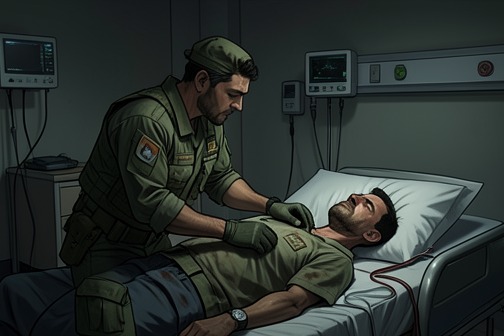
[Operation Radiant Honor](entity:event-recall-event-b942e86891b4) is an [Iraq](entity:location-recall-location-iraq-57b030bc9041) operation whose episodes place the narrator’s work as a combat medic beside the violence and uncertainty of military action. Its significance lies not only in armed encounters but also in the demands of care: the narrator is expected to treat people in circumstances where training, authority, and available help may not be enough.
## Preparation and a Night Raid
Before deployment, the narrator’s two-week rotation at [Brooke Army Medical Center](entity:location-recall-location-8503abddb0b4) had offered basic hospital experience, but also made the limits of that preparation plain. He mishandled a blood-pressure cuff on a patient with a broken leg, then tended to a man stabbed in a street fight, washing him in bed. Another patient, a brain-damaged man whose penis had been torn off by a car, lay beside a grieving mother whose anguish the narrator found almost unbearable. These encounters gave his later role as a medic a concrete measure: he had to act while still learning what he could and could not do.
During the operation, at ten at night, [Delta Company](entity:organization-recall-organization-delta-d688981bf23d) had suffered yet another homemade-bomb attack, the latest in eight hours, and the battalion had taken casualties. The narrator’s unit was sent on a rescue mission. Near a cluster of houses, the soldiers confronted a metal door riddled with bullet holes, with light showing through it. After a moment’s hesitation, [Hueso-Santiago](entity:character-recall-character-hueso-santiago-6fec26f28caa) kicked the door in, and the soldiers entered behind him. Women, children, and an old man stood along the wall while a television played. In a wooden sideboard they found clothing and an [AK-47](entity:object-recall-object-ak-47-fa22870ff87d) wrapped in a shirt, with two full magazines. The weapon was not, in itself, unlawful for the residents to possess; nevertheless, the warrant officer Hightower took it and left speaking to it as if he had captured an enemy. The discovery makes the operation’s uncertainty immediate: a weapon’s presence could provoke a military response even when its possession was permitted.
## Medical Care and the Cost of the Operation
On the final day of Operation Radiant Honor, the narrator was assigned to a school where soldiers had set up a treatment station for local people. An elderly man in the queue had deep cuts around his wrists, which he said came from handcuffs placed on him several days earlier. The narrator cleaned the wounds with saline and dressed them with Bacitracin and gauze. When one swollen hand trembled, he feared a serious infection and sought advice from two senior NCOs sleeping outside in a five-ton truck. The chief medic identified the condition as cellulitis; when the narrator asked what he could do, he was told there was nothing, and that he should tell the man to go away and die. The exchange left the narrator responsible for caring for a patient while his superiors denied him either a remedy or a humane explanation to offer.
In another encounter, a young Iraqi man lay wounded after soldiers opened fire during a pursuit. The narrator had not fired because [Dallas](entity:character-recall-character-dallas-0eabdc62d971), a newly arrived soldier, had crossed his line of fire; the rest of the team shot. Asked to treat the man, the narrator packed the apparent abdominal entry wound with gauze, covered it with plastic and tape, and searched for an exit wound, but found none. He later recognized that he should have used more gauze and positioned the patient on his side, admitting that he had forgotten these steps while trying to act under pressure. With no clear wound track and the man’s eyes repeatedly rolling back, he attempted an IV but could not find a usable vein. [North](entity:character-recall-character-north-3da0ee40b7c6) had called for a medical helicopter and the narrator stressed that the case required emergency surgery, but the aircraft did not arrive in time to remove the uncertainty or the burden of care.
The wounded man began choking on vomit and lost consciousness, with no breathing or pulse. The narrator used a resuscitation bag and mask while [Bautista](entity:character-recall-character-bautista-7d67329f2d83) performed chest compressions; the man regained consciousness and began breathing again. He nevertheless died. When the narrator placed the body in a shroud, the dead man’s elderly relative rushed out, screaming and trying to reach him. Soldiers pushed her back; she fell to her knees, threw handfuls of dirt over her head, and struck her face against the ground. A heavily pregnant young woman joined her, while two boys screamed. As four soldiers carried away the shrouded body, the older woman pursued them and tried to pull the shroud back. The narrator was close to tears and thought he might shoot himself when three long bursts of automatic AK-47 fire abruptly ended the scene and sent the soldiers scattering.
The unit returned that evening, and nothing happened during the return visit. Later, [Sullivan](entity:character-recall-character-sullivan-bf74bd08e1ea) told the narrator that the elderly woman had been cut down by their own gunfire that morning; the narrator accepted the report because Sullivan would not have said it without being sure. The operation’s aftermath therefore reaches beyond the patient the narrator failed to save: the family’s grief becomes another casualty of the same armed response in which he had served as medic. His retrospective account distinguishes mistakes he can name from the violence he could not control, but does not make either consequence disappear.
## Responsibility and Retrospective Judgment
Later, the narrator’s anger at a lieutenant reveals how the operation’s battlefield experience sits within a larger pattern of ignored warnings and contested responsibility. He accused the officer of disregarding his advice about crossing soft ground, then blamed him for the deaths of four soldiers after the unit became stuck. Almost immediately, he qualified the accusation: the lieutenant had not literally killed them, and the narrator had exaggerated in calling them friends; they had been acquaintances. He also acknowledged that avoiding the delay would not necessarily have saved the men—they might instead have been killed. The outburst does not resolve who was responsible so much as expose the pressure behind the narrator’s effort to make responsibility legible, even as his own corrections undermine the certainty of his charge.
## The War Seen from the Hospital
The earlier hospital rotation also placed the war behind glass. At Brooke Army Medical Center, the narrator could not enter the isolation room of a boy burned in Iraq: the burns left him especially vulnerable to infection, so the boy could only be observed through a small window. The scene offered no procedure for the narrator to perform and no access to the patient, only the sight of a young soldier already bearing the consequences of the conflict. Set beside the operation’s improvised treatment station and the narrator’s efforts to keep a wounded man alive, that sealed room sharpens the limits of the medic’s role: seeing suffering did not guarantee the knowledge, authority, or opportunity to alter its course.
Event 12
Mahdi Army headquarters raid and deaths of forty people
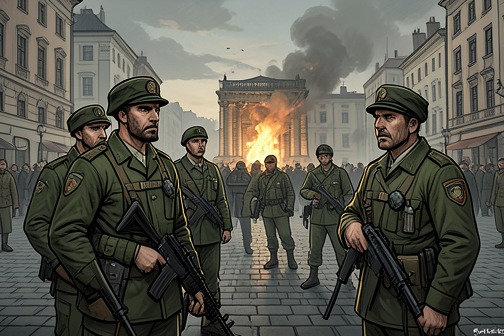
The [Mahdi Army headquarters raid and deaths of forty people](entity:event-recall-event-9501cb1d4e12) expose the distance between the violence unfolding around [Echo Company](entity:organization-recall-organization-echo-77d202678a6e) and the limited role its soldiers believed they had been given. While special forces carried out a lethal raid inside a Shiite city, the narrator and other infantrymen held a cordon at its edge, learned of the deaths only through the news, and came away questioning what their deployment was for.
## Background and Perimeter Duty
About a week after Cecco and Greenwald, some soldiers from Echo Company were assigned to prevent anyone from entering or leaving a large Shiite city. Special forces were preparing to raid the [Mahdi Army](entity:organization-recall-organization-f99693d64ca3) headquarters inside it. The narrator notes that the soldiers had not retaliated against the [Iraqi Police](entity:organization-recall-organization-6568c99fa198) in the preceding episode; the cordon is presented as their next distinct assignment, not as an assault they themselves would carry out.
A voice came over the radio with a sound the narrator likens to death metal, announcing that the raiding force was ready. The men on the perimeter remained at their posts. The division of roles was stark: special forces entered the headquarters, while Echo Company secured the city’s boundary.
## The Raid and the Deaths
The killing itself lasted only a few minutes. The narrator says that forty people were killed, but he and the soldiers around him heard nothing and did not witness the raid. Its speed and scale therefore reach them not as a battlefield scene but as a fact learned afterward.
The next morning, the narrator read about the deaths on Yahoo! News. He had not even known they had occurred until he encountered the report, and wondered how the raiding force had done it. The account leaves the method and the circumstances of the deaths undescribed; what it emphasizes is the gap between a deadly operation nearby and the cordon soldiers’ complete lack of access to it.
## Aftermath and Significance
The narrator identifies the episode as the point when he understood that his unit was not there to do anything consequential. In his bleak formulation, the soldiers were there to be blown up or killed by bombs and to waste their time each day, while no one believed they were capable of actually fighting, whatever fighting might mean. The deaths at the headquarters thus register less as an action by the narrator’s unit than as a contrast: a force elsewhere could conduct a rapid, lethal operation, while his own soldiers stayed in place, uninformed.
That contrast gives the raid its significance in the narrator’s account of the deployment. The cordon puts Echo Company close to a major act of violence without making its members participants or even witnesses. The narrator’s knowledge arrives through a news report, and his response is not triumph but uncertainty about the operation and a growing conviction that his own unit’s daily exposure and inactivity were the substance of its role.
Event 13
Route Polk IED attack
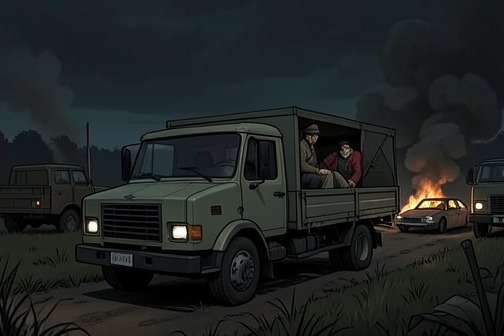
The [Route Polk IED attack](entity:event-recall-event-bc597c6f627f) turns a delayed emergency response into the narrator’s first close encounter with battlefield death. The incident begins with a diversion that leaves his unit badly placed to reach a patrol under attack; what follows shifts from rescue work to the discovery that apparently stable wounded soldiers have died and to the recovery of bodies from a burning vehicle.
## Causes and Background
The narrator’s unit was outside the base while a sergeant operated a small Raptor remote-control aircraft. When the battalion radio reported that a Charlie Company patrol had been attacked on [Route Polk](entity:location-recall-location-route-polk-24210ea3e181), the unit had to return through the main entrance at the base’s southeastern end, cross the base, and leave again through the northern entrance. The detour took nearly thirty minutes. Had the unit already been on the base’s other side, it could have reached the scene in five; instead, half the battalion arrived first, and a long column of vehicles stood between the narrator’s unit and the patrol.
## Rescue and the Wounded
The battalion radio reported five casualties from the roadside bomb: two dead and three wounded. Riding in Lieutenant Heyward’s truck, the narrator asked whether he should get out and help, since he was supposed to serve as a medic. Heyward ordered Private First Class [Sullivan](entity:character-recall-character-sullivan-bf74bd08e1ea) to accompany him. At the scene, an armored Humvee lay overturned and burning in a bomb crater. The three wounded soldiers were on the road nearby; their injuries—fractures, minor burns, and bruises—looked stable rather than immediately life-threatening. Company Charlie’s medics had treated them before the medical evacuation helicopter arrived, and medical personnel from the headquarters and logistics company had joined the effort.
The helicopter landed in a field to the left of the road. The narrator and the others lifted the wounded on stretchers and carried them across uneven ground toward it, crouching well short of the rotor blades. In the scant light, he saw the face of the soldier on the stretcher he was helping to bear: frightened and pained, as though instinct had taken over. Their eyes met, and the narrator told him he would take care of him. The words seemed foolish and melodramatic to him as soon as he had spoken them, but the moment captures the immediate, intimate work of rescue amid the noise and danger of the scene.
## The Dead and the First Aftermath
When the narrator returned to the road, the overturned Humvee had stopped burning, but its dead remained inside as a recovery truck tried to pull it from the crater. People gathered to look. Sullivan told the narrator that the bodies’ bones were visible, an observation that made the wreckage’s violence impossible to keep at a distance. The scene did not end when the flames went out: it left the living with the work of looking, lifting, and trying to understand what had happened.
Back at the base, soldiers waited in the parking area and asked who had been killed and what the narrator had seen. He was not ready to recount it. [Shoo](entity:character-recall-character-shoo-58cda58412ec) treated his reaction as comic, teasing him that he had just lost his [Cherry](entity:concept-recall-concept-cherry-aa35c42e082a)—the language of battlefield initiation turned an encounter with death into a crude rite of passage. The narrator then went to his room, where [Burnes](entity:character-recall-character-burnes-4b6738a29fc8), [Yuri](entity:character-recall-character-yuri-097baa4d9efb), [Lessing](entity:character-recall-character-lessing-17a95438bb16), Fuentes, and others were waiting for an account. He told them what he could, though he did not yet understand the scene himself. Fuentes, on radio duty at the company’s tactical operations center, left with solemn purpose to take over the watch.
Arnold entered after Fuentes had gone and reported what he had heard over the radio: all three wounded men loaded onto the helicopter had died. Their injuries had appeared stable at the roadside, so the news struck the narrator as a reversal he could not explain. His question was not merely who had died, but what the rescuers might have missed. The attack’s aftermath thus unsettles the apparent distinction between the visibly dead and the wounded who seem likely to survive: evacuation offered hope, but did not secure it.
## The Second Blast and the Recovery
The attack’s aftermath turned into another disaster before the recovery was complete. After three trucks became bogged down, the QRF arrived with a Bradley leading three Humvees. The Bradley drove into the mud and sank until its tracks were buried, ending the attempted rescue. The narrator took a turn in the turret while the soldiers waited, watched by a man near the houses who eventually walked away. [Caves](entity:character-recall-character-caves-1eb5751db10c) had come with the recovery team; he and [North](entity:character-recall-character-north-3da0ee40b7c6) talked about the day going badly and about places they might hunt after returning to the United States. The battalion then ordered the recovery team back to the base for a wrecker, leaving the Bradley where it was. The QRF departed with Caves. A dull blast followed, and smoke rose into the sky.
As soldiers tried to put out the fire, the narrator removed his helmet and used it to carry water from the fields. Jackson, the new medic in the first section, called for a security cordon, but the others were fixed on the flames. The narrator later recognized the futility of hurrying to extinguish a fire when the men in the vehicle were already dead. His first count named Caves, [Rodgers](entity:character-recall-character-rodgers-d554cc5dba37), and [Clover](entity:character-recall-character-clover-8922cac35ff4) among the dead, with a fourth man unidentified; then Clover walked toward him. Clover had been due to leave on mid-tour leave that morning, but his flight had been cancelled. He identified Easton as the gunner and Dewitt as the fourth casualty. The mistaken assumption that Clover had died makes the scene’s confusion explicit: even the living could be misread amid smoke, wreckage, and hurried casualty counts.
The recovery proceeded through physical details that resisted any clean account of the deaths. Dewitt’s face was gone, and Clover’s identification was what made his body identifiable. The narrator and the captain carried him toward a mortuary bag, but the heat of his remains tore their latex gloves and forced the narrator to put the body down before they could lift it again. Easton’s entrails spilled as soldiers moved him; a small patch of face and his blue eye remained recognizable, and one of his friends lowered his head in tears. Caves and Rodgers had no faces. Caves was easier to remove because his body armor held his viscera in place, but the grenade still attached to his vest had to be dealt with by explosive-ordnance personnel after the narrator sent him toward the aid station without remembering it was there. Rodgers was identified by his place in the driver’s seat, as Caves’s driver. When a stunned sergeant pointed out what remained of Rodgers along the ruined seat frame, the narrator gathered the greasy residue with his fingers and threw it into the water. He walked away bloodied and unable to make sense of what he had done or seen.
Event 14
False report nearly triggers an airstrike on friendly forces
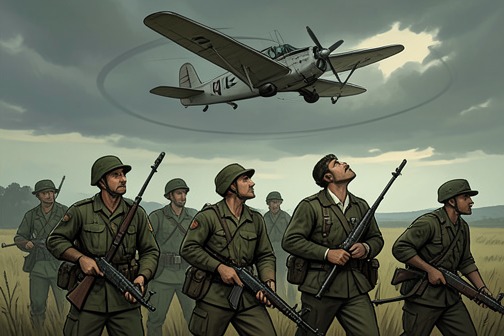
The near-friendly-fire airstrike during the search for missing paratroopers exposes how a false radio report, missing identification equipment, and a misplaced assumption about troop positions could turn American aircraft against their own forces. The danger is interrupted only after [Hueso-Santiago](entity:character-recall-character-hueso-santiago-6fec26f28caa) recognizes the threat and Greene cancels the operation in time.
## Background and mistaken identification
After waiting more than an hour, the force moved north past [Checkpoint 9](entity:location-recall-location-checkpoint-9-960122f7ee27) and split into groups. Hueso-Santiago led a brigade into fields west of the road, while [North](entity:character-recall-character-north-3da0ee40b7c6) directed a fire team northeast. The narrator, [Evans](entity:character-recall-character-evans-ce0652551072), Hightower, and [Castro](entity:character-recall-character-castro-8c719e55281f) went east. Aircraft circled overhead, and one reported a target house for inspection. The ground teams’ divided positions and the air operation’s dependence on radio confirmation formed the conditions for the near-disaster.
The brigade under Hueso-Santiago had no infrared beacon on its equipment. As [Sullivan](entity:character-recall-character-sullivan-bf74bd08e1ea) later explained, its soldiers had come from units normally assigned to Bradley fighting vehicles and were now being used as infantry. The aircraft could not identify them as friendly forces and mistook them for enemy fighters. The error was not simply a bad observation from above: the expected means of distinguishing the brigade was absent, while the radio channel supplied a false assurance that friendly troops were where they were supposed to be.
## How the airstrike was nearly directed at friendly troops
The aircraft radioed the captain to confirm that all friendly soldiers were at their assigned posts. The captain was not in his truck, so [Jeffries](entity:character-recall-character-jeffries-617109782d9f) took it upon himself to answer that everyone was present and in position. That report gave the aircraft a misleading picture of the ground situation even as Hueso-Santiago’s brigade was out in the field.
Hueso-Santiago then radioed the company to warn that one of their own aircraft appeared to be preparing to fire on him. Greene understood what the warning meant, rushed to the captain’s truck, and removed Jeffries from the radio. He cancelled the operation just in time. The account establishes that the airstrike was authorized or under way as an operation, but that Greene stopped it before the attack hit the brigade.
## Aftermath and significance
When the narrator returned to the road, Greene was dressing Jeffries down and threatening to kill him personally if he touched the radio again. The rebuke makes the immediate responsibility plain: Jeffries had answered without authority while the captain was absent. Sullivan’s explanation adds the larger failure behind the moment, as soldiers serving in an unfamiliar infantry role lacked the infrared equipment that would have helped aircraft recognize them.
The danger did not end the search. The force regrouped on the road; the target house had been inspected, and the soldiers had to continue looking elsewhere for the missing paratroopers. In that sequence, the near-strike is neither a separate battle nor a completed attack, but a sudden reversal within an ongoing operation: the aircraft overhead, intended to support the mission, become a threat to the brigade on the ground. The episode makes the fragility of coordination tangible, with the lives of friendly troops briefly resting on a correct radio picture and a warning sent in time.
Event 15
The Narrator and Raul's First Successful Bank Robbery
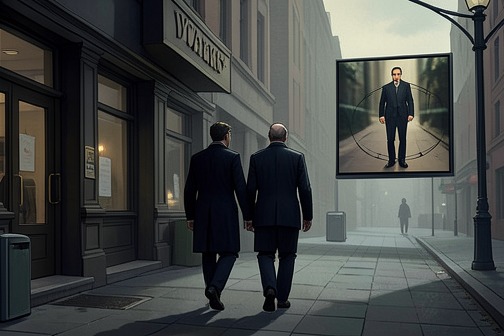
The narrator and [Raul](entity:character-recall-character-raul-e8b24e978d6d)’s first successful bank robbery converts the narrator’s growing desperation into a practical crime—and then, with little pause, into money for heroin. Its significance lies not only in the escape but in the sequence that surrounds it: a failed attempt to find another target, an improvised plan at an aging shopping-center bank, and the immediate transformation of the proceeds into drugs and debt repayment. The robbery is a turning point in the narrator’s self-description as someone becoming corrupt, but the scene presents that change as a chain of compromised decisions rather than a single dramatic conversion.
## Background and Motive
The robbery follows a night of driving with Raul and [Rider](entity:character-recall-character-rider-f49a695e2c76) in search of a particular car. They intend to rob its owner, but never find the car; instead, they go to the owner’s home. The search establishes that the bank is not the first criminal possibility considered that night. It also shows the trio’s movement through a world of targets and opportunities, although the account does not say what happens at the house or why that plan ends.
The narrator connects becoming a rotten person to needing money and spending too much time with drug dealers. His explanation is neither a claim of innocence nor a simple confession of greed. He distinguishes moral character from the willingness to commit a robbery: in his view, some thoroughly bad people would never do it, while robbery belongs to a further stage of degradation. The relevant question, as he frames it, is whether a person has become degraded enough to cross that line.
His immediate circumstances give that reflection its force. He owes money to dealers, including [Black](entity:character-recall-character-black-9a228068f885), but says the debt itself no longer matters to him. What he fears is losing access to heroin. He describes himself as never more than twelve hours from complete collapse, and identifies despair and his compromised condition as part of what has brought him to the bank. The motive is therefore not presented as a plan to improve his life through crime: he wants heroin, and the robbery offers a way to obtain it.
## The Bank and the Decision to Act
The bank is inside an old shopping center. The narrator reads its age as an advantage, reasoning that the security system, doors, and cameras are likely outdated or poor. This is his assessment, not confirmation that the security actually is defective. He and Raul wait for the bank to empty, because the narrator does not want other people in the way. Raul has brought him a hooded sweatshirt and a knit cap. The narrator also carries [Emily](entity:character-recall-character-emily-79a1b5f3c22d)’s bear spray, borrowed without asking; it dates from her time in the woods in [Washington State](entity:location-recall-location-washington-state-99617d550657). He has never robbed a bank before, but says he feels relatively comfortable despite not knowing what to expect.
The timing narrows the gap between preparation and action. Raul goes around the side of the building to urinate, then returns and reports the time as twenty minutes to seven. The narrator agrees and decides to go in. At the bank, three employees and one customer are present: two young female employees and an older male branch manager in a separate office with a glass wall. The narrator describes the manager’s appearance in unflattering terms, noting his suspenders and comparing his bulk and age to a large baby. The customer, a small woman around forty-five or fifty, wears a black wool coat and has shoulder-length dark hair graying at the edges. Snow is falling outside, leaving the narrator’s hood and cap open to an ordinary explanation: he might simply be cold.
Instead of immediately approaching the manager, the narrator stands by a table of pens and deposit slips and writes the same obscenity on them about ten times, slowly. He is waiting for the customer to leave. The pause gives the scene a peculiar, concrete rhythm: the intended crime is held in suspension while he makes marks on bank stationery and watches for one civilian to depart. Once she has gone, the narrator moves quickly toward the door. The account does not specify the exact words or gestures used to obtain the money, or whether the bear spray is ever used; it records the robbery’s outcome without filling in those details.
## Escape and Proceeds
The narrator gets into the car and lies across the back seat, telling Raul that he has done it and that they should drive. Raul starts the car. Sirens are approaching, but the two have already blended into traffic and left. The narrator puts the license plate back in view behind the windshield, a small adjustment that marks the shift from concealment to ordinary appearance. The street is rendered as a river of light, a brief image of motion and escape amid the otherwise practical account.
They divide the money, and Raul drops the narrator at his own car. The robbery therefore produces a shared payout and a clean separation of their immediate routes, but not a lasting reprieve from the need that drove the crime. Ten minutes later, Raul calls back and tells him to contact Black. The narrator buys three grams of heroin from Black, repays what he owes, and goes home. The proceeds have served both purposes at once: obtaining the drug he fears being without and settling the debt he had said he no longer cared about.
## Disclosure and Significance
Emily is already home when the narrator returns. He shows her both the heroin and the money, then tells her that he has robbed a bank. This disclosure closes the event not with a report of arrest, confrontation, or an attempt to hide the proceeds, but with the narrator presenting the results to his partner. The account does not describe Emily’s response, so the scene leaves the interpersonal consequences unstated.
The robbery’s structure makes its value shift stark. Before entering, the narrator is desperate for heroin and convinced he is close to collapse; afterward, he has money, drugs, and a repaid debt, while the sirens have not caught the car. Yet the apparent success does not alter the underlying dependence. The money is rapidly converted into heroin, and the narrator’s return home carries the crime directly into his relationship with Emily. In that sense, the escape is real but limited: he gets away from the bank, not from the need that made the robbery seem possible.
Event 16
The Narrator Robs a Bank Again During Withdrawal
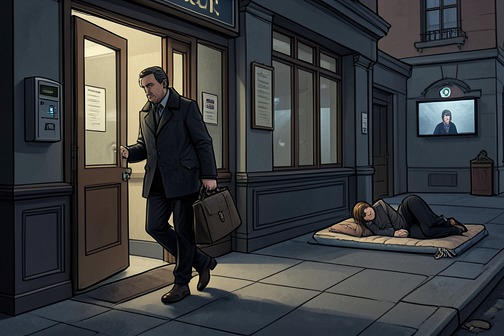
[The Narrator Robs a Bank Again During Withdrawal](entity:event-recall-event-3a670afad211) is a desperate, improvised bank robbery driven by the immediate needs of heroin withdrawal. The narrator leaves [Emily](entity:character-recall-character-emily-79a1b5f3c22d) sick at home, enters a bank without a weapon or disguise, and walks out with money; within hours, a surveillance photograph makes the escape feel precarious. The episode’s sharp reversal is its measure of relief: cash briefly quiets the bodily crisis, while the image of the robber brings the law back into view.
## Causes and Conditions
The robbery grows out of a cycle in which the day begins not with the morning but when the available heroin runs out and the couple must find more. The narrator and Emily have been injecting together, and the surrounding supply network is unstable. [Manny](entity:character-recall-character-manny-1253819185c9), who had access to strong heroin, became an informant and had to expose two suppliers; later, he owed [Cookie](entity:character-recall-character-cookie-eba0d3b0415c) six hundred dollars for drugs advanced on credit, and his usual way of handling such debts was to inform on a dealer. These episodes make the drug economy a web of access, debt, and betrayal rather than a dependable source of relief.
The narrator’s immediate circumstances are more physical than strategic. Emily is on a mattress on the floor in another room, tangled in blankets. They cannot lie beside each other while trying to withdraw: both are sweating and vomiting into small plastic wastebaskets. The narrator stands at the kitchen sink for three quarters of an hour, drinking water that comes back up mixed with bile and mucus. More than twenty-four hours have passed since their last injection; they have no money, and he concludes that they are trapped.
The preceding day’s events show how each crisis renews the search for drugs. [Mike](entity:character-recall-character-mike-cb6fa8ab1468) has been robbed of twenty-eight grams of cocaine, a loss valued at about eight hundred to a thousand dollars. The narrator accompanies him to his blue Mercury, left with all its doors open near Coventry Boulevard, just north of Mayfield Road and on the edge of East [Cleveland](entity:location-recall-location-16ae08cc1a87). Afterward, the narrator gives Mike another pill, then calls [Black](entity:character-recall-character-black-9a228068f885), who says he has found something. The narrator buys a gram from him without contacting [Raul](entity:character-recall-character-raul-e8b24e978d6d). These transactions do not solve the couple’s larger shortage; the next morning, the remaining heroin is gone and the need for money has become urgent.
## The Improvised Robbery
The narrator dresses in secondhand clothes: gray trousers, an Oxford shirt, a baseball cap from his mother, false glasses, and a pea coat. He takes a small plastic wastebasket because he expects to vomit. His mood is described as melancholy but calm, and he tells himself that life is precious even as he prepares to rob a bank. The combination makes the decision neither a carefully organized plan nor a sudden scene of armed force: it is an attempt to act while sick, with Emily suffering at home and no money left.
He first drives past the bank and notices an empty police car parked across the street. Turning into a side street, he vomits into a small green wastebasket, continues to [North](entity:character-recall-character-north-3da0ee40b7c6) Park, and parks halfway down a block. There is no plan, timing device, ski mask, or gun. He does not want to follow the usual preparations and decides to go in directly, without knowing how events will unfold. On the way to the entrance, he vomits again onto a planted strip beside the sidewalk. He then sees the officer associated with the parked car walking about a hundred meters away and turning into a bar.
Inside, the bank is busy, but several teller windows keep the line moving. The narrator has a paper message in an envelope. While waiting, he vomits into his shirt beneath the front of his coat; a woman behind him notices that he seems ill. When his turn comes, he unfolds the paper and shows it to the teller, presenting it as something received in the mail. The teller reads the message and places money in front of him. He takes both the money and the paper and leaves. The robbery’s central action is quiet and compressed: a message changes hands, the teller supplies the cash, and the narrator crosses back into the street.
## Escape and Immediate Relief
Once outside, the narrator runs, turns around, vomits on himself, and drives toward North Park. At the junction, a right turn would take him back into Cleveland proper in about twenty seconds; he turns left into [Cleveland Heights](entity:location-recall-location-cleveland-heights-725332ec6a8f), where he laughs as he drives away. At Lee Road he believes he is safe, as though nothing has happened. That sensation lasts long enough for him to return home and empty the money from his pockets in front of Emily, who is on the couch with her eyes closed.
The cash is converted almost immediately into heroin. The narrator calls Raul and asks to meet at once; Raul names the Subway at the corner of Mayfield and Warrensville. After changing clothes, the narrator and Emily go there, with Emily riding in the back seat. Raul is on time for once. The narrator buys all the heroin Raul has in his pockets: seven grams. He and Emily leave and inject large amounts. Their hearts seem to beat slowly, and the narrator experiences the supply as a rescue. They are hungry, so they return to the Subway for sandwiches and cookies; he gives the sandwich maker a twenty-dollar tip. That night they inject heavily, reassured that they have enough heroin for the coming week and perhaps longer. The stolen money has purchased not security but a temporary extension of the same dependency that made the robbery seem necessary.
## Exposure and Unresolved Ending
The first warning arrives by telephone from [Joe](entity:character-recall-character-joe-9b197d8c56ff), whom the narrator has not heard from in more than a year. Joe asks whether he robbed a bank that day because the news has shown a man who looks like him. The narrator denies it, then ends the call. After the local news has finished, he searches online and finds a clear photograph of himself taken by the bank’s surveillance system. The image contradicts the brief conviction, reached at Lee Road, that the escape had erased the event.
The narrator tells Emily that he is finished and fears prison, but immediately searches the report for a reason to doubt the identification. The news describes the suspect as six feet two, while he says he is six feet; he asks whether the photograph can really be identified as him. Emily reacts with alarm. He injects half a gram of heroin to calm himself, then looks at the photograph again. The account ends on that repeated act of looking, not on an arrest, a decision to flee, or any confirmation that the image will lead to capture. The robbery’s outcome therefore remains suspended between the temporary relief purchased with the money and the public evidence that may undo it.
Event 17
The Narrator and Ryder's Bank Robbery
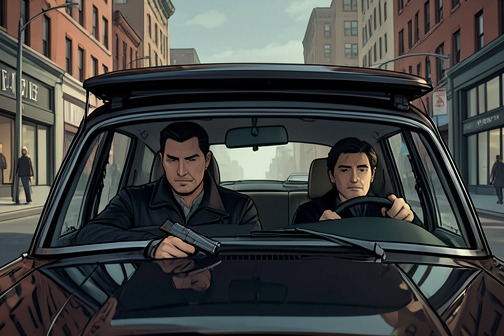
The Narrator and [Rider](entity:character-recall-character-rider-f49a695e2c76)'s Bank Robbery is a completed downtown holdup whose escape exposes the weakness of the partnership behind it: the narrator remains detached and methodical while Rider bolts at the first sight of a police car. The episode also links the robbery to the narrator’s drug dependence and to his efforts to protect [Emily](entity:character-recall-character-emily-79a1b5f3c22d) from being left without heroin if he is jailed.
## The Bath Proposal and the Decision to Rob
Rider proposes a bank in Bath, [Ohio](entity:location-recall-location-4c66c89ead05), which he describes as ideal for a robbery. The narrator distrusts the suggestion because Rider had previously wanted him to kill a man in Bath. He imagines the proposed trip as a possible pretext: they might drive there under the guise of robbing a bank, only for Rider to redirect them toward the killing. The narrator dismisses Rider as the kind of person who would set up such a switch, and refuses to join the Bath plan.
Instead, he tells Rider to go to Bath without him if he wants, while he intends to rob a bank downtown. The narrator picks Rider up the next morning. Rider is with [Pistol](entity:character-recall-character-pistol-bcd98d617742), who supplies a gun and advances the narrator two grams of heroin; the narrator promises to give Pistol money that afternoon. The practical arrangements for the robbery therefore begin intertwined with a drug debt and an advance, rather than with any independent plan or crew.
## Emily and the Preparation
Because it is a weekday, Emily is attending classes. Before going to the bank, the men stop at her college. The narrator wants to make sure she will have her share of heroin in case he goes to prison. Emily comes out of the main building and meets them in the parking lot across the street. At the narrator’s request, Rider gives up the front passenger seat for her. She asks whether the heroin is good; the encounter makes the planned robbery’s stakes personal and immediate, even before the men reach the bank.
The bank is only a few blocks west. The men park across the street, a little beyond the branch, positioned to drive east again. The narrator tells Rider not to lock the doors and says he will be back in less than two minutes. He has the gun tucked into his waistband, but neither of the two pairs of pants he is wearing holds it securely. The detail leaves him with only one free hand as he crosses to the bank and enters.
## The Holdup
The branch is nearly empty: a teller, the branch manager, and a customer. The two men are talking business and, like the teller, initially ignore the narrator. He gives the teller his message. She pushes forward bundles of one-dollar bills, each bundle fastened in groups of fifty. Her name badge identifies her as Sheina. The narrator addresses her by name and tells her not to be ridiculous, adding that she is better than that. She then takes all the cash from the drawers.
The narrator’s response is not triumph or anger. Looking at Sheina’s face and her hostile expression, he feels compassion for her, and thinks that her appearance is not her fault: people do not choose their own eyes. That moment complicates the mechanics of the robbery. He has entered with a gun and is taking money, yet his attention turns toward the teller as a person caught in the situation, not simply an obstacle. The scene’s brief intimacy sits uneasily beside the threat implicit in the holdup.
## Rider’s Flight and the Aftermath
Once they are on the highway, Rider wants to see the money. The narrator begins pulling out the bills, counting the bundles, and handing Rider half as he goes. Rider repeatedly demands more. The narrator tells him to stay on the highway, but Rider takes an exit only three exits from where they joined it. A police car is approaching at the bottom of the ramp. Rider erupts into panicked shouting, gets out of the car, and runs away.
The narrator finds the flight strange and cannot see what the problem is. He returns to the highway, taking Interstate 90 east toward Route 271. He smokes Pall Mall cigarettes, burns the paper straps from the bundles, and drops them into the ashtray. He believes he is on schedule; the Gunsmoke is still working, and nothing worries him. The police car has broken the partnership in the getaway, but the narrator continues alone without describing any pursuit or arrest.
He exits at Chagrin, buys burgers at Wendy’s, returns home, takes Livinia out, and feeds her. He then calls Pistol to say that he has the money. Pistol asks whether the narrator will have three and a half grams for him, and agrees when the narrator says he will come by. When they meet, the narrator does not tell Pistol that Rider lost his nerve. He wants to spare Rider the humiliation, and also fears Rider might kill him if he learned that the narrator had told someone what happened. The narrator gives Pistol the money he owes for the three and a half grams, returns the clothes worn during the robbery and asks Pistol to dispose of them, returns the gun, and adds five hundred dollars for the trouble.
## Narrative Significance
The robbery’s decisive reversal occurs not inside the bank but on the highway. The teller complies and the narrator leaves with the cash; the supposed accomplice, rather than the narrator, collapses when a police car appears. The narrator’s steady handling of the money and disposal of its paper straps contrasts with Rider’s panic, while his later silence preserves the appearance of loyalty even as he privately judges the escape. That concealment is practical as well as protective: he considers the danger of Rider learning that his fear has been disclosed.
The episode also places criminal action inside an ordinary chain of obligations: a gun and heroin advanced by Pistol, a stop at Emily’s college, cash counted for division, a debt repaid, clothes returned for disposal, and a dog fed after the escape. The narrator’s concern that Emily receive heroin if he is imprisoned gives the planned robbery a domestic consequence without making it an act of provision alone. By ending with the repayment, returned weapon, and extra five hundred dollars, the account closes on settlement rather than celebration. The narrator has escaped the immediate scene, but Rider’s abandonment and the secret kept afterward show how unstable the partnership remains.
Event 18
The Narrator and James's Armed Bank Robbery
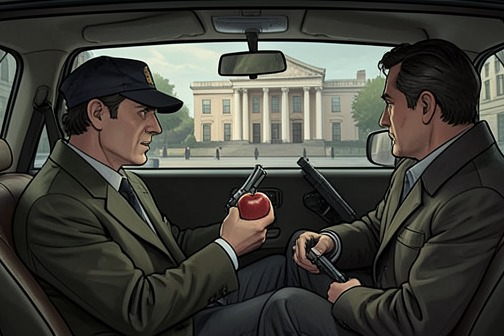
[The Narrator and James's Armed Bank Robbery](entity:event-recall-event-c5400c17064e) is a failed but consequential criminal episode: a planned hold-up turns into a confrontation inside a crowded bank, and the narrator’s attempt to regain control through gunfire ends with a hurried escape rather than a clean robbery. The scene’s reversals are practical as well as volatile: the bank’s door appears to trap him, the getaway car’s rear door will not open, and the weapon must be disposed of afterward.
## Planning and Approach
[James Lightfoot](entity:character-recall-character-james-lightfoot-fcaabcc76403) drives, with the narrator in the passenger seat. The narrator is relaxed enough to wear an Indians cap and eat an apple, while James raises the possibility that cameras may be mounted on streetlights. His reassurance is qualified: he thinks the area may not see many robberies and that they should be all right. The exchange establishes that the pair have considered surveillance, but their confidence rests on a guess rather than certainty.
They park in front of Whole Foods, with the bank in view. The narrator has a gun, but it is not his, and he can no longer remember who gave it to him. He reflects that people who know someone is accustomed to robbing banks will supply weapons, likening the arrangement to financing missionaries. The thought makes the gun part of a wider criminal economy: access to a weapon follows the narrator’s reputation, even when its origin is obscure. He throws away the apple and asks whether James is ready. James reminds him that the car’s rear left door is broken, a detail that becomes important during their escape.
## The Hold-Up Breaks Down
The narrator screws his cap onto his head, leaves the car, and walks into the bank. It is the first hot day of the year, and the branch door is open; he enters without needing to force it. At first he gets what is in the teller’s first drawer. Then the teller refuses to give him more money, while the branch manager will not stop talking and repeatedly addresses him as sir while demanding that he remove his cap.
The manager presses a button. The narrator does not know what it does, but supposes it may be a silent alarm. Looking behind him, he sees the door closing by itself, apparently through a hydraulic mechanism. There are many people inside, and he concludes that the manager is trying to lock him in with them. Their attention intensifies his sense of being watched: the narrator imagines that they see not a formidable robber but an unimpressive man attempting to hold up a bank. He responds by drawing the gun and firing three shots into the ceiling.
He shouts that he does not even want their money, then fires two more shots into the roof. The sequence turns the original demand for cash into an effort to force the room to respond to him. He approaches the counter and points the gun at the branch manager, who appears either to have wet himself or to be in the process of doing so. The narrator threatens to shoot him in the face if he does not open the door. The manager tells him to get out; by then, the door is open, and the narrator leaves. The account specifies shots into the ceiling and roof, not at a person, and the narrator later says that he did not kill anyone.
## Escape and Immediate Aftermath
Outside, the narrator descends from the sidewalk and crosses two rows of parked cars. James is arriving in the getaway car. The narrator grabs the handle of the broken rear left door, pulls, and then strikes the window before demanding that James unlock it. James yells back that the door is broken. The reminder from before the robbery has become an immediate obstacle: instead of slipping into the rear seat, the narrator must hurry around the back of the car and get into the passenger seat. James accelerates and drives away.
James asks whether the narrator has killed anyone. After the narrator says no, he describes how badly the robbery went: the manager was shouting, seemed indifferent to the possibility that everyone might die, and would not react as a robber expected. The narrator treats the confrontation as a dangerous escalation over pieces of paper, an explanation that contrasts the small value of the cash with the threat created by the gunfire. Despite the failure, he gives James half the money. James accepts the outcome as survivable because they managed to get away, rather than treating the robbery as a success.
The narrator says that he needs to take the gun apart and get rid of it. This final practical intention follows directly from the weapon’s uncertain provenance and its use inside the bank: escape has not ended the risks attached to it. The episode closes not with a captured robber or a successful score, but with an improvised getaway, a divided sum, and the need to remove evidence. Later that same afternoon, the narrator, [Emily](entity:character-recall-character-emily-79a1b5f3c22d), and Livinia go to a dog park; the abrupt move into an ordinary outing sets the armed confrontation beside the day’s mundane routines without resolving its consequences.
Event 19
Raul and the Others Make Repeated Plans to Rob Banks
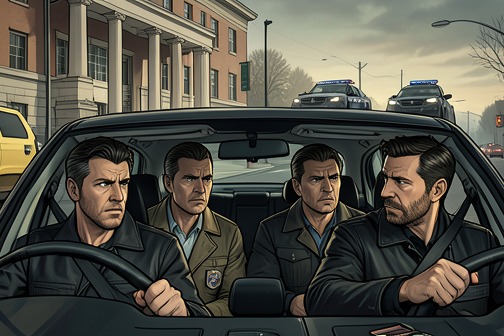
[Raul](entity:character-recall-character-raul-e8b24e978d6d) and the narrator’s repeated bank-robbery plans turn preparation into a measure of the group’s instability: a first target is abandoned when police cars appear, and a later attempt yields money only after Raul bolts and leaves the narrator to finish alone. James and [Rider](entity:character-recall-character-rider-f49a695e2c76) are drawn into plans shaped by prison, drug use, uncertain loyalties, and improvised escape arrangements. What follows is not a progression toward mastery, but a sequence in which every contingency exposes another failure of coordination.
## Causes and Participants
Raul proposes the robbery at the bank near Warrensville and Mayfield because he wants to set money aside before going to prison. The narrator joins him, James, and Rider in the car, hoping that having three people inside will bring in more money and allow someone to manage the doors. The group is unarmed, making the proposed division of labor part of the plan rather than a detail they can take for granted. The narrator asks James to drive and expects the attempt to go better than it does.
The four do not inspire equal confidence. The narrator is not concerned about James or Raul, but doubts that Rider can withstand the pressure. Rider is Raul’s protégé, and the narrator hopes Raul’s presence will give him courage. That hope is already a warning about the operation’s dependence on personal influence: the group has no formal discipline, and its confidence rests on whether one participant can steady another.
## The First Plan Is Abandoned
The first signs of trouble come while the group is driving around the bank to inspect the area. Raul wants to go in immediately; the narrator insists on another look. They cross Mayfield and continue south on Warrensville, where the narrator sees four police cars parked behind buildings across from the bank. All are pointed in the same direction, apparently ready to pull out quickly. The cars change the meaning of the reconnaissance: what was meant to clarify the approach instead reveals a conspicuous risk. The narrator tells James to keep driving, and the robbery is called off before anyone enters the bank.
On Belmar Road, the group regroups rather than proceeding with the original plan. James trades twenty-eight grams of marijuana for a few grams of heroin, while the narrator takes Raul aside to ask about a plan in Bath that Rider keeps talking about and that seems to involve substantial money. The exchange places the aborted robbery among the group’s other negotiations and pursuits; the effort does not produce a payday, but the participants remain together and the possibility of another scheme is already in view.
## A Second Target, a Missing Partner
When the group returns to the car, James asks whether they are going to do anything. Rider says he needs to go to Severance. The narrator proposes a bank on Chagrin Boulevard, and James agrees. Those in the group who use drugs take a dose before they leave, then they drop Rider off. The narrator is glad to be rid of him, a blunt reversal of the earlier hope that Raul’s presence might help Rider endure the pressure. The party is smaller for the next plan, but its internal confidence has not improved.
They inspect two branches on Chagrin and choose one in a shopping center. Because the branch is new, the narrator expects it to have a double-door vestibule. The narrator explains a specific escape procedure to Raul: one person is to keep the inner door open while the other handles the outer door, then hold that door so they can leave together. The concern is that being trapped between the doors would lead to arrest and prison. The elaborate instructions show how much the group’s thinking is fixed on the mechanics of getting out; they do not, however, ensure that the participants will act together when the moment arrives.
At the entrance, the narrator has pulled a neck warmer over the lower face and makes an exaggerated Pacino-style entrance, invoking Attica. Raul says nothing. The narrator looks back and discovers that Raul is not there. The employees are watching; the narrator tells them not to say anything, turns around, and leaves. James has waited in the car, while Raul is on the back seat. The scene collapses before a coordinated robbery can begin. Soon afterward, the narrator sees police cars approaching from the opposite direction and tells James to pull over. The account gives no full explanation for Raul’s absence or for the police cars’ arrival, but the narrator later confronts Raul angrily over what he has done, and Raul apologizes.
## The Chagrin Boulevard Attempt and Its Cost
The group nevertheless returns to the bank. James and Raul make peace, and James lets Raul borrow his sunglasses to conceal his eyes. The narrator tells Raul to enter first and promises to follow. Raul goes inside; after counting to five, the narrator enters as well. It is a small branch with a single teller. Raul is standing against the back wall, facing the counter, dressed like a ninja in a parka despite the mild weather. The employee looks frightened. The narrator’s account presents the disguise and the teller’s reaction as concrete details of the scene, but does not describe a weapon or a spoken demand.
Raul suddenly runs past the narrator and out of the bank. The narrator is left inside, sees that the teller’s drawer is open, reaches over the counter, and takes the bills. A man entering the bank pretends not to notice the narrator on the way out. On the sidewalk, the narrator initially walks in the wrong direction, then remembers the instruction given to James and turns the corner. Raul is not in the car. The planned division of roles has now reversed: instead of a clean paired exit, the narrator has taken the money alone and must find the partner who has fled.
James turns around to look for Raul and drives slowly through a crowded area. The narrator describes the wait as lasting an eternity, but emphasizes that James keeps his composure rather than panicking. Raul eventually runs up from behind, climbs into the back seat, and urges them to leave. Once they are away, the narrator gives him the money to count. Raul reports a total of $1,300 and says he took nothing for himself. The narrator does not press him about the money and later suspects Raul kept it all.
The robbery’s aftermath makes its poor return plain. The narrator is tired of the whole affair, feels that the escape was narrowly achieved, and describes the role as resembling that of a pickpocket. James later reports that Raul dropped the borrowed sunglasses while running from the bank; they had cost James $300. The narrator goes to James and repays him that amount. In practical terms, the narrator loses $300 on the robbery, while James recovers the purchase price but not the additional costs of gas and a balaclava, which he considers negligible. The $1,300 taken from the teller’s drawer therefore does not become evidence of a successful partnership: the money’s final distribution remains uncertain, and the one definite reimbursement is for property lost in Raul’s flight.
## Significance
Across the two targets, the plans repeatedly promise a controlled operation and deliver improvisation. The first is stopped by the visible presence of four police cars before the group enters; the later effort is undermined first by Raul’s unexplained absence at the entrance and then by his sprint from the bank. At both points, the narrator’s attention turns to practical contingencies—surveying the street, keeping doors open, choosing an escape route—yet planning cannot make the group dependable.
The repeated schemes also expose a mismatch between collective language and individual conduct. The robbery is discussed as a joint undertaking, with roles assigned and money expected, but Rider is dropped off, Raul disappears and runs, James is left to drive and search, and the narrator ends up taking the open-drawer bills. The ending is not a clean division of proceeds but an exhausted narrator’s assumption about Raul’s share and a $300 repayment to James. In that imbalance, the episode registers the distance between the imagined payoff and the actual cost of trying to work together.
Event 20
Mike Is Robbed at Gunpoint During a Cocaine Deal
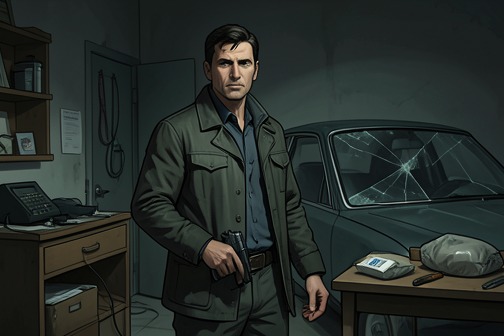
[Mike](entity:character-recall-character-mike-cb6fa8ab1468)’s armed robbery turns an ordinary drug-buying day into a demonstration of how quickly trust and violence intersect in the narrator’s circle. Lured by an offer to sell twenty-eight grams of cocaine, Mike is threatened at gunpoint by one of [Raul](entity:character-recall-character-raul-e8b24e978d6d)’s associates and loses both the cocaine and his car. Raul is not present, and the narrator cannot establish whether he knew about the setup; even so, he returns to the network for heroin before the day is over.
## Background and Vulnerability
The robbery takes place inside a routine governed by addiction. The narrator describes a day as beginning not on waking, but when the remaining drugs run out and it is time to seek more. That Saturday, he and [Emily](entity:character-recall-character-emily-79a1b5f3c22d) injected what they had left, then considered how to spend their money. Buying larger quantities of heroin offered no guarantee of receiving more of the drug, since it could be heavily cut; pills, by contrast, were not cut. They went to [Big](entity:character-recall-character-big-1b64a45c8172) and bought ten pills. At about two in the afternoon they were home, and the day seemed to be going well when the narrator’s phone rang.
That sense of security rests on an informal market in which access depends on personal connections, and those connections are unreliable. Elsewhere in the same account, [Manny](entity:character-recall-character-manny-1253819185c9) owes [Cookie](entity:character-recall-character-cookie-eba0d3b0415c) six hundred dollars for drugs advanced on credit and has a history of dealing with his debts by informing on suppliers. A surveillance van appears near [Pistol](entity:character-recall-character-pistol-bcd98d617742)’s house, where customers continue to come for heroin despite seeing police officers watching and recognizing that their own license plates are visible. These episodes do not explain who arranged Mike’s robbery, but they establish the surrounding conditions: people depend on dealers and intermediaries even as surveillance, debts, and betrayal make every transaction precarious.
## The Robbery
Mike tells the narrator that he has just been robbed and that the narrator’s associate set him up. When the narrator asks what happened, Mike explains that Raul said his associate wanted to buy twenty-eight grams of cocaine. Mike drove to meet the prospective buyer, who produced a gun and threatened him. Raul himself was not there; Mike was alone with the man who robbed him. The distinction matters: the deal came through Raul, but the evidence does not show Raul at the scene or confirm that he knowingly arranged the assault.
Mike’s car remains behind at the meeting place, so the immediate problem is not only the stolen cocaine but how to retrieve the vehicle. The narrator apologizes and agrees to accompany him. Mike asks whether he should wear a bulletproof vest, a question that brings the threat of the gun into their next decision without establishing that the robbers are still there or that another confrontation follows. The narrator and Mike first shoot drugs together with Emily; the narrator frames this as the response they chose after Mike had been robbed, not as a practical remedy for his loss.
## Retrieving the Car
The car is a blue Mercury parked outside apartments on Coventry Boulevard, just north of Mayfield Road at the edge of East [Cleveland](entity:location-recall-location-16ae08cc1a87). Its doors are all open. The location does not match the narrator’s idea of a place notorious for danger: two little girls are jumping rope nearby. The contrast between an armed robbery and this ordinary street scene makes the episode feel less like a carefully controlled criminal operation than a sudden, exposed humiliation.
Mike gets out of the narrator’s car, rushes into his own, and the two leave. Mike is wearing the bulletproof vest, but the narrator says they look like fools. That judgment captures the uneasy aftermath: the vest is a visible precaution, yet it cannot undo the robbery or make their situation seem secure. The narrator later gives Mike another pill and Mike goes home. The episode’s consequences are tangible—the cocaine is gone, the car has been abandoned with its doors open, and Mike needs help getting away—but the account records no arrest, recovery of the drugs, or further confrontation.
## Suspicion and Continued Dependence
After Mike leaves, the narrator calls [Black](entity:character-recall-character-black-9a228068f885), who says he has found something and invites him to come by. The narrator goes, buys a gram of heroin, and does not bother to call Raul. He tells Black about the robbery; Black says he knew nothing about it. The narrator does not believe him, but says that it makes no difference. The account thus ends without resolving responsibility. Suspicion attaches to people in the network, but the narrator’s need for drugs keeps him moving through it rather than withdrawing from it.
That unresolved ending connects the robbery to the broader pattern of the narrator’s drug life. Earlier, a particularly potent heroin supply—an ill-smelling tar that cost one hundred dollars a gram and made their ears ring—lasted only about two weeks before Manny was forced to identify its suppliers. The narrator recognizes the danger and thinks about getting out, yet the next day he records that he will remember the thought rather than act on it. Mike’s robbery repeats the same bind in a different form: the people and arrangements that make drugs available may also expose someone to betrayal and violence. The narrator witnesses the cost, helps Mike leave, and then buys heroin through another connection.