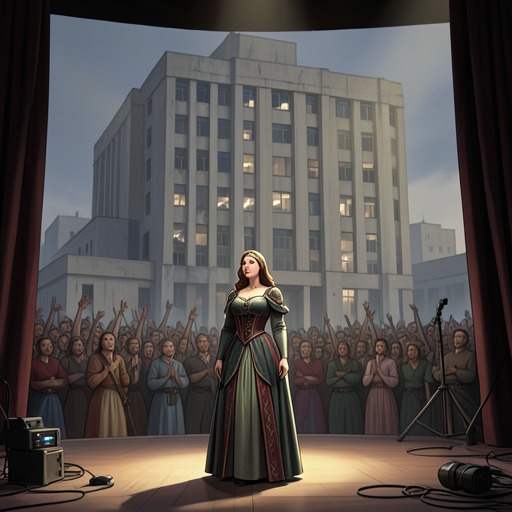
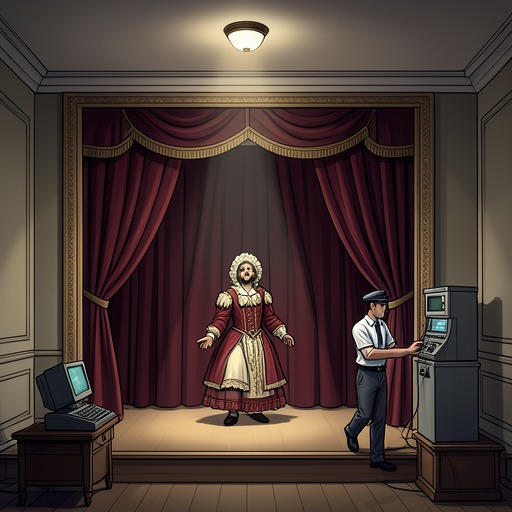
«Viene Connie» · «Connie, la Mujer»
Chowringhee«Viene Connie» / «Connie, la Mujer» is a publicity slogan and stage persona built around the promise of a woman as a singular attraction at the Hotel Shahjahan. Its importance lies in the distance between the image sold to customers and the person who appears before them: the hotel advertises an idealized feminine spectacle, then lets Lambreta perform it, while the surrounding story exposes the economic and racial pressures that make women’s bodies and reputations objects of public judgment.
The Advertisement and Its Image
The campaign begins with an instruction to place the announcement in the newspapers: Connie is coming, and she is presented as the Woman. The copy does not introduce her through a history, a profession, or an individual desire. It offers an emphatic category, promising a unique female figure made for the present century. A photograph supplies the image behind that promise: a blue-eyed beauty with platinum-blond hair. The advertised Connie is thus constructed through visual shorthand and superlative language before the hotel audience has encountered her in person.
Satyasundar Bose gives the narrator photographs of Connie and tells him to learn how to display them, since he will soon be taking on different roles. The narrator arranges the pictures artistically on the two counters near the entrance and adds the shorter announcement that Connie is coming. Satyasundar Bose approves the arrangement, comparing its effect to the narrator’s supposed experience arranging photographs of the Shahjahan’s half-naked cabaret dancers. Publicity is not incidental decoration here: the images at the entrance turn the hotel’s threshold into a place where customers are invited to anticipate and consume a female body before the performance begins.
Desire, Novelty, and the Hotel Audience
Satyasundar Bose explains the slogan’s appeal as a matter of language and appetite. In his view, cinema performers and the hotel have exhausted the dictionary’s descriptions of female beauty; explicitness alone can no longer make an advertisement provocative. He likens the audience’s response to a desire for home cooking after days of heavily seasoned food. The phrase Connie, the Woman therefore sells novelty by promising a departure from familiar erotic display, even as it continues to define Connie through the audience’s appetite for femininity.
The more sophisticated circles respond favorably, and calls begin the day after the advertisement appears. The callers include sons of wealthy parents and salesmen seeking to please clients or secure business. Their varied purposes show how the spectacle is folded into the hotel’s commercial life: Connie’s advertised arrival can serve private curiosity, social entertainment, and business hospitality at once. The slogan is not only a description of a performer but a device for drawing customers into the hotel and shaping their expectations before they arrive.
The Stage Reveal and Its Reversal
At the first presentation, the narrator addresses the audience as ladies and gentlemen, praises the French chef’s cooking and wines selected from different countries, and introduces Connie as the only woman of her kind created for the century. The language enlarges the promise to near-mythic scale. Yet the narrator observes that no ladies are present in the hall, making the formal address part of the performance’s own artifice: the room’s customers are invited to look at a woman who has been announced as an exceptional spectacle.
The lights go out, a restless spotlight searches the stage, and anticipation rises and falters. The audience initially cannot see Connie. Instead, a dwarf in evening dress appears, wearing a top hat a metre high and carrying a cane. The next night, the narrator repeats the grand introduction, now with experience as a presenter, and the audience again waits through the same blackout and murmur. The reveal again overturns expectation: the figure is Lambreta, not the woman promised by the campaign. Moments earlier Lambreta had been exhausted and unwilling to take part; onstage, he becomes the poised performer who greets the audience as Connie. The repeated substitution makes the gap between promotional image and stage identity the performance’s central joke and its governing theatrical device.
The Slogan Beside Women’s Material Lives
The slogan’s idealized Woman stands in sharp contrast to the conditions described elsewhere in the same evidence. Rosie says that people call her dark behind her back and that her reputation has been damaged by others’ claims about her movements and relationships. She describes a family dependent on her work: a paralysed father, a mother, and two unmarried sisters without jobs. Their meals are bread, potatoes, and onions, while her position at the hotel gives her better food. She had considered marrying Banerjee and leaving, and asked Jimmy to give her job to her sister, who longed to dine at the Shahjahan. Her choices are entangled with family survival, not with the glamorous freedom implied by a staged female icon.
William’s account further locates Rosie’s life in a history of displacement. He describes her family’s cramped home, where three ill people share a room and a half, and reports that Rosie identified herself as African rather than Anglo-Indian. Her ancestors, she told him, were brought from Africa in the early nineteenth century in chains, landed at Chandpal Ghat, and sold at Murgighata for twenty-five rupees each. After emancipation, they remained in Calcutta and adopted the names of former owners. This history makes the racialized gaze around Rosie more than a matter of personal insult: the hotel’s polished image of feminine glamour coexists with the legacies and material constraints shaping the lives of its workers.
The social stigma attached to women’s past work also reaches beyond Rosie. An English employee explains that he has lost his job because marrying a woman who once served drinks to strangers in a bar is said to diminish his firm’s prestige and harm its business. Against these examples, Connie’s slogan appears both commercially powerful and hollow. It elevates a woman into an extravagant image while the narrative shows how actual women—and those who love or marry them—remain vulnerable to racial contempt, economic need, and reputational punishment.