La Biblia se escribe antes de que nazca Jesús
ChowringheeLa Biblia se escribe antes de que nazca Jesús is Satyasundar Bose’s pointed metaphor for a public event whose story appears settled before the event itself begins. In his account of Calcutta’s charity banquets, familiar guests circulate through different venues while newspapers receive speeches and summaries in advance, exposing the gap between the ceremony’s public narrative and what actually occurs.
Meaning and Immediate Use
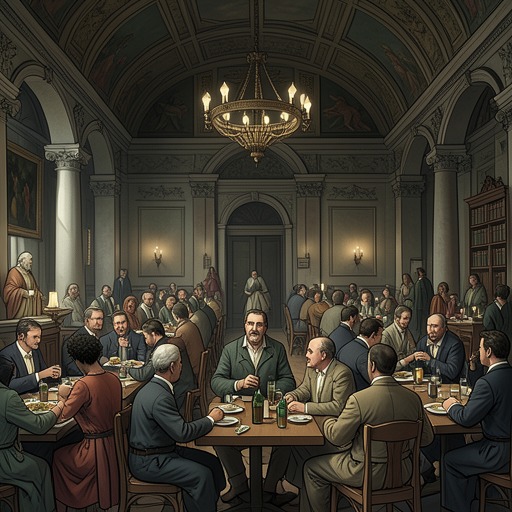
Satyasundar Bose introduces the expression while describing the city’s philanthropic social circuit. The same people, he says, are invited repeatedly; each night they dress for another gathering, held at a different hotel, club, or private home. Against this cycle, the image of a Bible written before Jesus is born casts the banquet’s account as something composed ahead of its ostensible subject. Its force lies in the reversal of ordinary sequence: instead of an event generating its report, the report is already prepared for the event.
The Banquet and Its Advance Report
The expression is tied specifically to the next morning’s newspaper coverage. Satyasundar Bose tells his listener to watch Calcutta’s philanthropic citizens, because the papers will report the banquet but will not show what truly happened. They will provide a tally of speeches and summaries, material that, he says, has already reached newspaper offices before the banquet. The saying thus describes more than routine repetition among guests: it points to a public account prepared in advance and detached from the event it purports to record. The ceremony and its coverage appear as coordinated performances, with the printed version settled before the night can complicate it.
The surrounding scene sharpens the contrast between this polished public narrative and the hotel’s less visible routines. Earlier, the narrator learns that suite number two, with its personal telephone and several sitting rooms, requires special service and large quantities of flowers personally selected by Karabi Guha. Nityahari Bhattacharya, responsible for the Shahjahan Hotel’s sheets, curtains, napkins, and tablecloths, comes early with paper and pencil to attend to its requirements. The banquet’s visible display depends on such repeated work, even as the advance newspaper account reduces the gathering to speeches and summaries.
Repetition, Sin, and Hotel Routine
Nityahari Bhattacharya’s account of his work offers a separate, darker pattern of repetition. He understands his position as a washerman through a moral story about disobedience to his father, neglected studies, and punishment for supposed wrongdoing in a previous life. His habitual handling of hotel linen leads him to wash his hands carefully; at suite number one, he refuses to touch the taps because he believes sin has tainted them, and uses antiseptic soap he carries with him. He also treats hotels, bars, and drinking parties as places where immense quantities of sin are committed. These beliefs are not presented as the source of Satyasundar Bose’s saying, but they place its image of a story fixed in advance beside another hotel worker’s sense that present routines repeat a prior moral account. Together, the scenes show how the hotel’s cycles can be understood both as practical schedules and as narratives imposed on events before their participants can give them a different meaning.