Calcutta High Court
ChowringheeThe Calcutta High Court enters the narrative both as a physical landmark and as the institution around which the narrator’s early working life takes shape. He first approaches it as an astonished boy from Kashundia, then becomes a lawyer’s babu and experiences the affection and professional world surrounding the court. But his employment depends on an individual lawyer, not on the institution itself: when that employer dies, the narrator loses his position and is driven toward hunger and precarious work.
First Encounter and the Promise of a New World
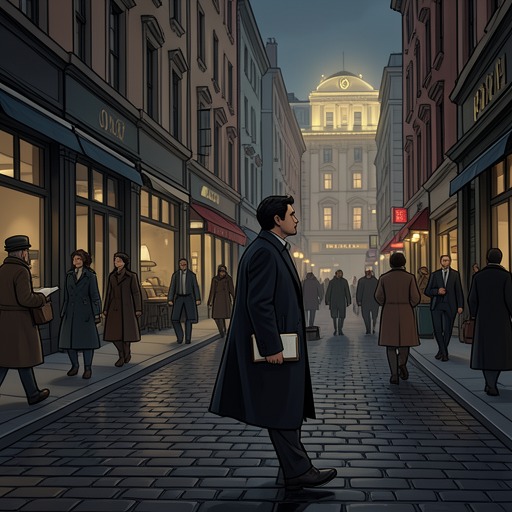
As an adolescent from the small neighbourhood of Kashundia, the narrator crosses the Ganges on the steamer Amba, departing from Ramkeshtopur Ghat, and stares in wonder at the Calcutta High Court building. The journey makes the court a threshold in his imagination: across the river lies a world whose beauty and possibilities seem far removed from the poverty and hardship he has known.
That first sight is followed by entry into the professional world associated with the court. The narrator secures employment with a British lawyer and serves as the lawyer’s babu, or secretary. He remembers receiving warmth from older colleagues such as Chhoka-da, as well as affection from judges, lawyers, and clients. The court is therefore not only an imposing building. For the young employee, it is also a social world in which people welcome him and a workplace from which he can look out on a larger life.
A Livelihood Dependent on One Lawyer
The narrator’s connection to the Calcutta High Court is through his employer rather than as a court officer. His position as the last babu of the last English lawyer associated with the court gives his work an unusual sense of finality, but no security. The kindness of his employer briefly lets him imagine that the oasis after years of deprivation might last. The lawyer’s death destroys that expectation: with the job gone, the narrator must begin again.
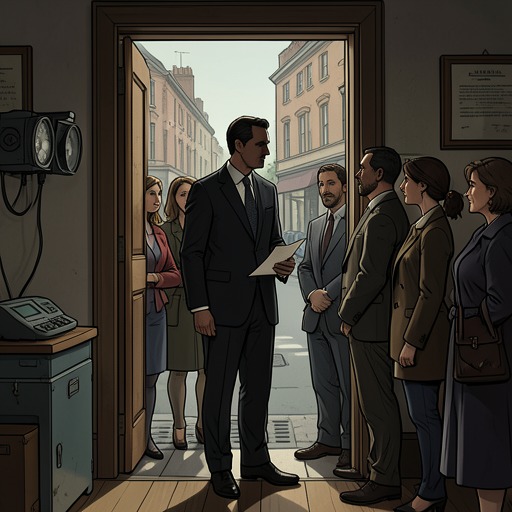
The collapse has immediate material consequences. He has saved nothing for a lean period and spends almost all he possesses; hunger becomes a present danger. Seeking help, he visits an office whose employee, Mr. Dutta, had once benefited from the narrator’s request that the law firm take his case without charge. Now Mr. Dutta will not see him. A note expressing regret and promising no meeting for weeks is delivered through an assistant; the narrator writes as requested and receives no reply. He sends applications in large numbers to acquaintances, strangers, and even post-office boxes, with no result.
His eventual work selling wicker wastepaper baskets is a sharp descent from the legal office. At Magpil & Clerk, he is to go from office to office and earns four annas commission for each basket sold. The company’s grand-sounding name conceals a cramped operation: its founder, M. G. Pillai, has only two rather dirty pairs of trousers and one tie, while a dim room in Chhatawala Lane serves as factory, office, showroom, kitchen, and bedroom. This contrast makes the narrator’s fall concrete. His earlier place near the court offered professional belonging; his new livelihood is measured basket by basket.
The Court as a Measure of Status
Even after losing his position, the narrator’s legal-office experience remains a way of understanding work. When a later employer praises his typing, the narrator recalls Satyasundar Bose’s comparison between a person who has never had a job and one who has lost a job: both are without work, but only the latter knows what has disappeared. The analogy casts employment not as an abstract status but as a relationship whose loss is felt through contrast. The narrator thinks of himself as having lost one employer and found another, an uneasy reprieve rather than a return to the security he once imagined.
The court also supplies a measure of professional ambition in the talk of B. Byron, who presents himself as a private detective. His card promises friendship when needed but leaves the telephone number blank; he explains that he expects eventually to acquire not just a telephone but also a car, a house, and a spacious office. He boasts that a detective who applies himself could earn more than a chief inspector of the Calcutta High Court. The comparison is Byron’s aspiration, not evidence of a career path at the court, but it shows how the institution’s rank can serve as a benchmark for imagining income and advancement.
A comic exchange gives the court a different, more ironic association. After Satyasundar Bose admits that he invented an aunt to end a conversation and save time, the narrator tells him that the Supreme Court on Old Post Office Street would be the right place for someone so cold-blooded. He jokes that Bose might by now have owned a car and a house. Bose responds with amusement rather than pursuing the prospect. The exchange turns legal work into a counterfactual career for a man whose apparent decisiveness might have suited it, while leaving the supposed success pointedly hypothetical.
Legal Procedure and the Limits of the Institution
In a separate divorce episode, the novel places courts within a broader legal process that demands time, money, and active participation. After seeking legal advice, Marco Polo learns that obtaining a divorce is not simple: the claimant must appear in court, witnesses must be found, and the proceedings may take as long as two years. This account does not identify the Calcutta High Court as the forum for that particular case. It does, however, show the legal world around the novel’s court as a system in which personal crises become formal proceedings with practical costs and uncertain duration.
Across these episodes, the Calcutta High Court carries several meanings without becoming a guaranteed source of protection. Its building first embodies a dazzling future to a boy crossing the river; its professional orbit gives the young narrator work, colleagues, and recognition; and its name later supplies a scale for status and ambition. Yet the narrator’s livelihood rests on the survival of a single employer. When that support disappears, the institution remains in the background while he confronts unanswered appeals, dwindling money, and the need to sell baskets for commission.