Magpil & Clerk
ChowringheeMagpil & Clerk is the firm the narrator once worked for in a building on Chhatawala Lane. The narrative gives little information about the company’s business or organization; its significance lies instead in the address, which brings the narrator’s earlier working life back into view and unexpectedly intersects with Byron’s search for a woman from Marco Polo’s past.
Identity and Setting
The company is identified through the narrator’s recollection of his former employment: Byron’s clue points to the same building that housed Magpil & Clerk. The location is not merely an office address. It also held the narrator’s memories of the women who worked there and of the small, practical kindnesses shared among people making a living under difficult circumstances.
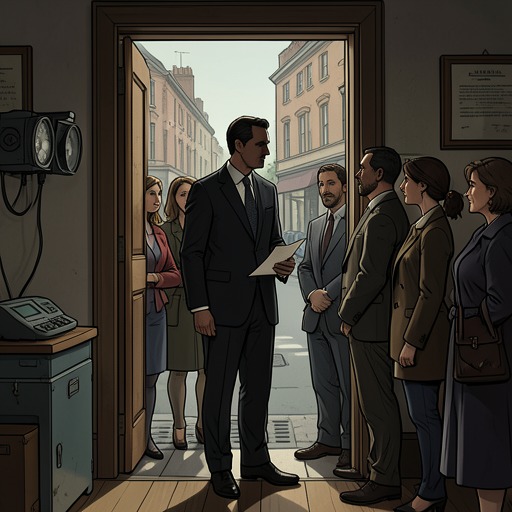
A small board outside the building stated that its doors would be closed from half past ten and that no one would be admitted afterward. The narrator mentions having had a strange experience inside, but postpones telling that story. The detail gives the premises a boundary and a withheld history without explaining what happened there.
Work and Mutual Aid
The narrator remembers women in the building counting and tying wastepaper baskets. In the afternoons, they sat on low benches in worn blouses and sandals, painted the baskets, and set them in the sun to dry. Rain meant bringing the baskets back in; their work earned only a few coins. The account places their labour alongside the narrator’s own former efforts, rather than describing the company from the perspective of its management.
The women had also helped M. G. Pillai in difficult times, and they treated the narrator with consideration. They urged him to rest after walking in the sun, reasoning that their livelihood depended on their bodies while his depended on his health. Their exchange makes the former workplace a setting of mutual recognition: different kinds of precarious work, understood through the shared necessity of staying able to work.
The Address Re-enters the Story
Byron’s investigation gives the old address a new purpose. A source had directed him to a woman who had once sung in a restaurant, in a dim corner of Chhatawala Lane. Byron and Marco Polo had gone there the previous night, but a guest was in the woman’s room, so they waited outside and failed to see her. When Byron recounts the lead, the narrator recognizes the building as the one that housed Magpil & Clerk.
The narrator tells Byron that he knew the women in the building because they had been his coworkers. He returns there with Byron later that day, but advises against arriving before eleven: for the women there, even ten o’clock was the middle of the night, and they would still be asleep. The investigation thus depends not only on a clue but on the narrator’s remembered familiarity with the place and its rhythms.
Memory and Narrative Significance
The company’s brief appearance links two chapters of the narrator’s life: the work he did before the hotel and the later investigation that draws him back to Chhatawala Lane. The return is personal as well as procedural. The narrator describes the encounter as the recovery of a forgotten chapter, yet he does not disclose everything he knows to Lisa before leaving to rejoin Byron. Magpil & Clerk therefore remains a modest but important point of connection between past experience, working relationships, and the search unfolding in the present.