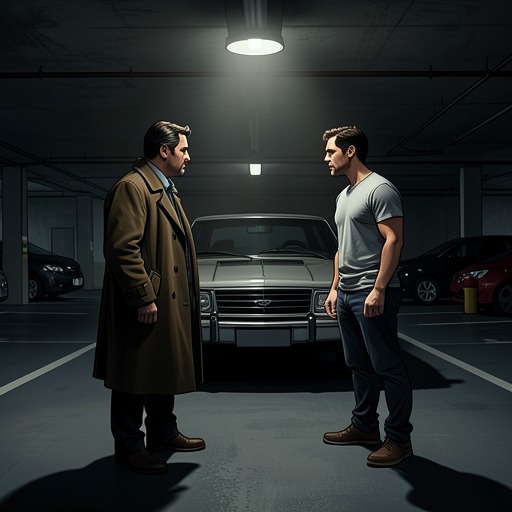
Ballard's First Meeting with Vaughan
CrashBallard's First Meeting with Vaughan is the decisive airport car-park encounter in which James Ballard first recognizes Robert Vaughan, the scarred former television scientist who has been watching him through a camera. What begins as an unsettling act of surveillance becomes the foundation of their year-long relationship: Ballard's apprehension gives way to deference, while Vaughan's damaged car, damaged body, and aggressive scrutiny announce a new erotic and technological logic organized around the automobile crash.
Setting and Immediate Circumstances
The meeting takes place on the roof of the multi-storey car-park behind the airfreight building at the airport. James Ballard has driven there with a prostitute and parked among the cars on the sloping roof, a space that combines the exposed height of an observation platform with the privacy of an improvised sexual enclosure. While the woman performs a sexual act inside the American car, the sound of horns and the flare of a flashbulb draw Ballard's attention to the concourse below. An airline coach has rammed a taxi outside the European Terminal, injuring the taxi driver amid a traffic jam of buses and taxis. The accident makes the car-park function simultaneously as bedroom, viewing gallery, and accident lookout.
The disturbance also reveals that Ballard himself is being watched. Across the parking bays, a tall man sits on the bonnet of another car with a camera, using the instrument as if it were both recording device and weapon. Ballard recognizes him as the scarred man who had observed him near the earlier accident site and as the doctor in the white coat seen at the hospital. The continuity of those sightings turns an apparently casual observer into a deliberate pursuer, while the photographer's indifference to the prostitute and her customer suggests that his real object is not ordinary sexual voyeurism but the relation between bodies, vehicles, and violence.
Vaughan's Identity and Appearance
The photographer is Robert Vaughan, known as Dr Robert Vaughan, a former computer specialist and one of the first new-style television scientists. His public career had joined personal glamour to an aggressive lecture-theatre manner and an apparently idealistic belief in applying computerized methods to the control of international traffic systems. He had driven a high-powered motorcycle between laboratories and television centres, presenting himself as a scientist with the posture of a hoodlum. That combination of technical authority, publicity, and physical aggression gives his first appearance an unusual force: Vaughan is not merely a damaged man fascinated by crashes, but a public expert whose professional vision has already treated traffic as a system to be mastered.
His career ended abruptly after a serious motorcycle crash. The impact had broken his legs beneath the rear wheels of a truck, and its effects remained visible in his face and manner. Scar tissue ridged his eyebrows and mouth; his nose had been broken and reset; two upper canine teeth were missing; and his features seemed laterally displaced, as though reassembled from damaged publicity photographs. The body that Ballard encounters therefore carries the evidence of the technology Vaughan studies. His scars are not background detail but a living record of collision, making his authority inseparable from the injury that destroyed his television career.
Vaughan drives a ten-year-old Lincoln Continental, the same make of vehicle as the open limousine in which President Kennedy died. The car connects his personal history to the public image of political assassination and to his established obsession with Kennedy's death. When Vaughan reverses past Ballard, the Lincoln's left fender brushes Ballard's knee before Vaughan sweeps down the ramp. The gesture is minor in physical scale but exact in dramatic effect: the car breaches Ballard's personal space without quite becoming an overt attack, turning an introduction into a controlled demonstration of risk.
The Encounter's Value Shift
The encounter changes Ballard's position from observer to observed subject. At first he watches the crash below and the prostitute inside the car; then Vaughan's camera reverses the direction of the gaze. The flashbulb, the camera's view-finder, and the police car's headlamps create a chain of competing visual authorities, while the injured driver and the traffic jam supply the violent spectacle that Vaughan has come to record. Vaughan's presence makes Ballard understand that the accident site is not only an emergency scene but also a field in which images, bodies, and technical objects are collected and arranged.
Ballard initially interprets Vaughan as a possible threat, but the encounter does not establish revenge or blackmail as Vaughan's motive. Instead, Ballard senses that Vaughan is interested in the anonymous individual's interaction with the car: the movements of a body across polished cellulose panels and vinyl seating, the face set against instrument dials, and the way an accident reorganizes both vehicle and person. This distinction becomes crucial. Vaughan is not pursuing Ballard for a conventional personal grievance; he is selecting him as material within a larger investigation into the automobile's role in modern life.
The first meeting consequently produces a negative-to-positive reversal in intimacy, though the intimacy is coercive rather than reassuring. Ballard's hostility gives way to deference and perhaps subservience as soon as he sits beside Vaughan. The encounter establishes the pattern that governs their relationship for the following year: Vaughan alternates aggression, distraction, sensitivity, clumsiness, absorption, and brutality, while Ballard is drawn toward the very figure who threatens his independence. The damaged Lincoln embodies this unstable power. Its second gear has been ripped out during a road race with Seagrave, and Vaughan sometimes drives it so slowly in the fast lane that traffic gathers behind them, then jerks it to a halt at the last moment as if mocking his own incapacity as a driver.
Surveillance and the Archive of Crashes
The car-park meeting is later enlarged by the discovery of Vaughan's photographic archive. In a darkened room, photographs cover the walls and lie among the enamel pails and the enlarger. Many show motor-cars and heavy vehicles involved in highway collisions, with spectators, police, impacted radiator grilles, and shattered windshields filling the frame. Some were taken from a moving car with an unsteady hand, preserving the blurred anger of police officers and ambulance attendants who protested as Vaughan swerved past them. The archive therefore records not only crashes but also the conflict between the photographer and the institutions that attempt to control their visibility.
The photographs also reveal that Vaughan had been following Ballard long before the meeting became explicit. One sequence begins with Ballard being carried into the casualty unit at Ashford Hospital, a moment Vaughan witnessed after listening to ambulance broadcasts on the VHP band of his car radio. Vaughan had tracked Ballard from the police pound to the airport reception area, from the multi-storey car-park to Helen Remington's house, photographing him in and around vehicles. The archive is ostensibly a record of Ballard's accident and recovery, but its deeper subject is Vaughan's own way of seeing: the automobile remains the constant background, while Ballard becomes an anonymous body moving through its surfaces, seats, roads, and instrument panels.
The same visual practice extends to women and to imagined wounds. Vaughan photographs women through windshields and revolving doors, and his carefully made images of six middle-aged women resemble Vera Seagrave as she might appear decades later. His camera thus projects bodies into possible futures while converting ordinary people into specimens within a private taxonomy of injury, age, sexuality, and vehicle design. The airport car-park encounter is the first point at which Ballard enters this system consciously, even though he does not yet understand its full scope.
Consequences and Narrative Significance
From this meeting onward, Ballard is continually aware of Vaughan's presence, scanning rear-view mirrors, overpass parapets, and car-park roofs along Western Avenue. The encounter has not ended when Vaughan drives away; it has installed a new observer inside Ballard's perception. Later, through Vaughan, Ballard discovers the supposed significance of whiplash, roll-over, and head-on collision. Together they visit the Road Research Laboratory, where calibrated vehicles crash into concrete target blocks, and they watch Vaughan's slow-motion films of test collisions. The repeated impacts first calm and then arouse Ballard, showing how the first meeting grows into an education in the erotic possibilities of technological violence.
The relationship's power is also bodily and sexual. Vaughan's conduct with Ballard combines provocation and dependence: he uses his sexuality casually, as though ready to discard it, while knowing that such displays will keep Ballard from leaving him. This dynamic was already latent in the first encounter's collision of camera, car, and exposed bodies, but it later becomes explicit as their friendship deepens. Vaughan's damaged masculinity—his scars, broken legs, dangerous driving, technical authority, and willingness to court injury—becomes a script that Ballard both fears and submits to.
The meeting therefore foreshadows Vaughan's final pursuit of a fatal crash with Elizabeth Taylor. His surveillance of the actress, his photographic matching of bodily details with surgical wounds, and his belief that the car crash can unite sexuality and death all develop from the same visual and technological obsession first displayed on the airport roof. Even after Vaughan's death, Ballard imagines that he cannot truly disappear: he will be reborn through twisted radiator grilles and cascading windshield glass. The first meeting thus functions not simply as an introduction to a character but as the novel's threshold into a world where watching becomes possession, injury becomes an image, and the automobile becomes the medium through which male intimacy approaches both erotic attachment and attempted destruction.