Northolt Stock-Car Accident Reenactment
CrashThe Northolt Stock-Car Accident Reenactment is a staged public performance in which a fatal North Circular motorway pile-up is reproduced as entertainment, only for the simulation to produce a real injury. Its decisive significance lies in the way Robert Vaughan converts recorded catastrophe into choreography: the event gathers spectators, machines, cameras, stunt professionals, and medical institutions into one apparatus that treats death as both spectacle and technical knowledge. For James Ballard, the rehearsal fixes the terms of his relationship with Vaughan and demonstrates how modern traffic culture turns actual destruction and its imitation into mutually reinforcing forms of desire.
Causes and Background
The reenactment occurs while Catherine Ballard is away for three days at an airline conference in Paris. Out of curiosity, James Ballard takes Helen Remington to the stock-car races at a stadium in Northolt. Several stunt drivers working on the Elizabeth Taylor feature at Shepperton Studios are giving displays of “hell-driving,” and Renata has supplied the pair with tickets, apparently as an ironic response to James Ballard’s affair with Helen, the widow of the man he killed in his own crash. The outing therefore begins as a mixture of curiosity, illicit intimacy, and morbid entertainment rather than as a formal scientific demonstration.
The stadium itself establishes the event’s uneasy status. Stripped-down saloon cars circle a cinder track before a bored, half-empty crowd, while the announcer’s amplified voice and the half-hearted cheers of the drivers’ wives impose the conventions of sport on mechanical violence. James Ballard suggests that an actual crash is available free of charge and directs Helen’s attention to the programme’s advertised “Recreation of a Spectacular Road Accident.” The phrase makes the central transformation explicit: a multiple pile-up in which seven people died on the North Circular Road during the previous summer has been removed from its original emergency context and reformatted as a repeatable public attraction.
Participants and Choreography
Five cars are assigned to the reconstruction. White bollards are arranged across the field to outline a road intersection, and Seagrave, a former racing driver and stuntman from the film studios, is strapped into a doorless car. His large, oil-smeared body, silver-studded jacket, tied dyed-blond hair, and hard, hungry face make him appear less like an athlete than a performer selected for his capacity to absorb danger. The announcer explains that Seagrave’s target car will be struck by a skidding truck and driven into the path of four oncoming vehicles, reproducing the chain reaction of the original disaster.
Vaughan occupies the role of director rather than ordinary participant. He leans against the windshield pillar, gives Seagrave instructions, adjusts the driver’s straps and the rake of the steering column, and develops the collision’s choreography through aggressive gestures. He holds a loosely wrapped hash cigarette for Seagrave while making these preparations, combining technical control with an atmosphere of casual intoxication. The performance is designed not merely to resemble an accident but to stage a sequence of impacts whose force, timing, and bodily consequences can be observed and perhaps repeated.
Vaughan then adds a private element to the spectacle. He leaves Seagrave to speak with the commentator and arranges for Seagrave’s closest friend to drive the skidding truck. The addition is presented as a dramatic intensification, although it fails to excite the audience. Vaughan, however, is satisfied, because the friendship converts the stunt from a mechanically executed scenario into a ritual of mutual masculine risk: the person who delivers the blow is also the person most closely bound to the man who receives it.
What Happens
The intended reconstruction rapidly becomes a genuine accident. The skidding truck strikes Seagrave’s car, but instead of producing a controlled cascade, it locks onto the car’s raw fenders. The image is compared to a myopic bullfighter running directly onto the bull’s horns. The truck carries Seagrave’s vehicle fifty yards before ramming it into one of the oncoming saloon cars. The unshielded collision is sufficiently violent to bring the entire crowd, including Helen Remington and James Ballard, to its feet.
The performance fails as a controlled representation and succeeds as an uncontrolled repetition of catastrophe. The drivers emerge stunned, while Seagrave is concussed and must be eased from behind the steering wheel. The spectators’ reaction marks the value shift at the centre of the scene: what began as a staged imitation of death becomes a real threat to a living performer. Yet the shift does not restore ordinary moral distance. The audience remains gathered around the damaged machines, and the actual injury becomes more compelling than the advertised spectacle because it has broken through the boundary between representation and event.
Vaughan alone remains unmoved. He crosses the arena swiftly, beckons peremptorily to Helen, and steers her through the mechanics and hangers-on while ignoring James Ballard’s presence. Although Seagrave can walk, Vaughan persuades Helen to accompany them to Northolt General Hospital. He then drives the dusty Lincoln Continental through the night at speed, pressing across traffic lights and travelling well above the speed limit on the Northolt overpass, where he overtakes a police car on the wrong side. The injured stuntman slumps beside Helen in the rear seat as Vaughan’s driving turns the aftermath into another test of speed, control, and nerve.
Consequences and Aftermath
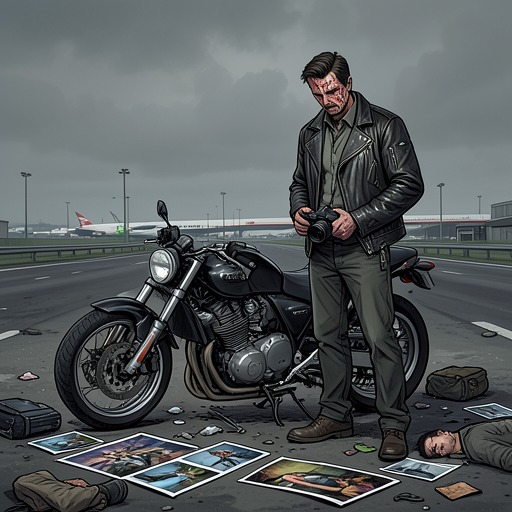
At Northolt General Hospital, Vaughan waits in the physicians’ car park with his camera, tracking the casualty department through its viewfinder. Photographs of crashed vehicles lie scattered on the ground, so that the hospital entrance, the injured man, and the documentary apparatus form a single continuum. The accident has not ended when Seagrave reaches medical care; it has become material for further observation, recording, and interpretation. Vaughan’s camera preserves the collision as an image even while the hospital attempts to contain its physical consequences.
For James Ballard, this evening establishes the entire future course of his relationship with Vaughan. Sitting beside him, James Ballard feels hostility give way to deference and perhaps subservience. Vaughan’s handling of the Lincoln Continental becomes a model for his wider conduct: aggressive, distracted, sensitive, clumsy, absorbed, and brutal by turns. The car’s failed second gear, damaged during a road race with Seagrave, makes this instability literal. Vaughan can crawl along the fast lane at ten miles an hour, appear helpless at the wheel, and then jerk the vehicle to a halt just before impact, mocking the role of the driver while retaining complete power over everyone inside the car.
The reenactment also exposes Vaughan’s treatment of people as extensions of accident material. He evaluates Helen Remington through possible wound areas, alternates between ironic dismissal and deferential interest in her medical profession, and uses Seagrave’s injury to draw her into his orbit. The event therefore links technical expertise with a predatory mode of attention: bodies are examined as sites of impact, cars as instruments of force, and relationships as further experiments in control.
Narrative and Thematic Significance
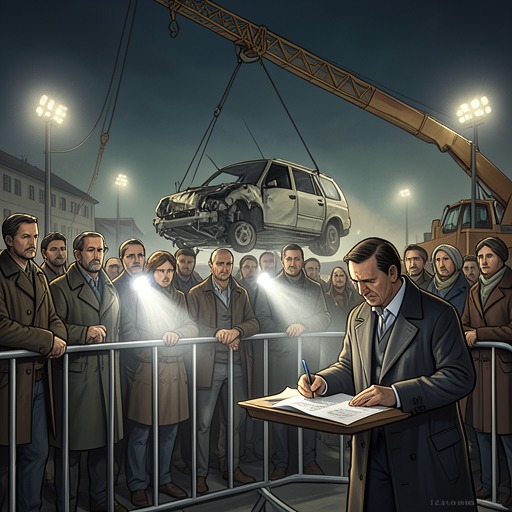
The Northolt event belongs to the novel’s larger pattern of accidents as public rituals. Elsewhere, Vaughan and James Ballard move from one motorway collision to another, listening to police broadcasts, watching firemen and police engineers cut victims from vehicles, and fighting over the right to photograph the scene. Traffic jams gather spectators whose faces show studied interest rather than alarm; children are lifted onto parents’ shoulders, and crowds inspect the displacement of radiators, the distortion of body frames, and the frosting of shattered windshields as though studying a technical display. The reenactment reproduces this social arrangement in a stadium, where the emergency spectacle has been deliberately packaged but remains dependent on the same collective appetite.
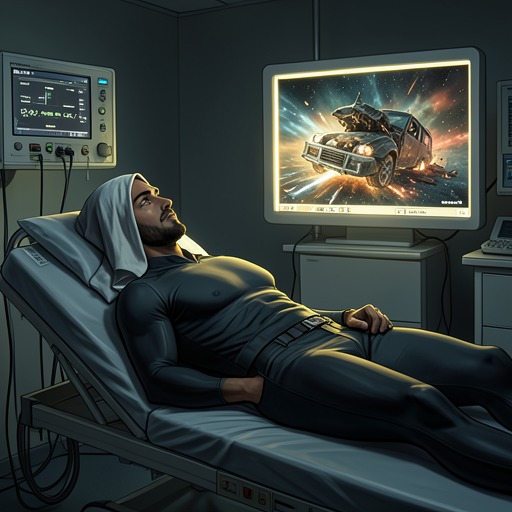
Its historical accident is also absorbed into an expanding system of risk knowledge. The novel connects Vaughan’s films and photographs with visits to the Road Research Laboratory, where calibrated vehicles crash into concrete target blocks. Slow-motion test films first calm and then arouse James Ballard, making the laboratory’s controlled impacts part of the same imaginative field as the stock-car performance. The distinction between prevention, documentation, entertainment, and erotic fantasy consequently collapses: each claims to study the crash, while each also gives the crash a new audience and a new form.
The scene is especially important for its treatment of masculine identity. Seagrave performs toughness by accepting the role of the target driver and by requesting that his closest friend deliver the decisive blow. Vaughan performs authority through cameras, technical direction, reckless driving, and the visible scars left by his earlier motorcycle collision, in which a truck’s rear wheels broke his legs. James Ballard, meanwhile, discovers that his fear of Vaughan is inseparable from fascination and submission. The reenactment does not simply show men taking risks; it shows risk becoming a language through which power, intimacy, injury, and sexual tension are negotiated.
Finally, the event foreshadows the novel’s increasingly unstable relation between rehearsal and reality. Vaughan later pursues further collisions and imagines a final crash with the film actress, while James Ballard comes to believe that Vaughan cannot truly die in a car crash but will be reborn through twisted radiator grilles and cascading windshield glass. The Northolt rehearsal is the first clear demonstration of that logic. A staged accident becomes real, the real accident becomes photographic evidence, and the evidence feeds the next fantasy. In this circuit, catastrophe is never merely represented: it continually returns as performance, memory, desire, and renewed danger.