Road Research Laboratory Crash Test
CrashThe Road Research Laboratory Crash Test is the novel’s defining encounter between institutional safety science and Robert Vaughan’s private mythology of collision. At the Laboratory, a motorcycle is propelled along steel rails into a saloon car carrying a family of mannequins, while engineers record the impact with sensors, metering coils, cine-cameras, and video equipment. For James Ballard and Vaughan, however, the demonstration exceeds its official purpose. The test turns engineered vehicles, artificial bodies, and measured injury into a slow-motion theater of destruction, revealing how the automobile crash can be treated simultaneously as a preventable public risk, a source of expert knowledge, and an object of intense fascination and desire.
Setting and Technical Design
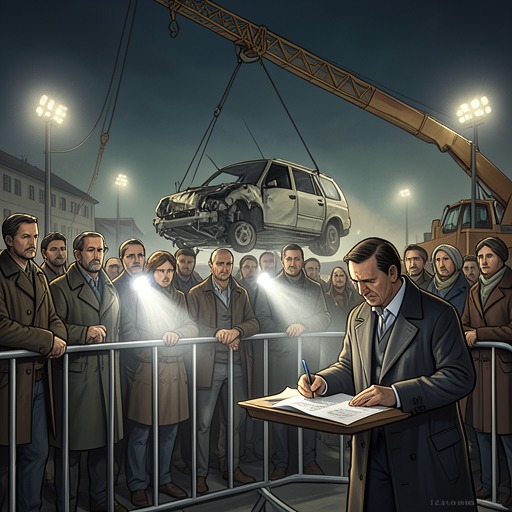
The event takes place at the Road Research Laboratory, where Ballard and Helen Remington walk from a crowded car park to the test sites among visitors, Ministry officials, road-safety engineers, traffic specialists, and their wives. Helen discusses projected legislation on anti-roll bars with a research scientist, while two lines of damaged cars stand on the concrete. Plastic mannequins occupy the wrecked hulls, their faces and chests splintered by earlier impacts and their likely wound areas marked in coloured panels on their skulls and abdomens. The site therefore joins medical classification to mechanical wreckage: the car is both a machine under examination and a model of the human body subjected to technical scrutiny. The principal experiment is arranged as a carefully controlled collision between a motorcycle and a saloon car. The motorcycle is secured to a cradle that will travel seventy yards along steel rails; the saloon car is connected by metering coils to recording devices on trestle tables. Two cine-cameras are positioned to capture the impact from different angles, and a video device replays engineers adjusting sensors in the engine compartment. Inside the car sits a family of four mannequins, with coils attached to their heads, chests, and legs and geometric carmine and violet injury zones already painted across their faces and thoraxes. The driver is placed behind the wheel with his hands in the ten-to-two position, turning a standard safety instruction into part of the ritual choreography of impending destruction.
Participants and Conflicting Purposes
The Laboratory presents the crash as a public experiment intended to improve knowledge and reduce accidents. Its commentator jocularly introduces the mannequin family as if they were an ordinary household out for a drive, while the assembled visitors gather around the impact point like spectators at a race track. The language of family normality, official measurement, and proposed safety legislation attempts to contain the violence within a rational administrative framework. Yet the very arrangement makes destruction visible, repeatable, and available for collective inspection. Vaughan enters this environment as both insider and renegade. Once a computer specialist and one of the first new-style television scientists, he had promoted computerized techniques for controlling international traffic systems before a motorcycle crash ended his television career. His scarred face, broken and re-set nose, damaged mouth, missing canine teeth, and hostile appearance carry the physical memory of that earlier collision. At the Laboratory he treats the test not merely as research but as an event capable of reproducing famous crashes indefinitely. He tells Ballard that the advanced simulation technology could duplicate the Mansfield and Camus crashes, and even Kennedy’s, over and over again. His remark transforms the Laboratory from a place of prevention into a machine for preserving and multiplying catastrophic images. Vaughan’s attention also makes the official demonstration personally charged. While the commentator calls the visitors to order, he watches the collision course and manipulates himself beneath his clothing, checking that Ballard is implicated in the spectacle. His response does not negate the Laboratory’s technical procedures; it parasitically feeds upon them. The measurement of impact, the arrangement of bodies, and the promise of replay become materials for his own fusion of violence and sexuality, while Ballard begins to experience the same fusion as an unsettling alteration in perception.
Course of the Collision
The motorcycle begins its run with a loud mechanical jerk. Its mannequin rider sits back against the force of acceleration, hands shackled to the handlebars and long thorax covered with metering devices. Ahead, the four mannequins sit rigidly in the saloon car, their faces marked with cryptic symbols. The scene is impersonal and ceremonial at once: the vehicles move according to cables, rails, and signals, but the bodies have been posed as though awaiting an ordeal whose injuries are already known in outline. The motorcycle strikes the front of the saloon car with a violent metallic explosion. Both vehicles veer toward the startled spectators; the motorcycle and rider sail over the bonnet, strike the windshield, and break across the roof in a black mass of fragments, while the car is driven ten feet backwards along its hawsers. The bonnet, windshield, and roof collapse. Inside the cabin, the mannequin family is thrown across the wreckage, and the decapitated torso of the front-seat woman passenger becomes embedded in the fractured windshield. Engineers then move toward the motorcycle and collect the separated sections of the cyclist’s body, treating the dismembered mannequin as a technical residue of the test. The violence becomes more elaborate when the impact is replayed in slow motion. The front wheel folds inward into a figure of eight; the motorcycle’s tail rises; and the rider appears briefly to achieve an unnatural, almost graceful horizontal posture. The metering coils sever one wrist as the mannequin launches toward the windshield, its painted wound areas presented to the advancing glass. The occupants of the car move toward the second collision at the same time, their heads and bodies meeting the windshield as the motorcyclist strikes it. Glass erupts around them, the rider’s face is torn away by the driving mirror, and his arm separates at the windshield pillar. The replay continues to multiply the crash’s stages. The inverted motorcycle falls onto the roof; its handlebars pass through the empty windshield and decapitate the front passenger, while the front wheel and chromium fork penetrate the roof and the drive chain severs the cyclist’s head. Inside the car, the driver rebounds from the collapsing steering wheel, the woman passenger rolls against the instrument panel, and her detached head travels through the rear compartment before exiting through the side door. The car finally settles, its passengers subsiding into the glass-filled cabin as their signalling limbs return to crudely human postures. The engineered sequence converts catastrophe into a series of isolated gestures, impacts, and trajectories that can be inspected after the event and replayed without end.
Aftermath and Psychological Effect
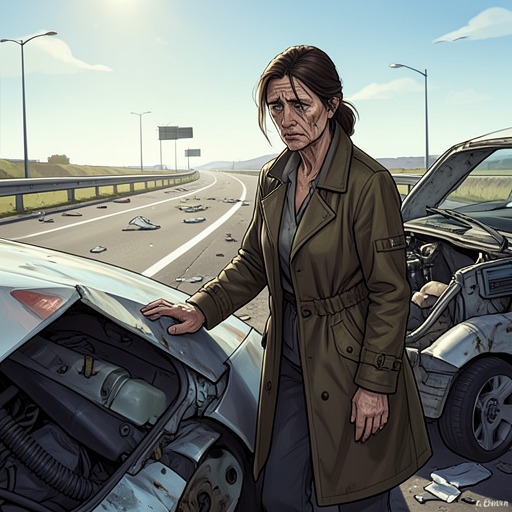
The audience watches the replay in a dreamlike stillness. Their own ghostly reflections appear behind the images on the screen, and the reversal of roles makes the living spectators seem less real than the mannequins. A Ministry official’s wife watches with rapt attention, as though witnessing the dismemberment of herself and her daughters. The test therefore produces not simple scientific distance but involuntary identification: the artificial family becomes a screen on which the observers project their own bodies and domestic futures. Ballard is left lightheaded by the rupture of metal and safety glass and by the deliberate destruction of expensive technological artefacts. Vaughan remains fixed on the wrecked car, touching its torn bonnet and roof and looking into the cabin as though about to embrace it. The collision of the damaged vehicle, the dismembered mannequins, and Vaughan’s exposed sexuality brings Ballard into an ambiguous mental territory where mechanical destruction and sexual penetration appear as related abstractions. Afterward Vaughan recovers his ordinary aggressiveness, using his battered Lincoln Continental to press smaller cars aside on the motorway, as though the test had intensified rather than discharged his appetite for danger. The event also deepens the relationship between Ballard and Vaughan. Earlier, their first meeting had established a dynamic in which Ballard’s hostility gave way to deference and possible subservience, while Vaughan’s driving expressed his shifting character: aggressive, distracted, sensitive, clumsy, absorbed, and brutal. At the Laboratory, the crash gives this relationship a shared object and a common vocabulary. Ballard later watches slow-motion films of test collisions in Vaughan’s apartment; the repeated impacts first calm and then arouse him, and solitary motorway driving makes him imagine himself at the controls of the vehicles. The Laboratory test thus becomes not an isolated demonstration but a template for the pair’s continuing interpretation of bodies, machines, and injury.
Institutional Risk and Vaughan’s Appropriation
The crash test embodies the novel’s broader paradox about the motor-car. Road-safety propaganda has already made Ballard feel that the gruesome climax of his life is being rehearsed in advance through televised and billboard accidents. The Laboratory realizes that rehearsal materially: it produces a controlled accident so that injury can be observed, classified, and potentially prevented. Its handouts include studies such as “Mechanisms of Occupant Ejection” and “Tolerances of the Human Face in Crash Impacts,” and its instruments translate collision into measurable data. The same culture that seeks to reduce slaughter therefore generates an extensive archive of violent possibilities. Vaughan exploits that archive for an opposite purpose. His questionnaires later circulate among programmers, a dietitian, airport stewardesses, a medical technician, Seagrave and Vera Seagrave, a television producer, and Gabrielle, all of whom have experienced some automobile crash. They ask participants to imagine the deaths of public figures and offer an exhaustive catalogue of injury mechanisms, including passenger ejection, kneecap and hip-joint damage, deformation of passenger compartments, roll-over abrasions, limb amputation, facial injuries, and whiplash. The Laboratory’s measured collision supplies the technical grammar for this wider imaginative project. Expert knowledge no longer remains confined to prevention; it becomes a repertoire through which private fantasies can be designed. The crash test also clarifies why Vaughan’s authority is so unstable. He rejects the limits of a large government laboratory, claiming that such an institution is not psychologically equipped for his project, yet he borrows its apparatus, procedures, and vocabulary. His proposed television work depends on cameras, questionnaires, crash records, and the prestige of scientific expertise, while his own fascination turns these instruments toward eroticized destruction. He is neither simply outside the system nor securely within it. He is a distorted continuation of its practices, making visible the desires and spectacles that official safety discourse attempts to exclude.
Narrative Significance
The Road Research Laboratory Crash Test is a miniature of the novel’s technological landscape. Its cars, mannequins, sensors, cameras, engineers, commentators, and spectators form a social-technical system in which danger is distributed among machines, institutions, professionals, and viewers. The event shows how a crash can be made calculable without becoming emotionally neutral, and how measurement can intensify rather than eliminate fascination. In Vaughan’s presence, the safety demonstration becomes an initiation into the automobile crash as a new form of knowledge and desire. Its influence persists beyond the Laboratory. Ballard and Vaughan later visit real accident sites, follow police broadcasts, and watch rescue workers free trapped passengers from wrecked vehicles. Crowds at motorway collisions display the same calm, studied interest that surrounds the simulated crash, inspecting distorted grilles, crushed frames, and patterns in shattered windshields as though catastrophe were a public exhibition. Vaughan’s later vision of his final collision likewise depends on repeated images, carefully specified wounds, and the conversion of death into an endlessly revisable scene. The Laboratory test is therefore both a literal event and a governing model: it teaches the characters to see the car crash as an engineered spectacle in which technology, bodily injury, collective spectatorship, and sexuality converge.