Gabrielle's invalid car
CrashGabrielle's invalid car is the adapted vehicle that enables Gabrielle to move from institutional dependence toward self-directed mobility, but it also becomes far more than a prosthetic device. In the narrator's imagination, its controls and body-contoured interior form an erotic machinery that joins damaged flesh to automotive technology. The car therefore carries two opposed meanings at once: it is a concrete accommodation through which Gabrielle regains a degree of agency, and it is an object repeatedly appropriated by the narrator's gaze as evidence for his theory of injury, desire, and technological transformation.
Origin and Physical Design
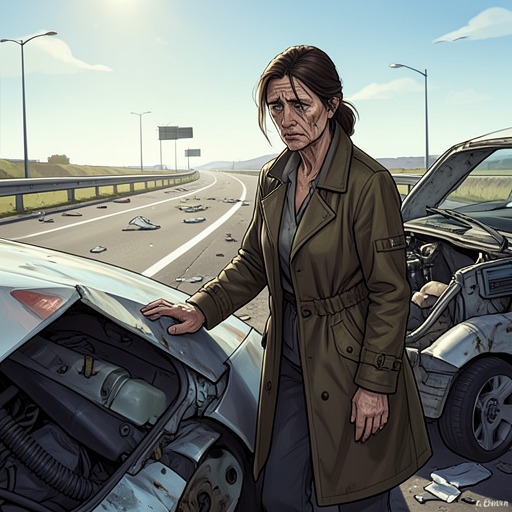
Gabrielle first enters the photographic record as a young social worker whose small sports car has collided with an airline bus near the airport underpass, close to the site of James Ballard's own accident. The early photographs show the conventional vehicle crushed around her and her injuries emerging gradually through bruising. The later sequence follows her recovery in a convalescent institution: she propels herself in a chromium wheelchair, attends an archery meeting, and finally takes her first lessons in an invalid car. This progression establishes the vehicle as part of a material chain linking crash, hospitalization, rehabilitation, and renewed movement rather than as an isolated luxury or fetish object.
The car is designed around Gabrielle's altered body. Its controls include inverted treadles, clutch levers, auxiliary braking arrangements, and a gear mechanism modified for hand operation. A cluster of chromium treadles is fixed to a steel pivot clamped to the steering column; an extension rises laterally from the floor-mounted gear lever and ends in a vertical chromium wing moulded to the reverse of a driver's palm. The seat has been shaped around the depressions made by her spinal harness and backstraps, while the leg brace and its buckles remain part of the bodily and mechanical arrangement through which she drives. These details make adaptation visible as an active reconfiguration of the vehicle's ordinary architecture.
Mobility and Public Display
At the motor show at Earls Court, Gabrielle moves among immaculate cars while Vaughan guides her from stand to stand. Her shackled legs, scarred hands, swinging shoulder, and injured hips appear in deliberate contrast with the chromium and cellulose bodies displayed as perfected products. She touches the paintwork, rolls her injured hips against the vehicles, and accepts the embarrassed assistance of a young Mercedes salesman as he helps her into a white sports car. The showroom turns the adapted car's practical purpose into a public spectacle: disability confronts the motor industry's ideal of geometric perfection, and Gabrielle's body becomes the unwelcome measure against which the new machines are seen.
Vaughan then asks James Ballard to walk with Gabrielle and hold her arm. When Vaughan withdraws, Ballard accompanies her through a succession of invalid cars and discusses the installation of auxiliary controls with the demonstrators. His formal attention to brakes, treadles, and hand-operated clutch levers is inseparable from his fixation on Gabrielle's thighs, breast, pelvis, and the pressure of her hand on his arm. The vehicle thus organizes a scene in which technical expertise, assistance, public scrutiny, and sexual observation become difficult to separate. Gabrielle's access to mobility is real, but the social world surrounding that access continually turns her into an object of inspection.
The Car as an Erotic Apparatus
Ballard's first sexual encounter with Gabrielle takes place in the rear seat of her small car, among the braces, straps, and unusual geometry of the adapted controls. He experiences the unfamiliar planes of her hips and legs as routes into what he calls new forms of violence, treating each deformity as a metaphor for a sexual possibility. The car does not merely contain the encounter. Its interior directs Ballard's movements, interrupts ordinary bodily contact, and makes the relation between flesh and mechanism the scene's governing structure.
Gabrielle drives toward the airport using the unfamiliar controls, and the vehicle's practical operation remains present during their intimacy. Near the reservoirs, they stop to watch aircraft land. The scent of her body mingles with the smell of mustard leatherette; a contoured seat presses against her brace and backstraps; controls jut beneath the steering wheel; and the chromium treadles and gear extension occupy the space around her body. The automobile's design gives physical form to a new set of bodily relations, but the narration repeatedly converts that form into erotic symbolism. The apparatus accommodates Gabrielle, while Ballard reads the accommodation as a sexual script.
In the most concentrated description of the encounter, Gabrielle's leg brace rests against Ballard's knee, and the loosened straps expose depressions in her skin left by buckles, clasps, and the spinal support. Ballard treats these grooves, together with the marks beneath her breast and armpit, as templates for hypothetical organs and future sexual possibilities. The car's interior, the braces, and the wounds on Ballard's own body become a single system of impressions and pressures. Yet the scene also exposes the limits of his interpretation: he expects Gabrielle's breast to be a detachable latex structure fitted alongside her supports and feels disappointed when it proves to be ordinary human flesh. His fantasy attempts to replace the person with an assemblage of parts, surfaces, and mechanisms.
Relations, Agency, and Consequences
Gabrielle does not simply submit to the meanings Ballard assigns to the car. At the motor show she actively provokes the salesmen and takes pleasure in moving through the displays. During the intimate drive she handles the adapted controls herself, follows her own hand with her intelligent eyes, and lifts her braced leg so that Ballard can unfasten it. Her body is not merely repaired to fit a pre-existing vehicle; the vehicle has been redesigned around her, and she learns to inhabit that redesign. The car makes possible a form of independence that the hospital ward cannot provide, even as the surrounding observers repeatedly interpret her mobility through pity, fascination, or desire.
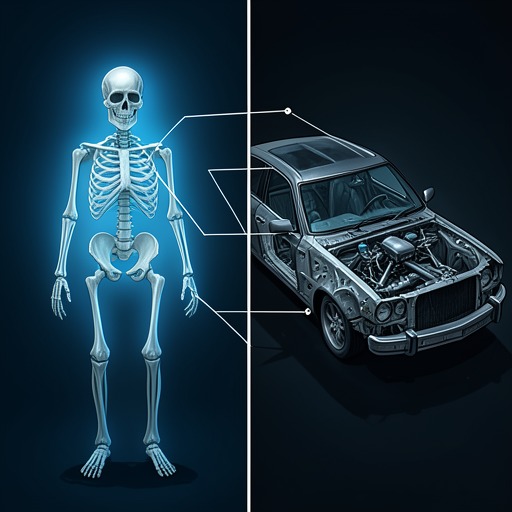
The vehicle also extends the novel's wider pattern of treating injury as a meeting point between bodies and machines. James Ballard's own recovery begins in a casualty ward near London Airport, where his fractured kneecaps, drainage tubes, dressings, and harnesses are managed by medical staff. Nurses steer his penis through the opening of his pyjama shorts, adjust the tubes in his knees, and examine wounds that retain the shapes of automotive components. A new casualty nurse studies the bruised contours of his body and wonders, in the narrator's speculation, which car model might have produced them. Gabrielle's invalid car reverses this process: instead of the crash imprinting the vehicle's structure onto the injured body, technology is altered to receive and extend the injured body.
Vaughan's photographic album makes the transformation into an explicit narrative. He records Gabrielle from the crushed sports car through hospitalization, convalescence, wheelchair use, and driving lessons, and later follows Ballard's own accident and recovery. The album is ostensibly a record of people, but its true subject is the interaction between anonymous bodies and automobiles. Gabrielle's invalid car is consequently both an object in the photographs and a device through which Vaughan and Ballard project their theories of damaged sexuality. It changes Gabrielle's practical circumstances, yet it also draws her into a network of surveillance in which her rehabilitation is made into a spectacle of technological and erotic possibility.
Narrative and Thematic Significance
The invalid car crystallizes the novel's claim that modern technology does not remain external to human identity. It enters posture, movement, sensation, and desire. For Gabrielle, the vehicle's controls are not decorative symbols but necessary means of driving; the car's design accommodates the consequences of her crash and allows her to act in public space. For Ballard, however, the same controls become a vocabulary for imagining a sexuality beyond conventional bodily junctions. His response is deliberately unstable: it recognizes the intimate material relationship between body and device, but it also reduces Gabrielle's disability to an erotic and violent metaphor.
That contradiction is central to the object's significance. The invalid car can be read as a form of narrative prosthesis, since the story repeatedly uses Gabrielle's altered body and adapted vehicle to generate meanings about desire, technology, and violence. At the same time, the detailed presentation of treadles, braces, levers, buckles, and contoured upholstery keeps disability grounded in concrete practices of movement and care. The car is therefore not only a symbol of aberration. It is an enabling environment whose material design changes what Gabrielle can do, even while the narrator's gaze tries to make that change signify something else.
By joining rehabilitation to spectacle and mobility to erotic projection, Gabrielle's invalid car becomes one of the novel's defining objects. It carries Gabrielle into a world from which her injuries might otherwise exclude her, confronts the polished fantasy of the motor show with the visible reality of damaged flesh, and provides the enclosed setting for Ballard's first sexual encounter with her. Its altered machinery suggests that the future body will be shaped not only by wounds but by the devices built around them. The car's decisive power lies in this doubleness: it is an instrument that restores movement, a public object that attracts judgment, and a charged material partner in the narrator's attempt to imagine a sexuality generated by the collision of body and technology.