Narrator's Western Avenue Crash
CrashNarrator's Western Avenue Crash is the head-on collision below the Western Avenue flyover that initiates James Ballard's altered relationship with cars, wounds, and death. A June drive home from Shepperton ends in the destruction of three vehicles, the instantaneous death of Dr Hamilton, and an encounter with Dr Helen Remington that the narrator experiences less as a legal accident than as an obscene and formative union. The crash becomes the original pattern later repeated in Robert Vaughan's fantasies and staged collisions: bodies and machines locked together, injury converted into erotic charge, and death treated as a technological revelation.
Causes and Immediate Circumstances
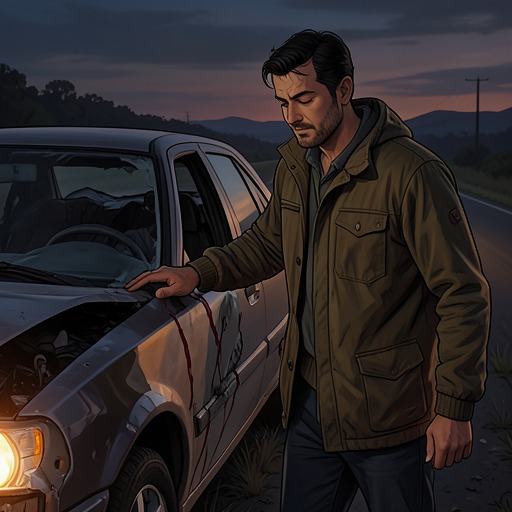
On a rain-swept June evening, James Ballard was driving home from Shepperton when his car skidded at the intersection beneath the entrance to the Western Avenue flyover. Within seconds it crossed into the oncoming lane at roughly sixty miles an hour. The off-side tyre blew out as the car struck the central reservation, and the uncontrolled vehicle turned up the high-speed exit ramp toward three approaching mass-produced saloon cars.
Ballard avoided the first two vehicles only by pumping the brakes and forcing his car between them. The third carried Dr Hamilton, a chemical engineer employed by an American foodstuffs company, and his wife, Dr Helen Remington. Ballard struck their car head-on. The immediate cause was loss of control in wet traffic, but the event is narrated with an almost mechanical inevitability: tyre, reservation, ramp, approaching cars, and failed braking form a chain in which human intention is rapidly displaced by momentum.
The crash also follows Ballard's departure from his secretary Renata, who was attempting to free herself from an unsettling affair with him. He had deliberately fastened his safety belt to spare her the embarrassment of embracing him. That ordinary gesture of emotional avoidance becomes part of the accident's physical logic: the belt keeps him alive while his body is driven forward into the steering wheel and instrument panel.
Collision and Injuries
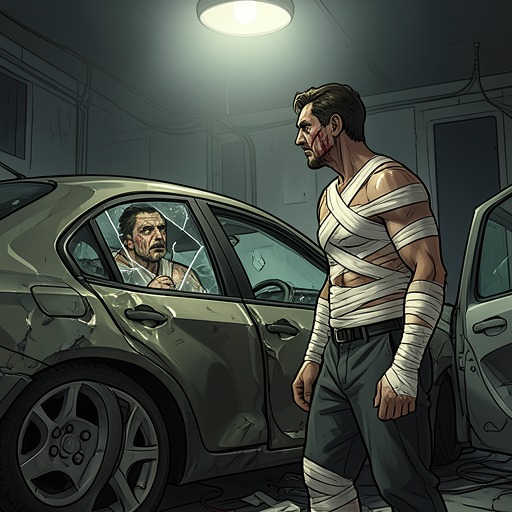
Dr Hamilton was thrown through his windshield and killed instantly. His body came to rest on the bonnet of Ballard's car, while the dead man's blood sprayed through the fractured windshield over Ballard's face and chest. Firemen later mistook the blood for evidence of a massive open-heart wound, an error that captures the crash's confusion between external violence and internal injury.
Ballard's injuries were severe but not fatal. His chest was badly bruised against the steering wheel, his knees were crushed into the instrument panel, and a nerve in his scalp was severed. The same unexplained forces that protected him from being impaled also left Helen Remington alive. Apart from a bruised upper jaw and several loosened teeth, she was physically unharmed at first, although a wound in her right cheek gradually deformed her face as the bruised tissue filled with blood.
The two survivors remained fixed behind their fractured windshields, unable to move and staring at one another across the body of Helen's husband. His hand lay palm-up beside Ballard's right windshield wiper; after striking a rigid object as he was hurled from his seat, it bore a blood blister shaped like the triton emblem on Ballard's radiator. The emblem turns a random injury into a sign, while the interlocked radiator grilles of the two cars become, in Ballard's perception, a model of an inescapable and perverse union.
Around the wrecks, spectators formed a silent circle before the scene erupted into emergency activity. Cars pulled onto the verge and central reservation, a traffic jam spread along Western Avenue, and police headlamps and sirens transformed the flyover into a theatre of public witnessing. An elderly man in a transparent plastic raincoat hesitated at Ballard's passenger door, while a young woman holding a tartan blanket peered through the window like a mourner looking at a corpse. The crowd's solemn attention makes the crash both a private encounter and a spectacle already shaped by strangers' eyes.
Hospital, Inquiry, and Aftermath
Ballard spent three weeks recovering in an otherwise empty casualty ward near London Airport, a hospital area normally reserved for possible air-crash victims. The setting links the road accident to aviation catastrophe and places his recovery within the infrastructure of modern transport: used-car marts, reservoirs, remand centres, motorways, and the airport systems that surround London.
The accident produces an erotic fixation on Helen Remington. Ballard imagines the two cars' grilles as joined bodies and studies the contours of her thighs while she sits beneath a grey hospital blanket. He imagines sexual contact with her as a way of re-conceiving her dead husband in her womb, making the collision's physical conjunction the basis for a grotesque fantasy of resurrection. Helen later visits him, masturbates him while discussing the police inquiries, and describes the crushed radiator grille and blood-spattered bonnet with the persistence of a voyeur. Her response does not restore conventional mourning; it confirms the crash as a shared imaginative object.
The legal process refuses the meanings Ballard attaches to the event. At the coroner's inquest, the verdict is accidental death, and the police bring no charges of manslaughter or negligent driving against him. Catherine Ballard treats this formal condolence as a stylized performance, while Ballard insists that his relationship with the dead man is located in the physical wounds, the final instants of violence, and the collision between his body and the car's interior. The law closes the case by assigning accident, but the narrator's imagination keeps reopening it as a charged relation among survivors, machines, and the dead.
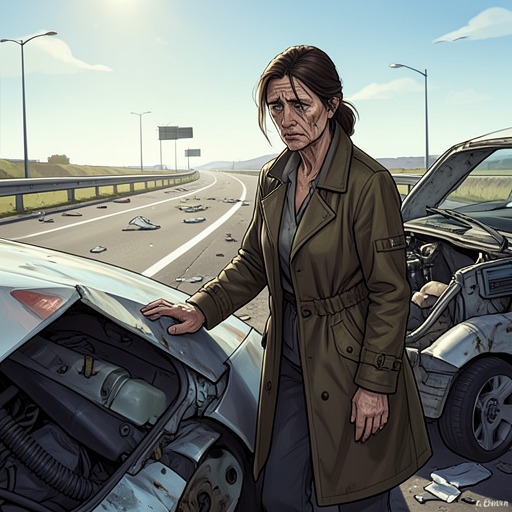
Helen is encountered again at London Airport after the inquest, moving through the parked cars toward the immigration department with her scar turned away from Ballard. Her face appears deliberately to erase him, yet he also sees her as completely lost. The crash has therefore created a bond that neither ordinary grief nor institutional procedure can dissolve: it joins them through recognition, avoidance, and the shared knowledge of the husband's death.
Pattern for Vaughan's Obsessions
The Western Avenue collision becomes the first decisive model for Ballard's relationship with Robert Vaughan. Vaughan's scarred body already bears the memory of a motorcycle crash in which a truck's rear wheels broke his legs, and his career as a television scientist ended after that injury. When Ballard first encounters him, Vaughan's manner of handling his damaged Lincoln Continental establishes the aggressive, distracted, sensitive, clumsy, absorbed, and brutal pattern of their later relationship.
Vaughan studies crashes through photographs, vehicles, and repeated rehearsals. His own projected final collision with a film actress extends the structure first made visible on Western Avenue: two cars meet head-on, bodies receive corresponding wounds, and the car's emblems and instruments become sexualized organs. Vaughan describes such injuries with erotic tenderness and uses his exposed sexuality to keep Ballard near him. The narrator's first crash thus supplies not merely a past incident but the grammar of Vaughan's later fantasies and of the men's increasingly dangerous intimacy.
The automobile's political and technological associations enlarge the event beyond personal trauma. Vaughan connects his ten-year-old Continental with the limousine in which President Kennedy died and treats Kennedy's assassination as a special kind of car crash. The vehicle becomes at once transport, weapon, memorial object, and sexual apparatus. Against this background, Ballard's collision is retrospectively recoded as an early instance of the novel's broader marriage of sex and technology.
Repetition and Narrative Significance
Ballard does not leave the crash behind when his wounds heal. Its images return through later encounters with Vaughan, through repeated descriptions of wrecked cars and injured bodies, and through the narrator's conviction that technological violence can generate a new erotic language. The crash's delayed force resembles a trauma that becomes intelligible only through recurrence: the original impact is followed by hospital fantasies, legal proceedings, photographic records, and increasingly deliberate reenactments.
In the aftermath of Vaughan's death, Ballard continues to understand the earlier collision through Vaughan's logic. He imagines Vaughan as someone who cannot truly die in a car crash but will be reborn through twisted radiator grilles and cascading windshield glass. That later vision confirms the Western Avenue crash as the narrative's originating image of death as repetition rather than closure. Ballard's survival is consequently ambiguous: it preserves his life, but it also leaves him permanently attached to the accident's wounds, its surviving woman, its dead man, and the machines that brought them together.
The event's decisive value shift is from routine mobility to irreversible conjunction. A drive home becomes a death, a public spectacle, a legal case, a sexual fixation, and the first entry into Vaughan's world. Its power lies in the gap between the official account and Ballard's experience: the authorities see accidental death, whereas the narrator sees a technology-mediated union whose consequences continue through desire, memory, and repeated collision.