Vaughan's Lincoln Continental
CrashVaughan's Lincoln Continental is not merely Robert Vaughan's vehicle but the hard, mobile environment through which his obsessions become visible and operative. Its age, damaged transmission, heavy American body, photographic equipment, and repeated involvement in collisions turn it into an extension of Vaughan's scarred body and theatrical masculinity. It carries surveillance, sexual tension, and violence through the plot, finally becoming the weapon with which Vaughan attempts to run down the narrator before escaping toward the road above.
Appearance, History, and Associations
The Lincoln is introduced as a ten-year-old model, conspicuous less for mechanical elegance than for its weight, age, and historical charge. James Ballard immediately connects it with the open limousine in which President Kennedy died, recalling that Kennedy's assassination was one of Vaughan's obsessions. The car therefore enters the narrative already burdened by an association between public spectacle, political death, and automotive impact. It is both an ordinary used vehicle and a rolling emblem of a technologically staged killing.
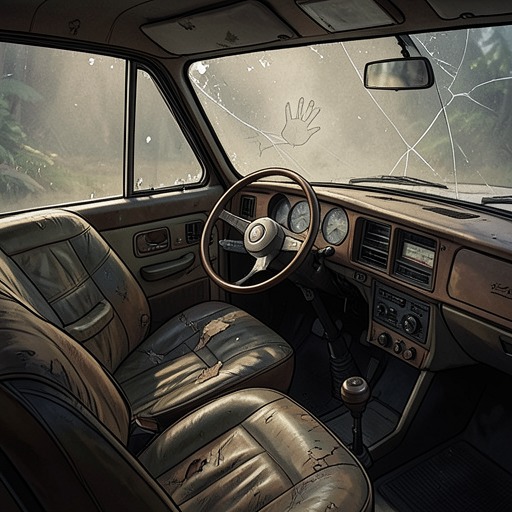
The car's condition makes its material history legible. Its second gear has been torn out during a road-race with Seagrave, leaving it unable to accelerate normally. Along Western Avenue, Vaughan sometimes holds up the fast lane at ten miles an hour while the damaged automatic transmission struggles to build speed. The Lincoln's mechanical failure does not simply limit Vaughan; it becomes part of his performance. He drives as if the vehicle were equipped with invalid controls, fumbling with the wheel and letting his feet hang helplessly while moving toward a stationary taxi, then jerking to a halt at the last moment. The car's defect becomes a repeated rehearsal of disability, danger, and deliberate loss of control.
Vehicle and Mobile Observatory
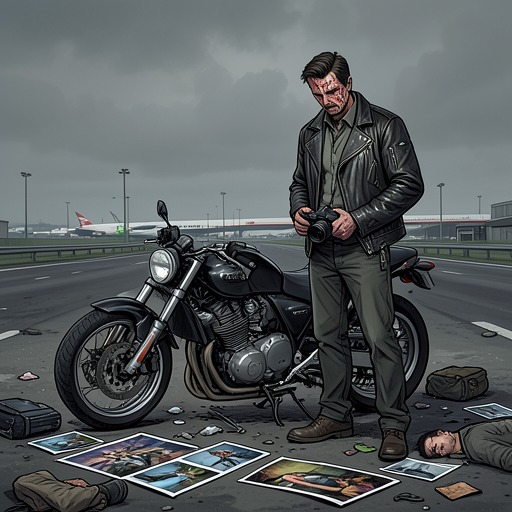
The Lincoln is also a platform for looking. When Ballard first recognizes Vaughan on the roof of the multi-storey car-park, the passenger seat is loaded with cameras, a tripod, and a carton of flashbulbs, while a cine-camera is fixed to a dashboard clamp. The car is consequently arranged as a mobile observatory: it carries the apparatus by which Vaughan converts accidents, bodies, and strangers into images. His camera is held like a weapon, and the boundary between recording an event and preparing one is already unstable.
That visual function links the Lincoln to Vaughan's broader practice of surveillance. He watches Ballard through a mud-spattered windshield near an accident site, photographs from the car-park, and later works among hundreds of crash photographs in his laboratory. Many of those images show damaged motor-cars, radiator grilles, windshields, spectators, police, and ambulance attendants; others, made with greater care through windshields and revolving doors, focus on women resembling Vera Seagrave. The Lincoln thus participates in a system in which the car is simultaneously shelter, camera position, stalking instrument, and scene of voyeuristic control.
Encounters and Sexualized Violence
At Vaughan's first meeting with Ballard, the Lincoln establishes the relationship's tone before either man fully understands it. Vaughan reverses past Ballard so closely that the left fender brushes his knee, then sweeps away down the ramp. The contact is minor in physical scale but decisive in narrative effect: the car enters the relationship as an object capable of touching, testing, and threatening the narrator without openly declaring an attack. Ballard recognizes that Vaughan's pursuit is not motivated by revenge or blackmail, but the vehicle has already made the pursuit bodily.
The car's interior repeatedly fuses driving with sexual imagery. While Vaughan watches through a cine-camera, Ballard imagines the driver's body forcing itself toward the illuminated instrument panel, the accelerator, and the speedometer. The dashboard is not a neutral control surface; it becomes part of the eroticized anatomy of the vehicle. This association intensifies when Vaughan casually exposes his sexuality and uses his body to hold Ballard's attention. The Lincoln provides the enclosed, technologically charged space in which mechanical control, male display, and the desire for impact become difficult to separate.
The vehicle also carries this charged arrangement into encounters with women. After a multiple-vehicle crash, Vaughan climbs into the rear seat beside Catherine while Ballard drives. Vaughan's knee presses against her thigh, one hand rubs his groin, and his gaze moves over the nape of her neck, cheek, and shoulder. The car becomes a constrained relational chamber: Ballard occupies the driver's position, Catherine sits between competing forms of attention, and Vaughan's body turns the rear compartment into a scene of appraisal and threat. The accident they have just passed has already activated the same mental traps in Ballard and Catherine that Vaughan inhabits more completely.
The Lincoln as an Instrument of Collision
Vaughan's use of the Lincoln repeatedly shifts it from damaged object to active participant in violence. At the final confrontation recorded in the evidence, the narrator emerges from an abandoned car after waiting for acid to pass through his nervous system. A heavy black vehicle accelerates from beneath the overpass: it is the Lincoln, and Vaughan is driving it directly toward him. The car's white-walled tyres tear through roadside debris, mount the kerb, and strike the rear wheel housing of the abandoned vehicle in which the narrator had been sitting.
The impact gives the Lincoln a destructive agency beyond simple transportation. Its front fender rips the open passenger door from its hinges; the car slides across the access road, crushes a ten-yard section of wooden palisade, regains traction, and climbs back toward the motor road. Vaughan's bloodied hands whirl at the steering wheel, but the physical sequence is produced by an assemblage of human intention, damaged machinery, road surface, kerb, debris, and barrier. The car does not merely convey the attempted attack: its mass and momentum determine the form the attack can take, and its survival enables Vaughan to make his escape.
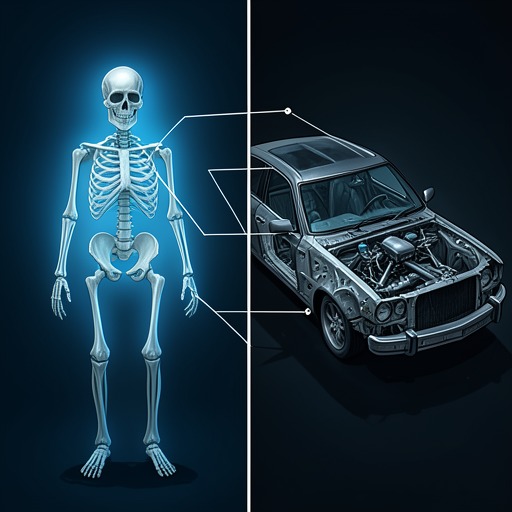
The aftermath makes the car's material violence comparable to Vaughan's own body. The abandoned car's passenger door is crushed into the front fender, its metal welded together by impact. Ballard thinks of Vaughan's scar tissue as fused along similar arbitrary seams, so that the damaged vehicle becomes a mechanical counterpart to the man's reconstructed face and body. The Lincoln's violence is therefore not external to Vaughan's identity. It repeats the pattern by which collision has already displaced and reassembled him.
Surveillance, Pursuit, and Final Significance
The Lincoln's relation to Elizabeth Taylor's death fantasy extends its role from personal vehicle to instrument of projected spectacle. During Vaughan's last weeks, his apartment near Shepperton Studios is covered with photographs of Elizabeth Taylor taken from pedestrian bridges, motorway viewpoints, and the roof of the studio car-park. Ballard prepares enlarged prints for him, while Vaughan compares details of her body with photographs of wounds in a plastic-surgery textbook. The intended crash with the film actress is imagined as an elaborate convergence of celebrity, image-making, bodily injury, and sexual climax; the Lincoln is the vehicle through which that imagined convergence is to become real.
The same car is therefore present at the intersection of watching and being watched. Its windshield frames victims, its cameras preserve collisions, and its body carries Vaughan through the roads on which he rehearses death. Yet the Lincoln also exposes the limits of his control. Its damaged transmission slows him, its bulk turns his gestures into awkward displays, and its collisions produce consequences that exceed the theatrical pose he tries to command. Even after Vaughan's death, Ballard imagines that Vaughan can be reborn through twisted radiator grilles and cascading windshield glass. The Lincoln's ultimate significance lies in this fusion: it is a machine that seems to contain Vaughan's will, but also a material form that survives, resists, and reshapes that will, making the automobile inseparable from the novel's vision of technologically generated desire and collision as a rehearsal for death.