Vaughan's final crash into Elizabeth Taylor's limousine
CrashVaughan's final crash into Elizabeth Taylor's limousine is the decisive enactment of a death he had rehearsed throughout his friendship with the narrator. He drives the narrator's stolen car toward the limousine of Elizabeth Taylor, the film actress whose death he has pursued as the climax of an elaborate erotic and visual project. The collision kills Vaughan, devastates an airline coach, nearly kills Elizabeth Taylor, and transforms the accident site into a public stage where the modern traffic system appears to display its own fantasies of violence, celebrity, and death.
Causes and Preparation
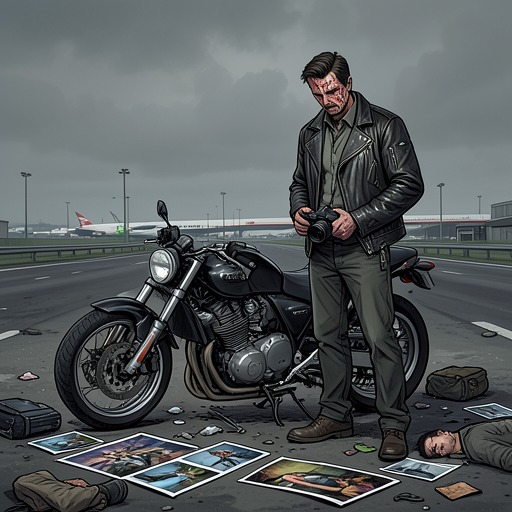
Vaughan's final crash grows out of a long practice of treating car accidents as rehearsals rather than unforeseen events. Before the final attempt, he had participated in many crashes and had repeatedly staged his own death. During the last weeks of his life, however, his attention narrowed almost entirely to Elizabeth Taylor. His apartment near Shepperton Studios was covered with photographs taken as she left her London hotel, crossed pedestrian bridges above westbound motorways, and moved through the studio car park. He used a zoom lens to isolate her knees, hands, thighs, and mouth, converting fragments of her body into components of a projected collision.
The photographs were not merely souvenirs of celebrity watching. The narrator reproduced packages of prints for Vaughan in his office, and Vaughan compared the magnified bodily details with photographs of grotesque wounds in a plastic-surgery textbook. His imagined collision joined the actress's body to the car's mechanical surfaces: windshield glass would frost around her face, her thighs would suffer compound fractures against the handbrake mountings, and the manufacturer's medallion would pierce her uterus. Vaughan imagined his own semen spilling across the illuminated instruments that recorded the engine's final temperature and fuel level. The crash therefore functioned simultaneously as murder fantasy, sexual fantasy, photographic composition, and mechanical diagram.
Vaughan's calmest moments came when he described these impacts to the narrator. He spoke of the wounds with the erotic tenderness of a separated lover and used his own sexual presence to keep the narrator from leaving him. The final accident thus arises from a relationship in which violence is repeatedly rehearsed, narrated, photographed, and shared before it is finally carried out. Its apparent spontaneity conceals months of preparation, stolen vehicles, collected images, and a deliberate attempt to make death assume the form of an artistic and sexual culmination.
Course of the Crash
Ten days before Vaughan's death, he stole the narrator's car from the garage of the narrator's apartment house. At the end of that interval, the car appeared again as the instrument of the final assault. Vaughan drove along the open deck of the flyover at maximum speed, trying to launch himself into the sky and drive into the limousine carrying Elizabeth Taylor. The attempt did not produce the head-on collision he had imagined in every detail. His car jumped the rails of the London Airport flyover and plunged through the roof of a bus filled with airline passengers.
The consequences were immediate and indiscriminate. The bus was packed with package tourists, and the crushed bodies remained across its vinyl seats when the narrator forced his way through the police engineers roughly an hour later. Vaughan's body was so disfigured by the impact with the airline coach that the police initially identified it as the narrator's. The broken positions of his arms and legs and the bloody geometry of his face seemed to reproduce the crash-injury photographs that had covered his apartment walls, as though the body had finally become one of the images he had spent his life collecting.
Elizabeth Taylor survived. She stood beneath the revolving ambulance lights while holding the arm of her chauffeur, one gloved hand raised to her throat. The gesture makes her appear both witness and threatened object: she is physically alive, but placed within the visual formula of the death Vaughan had devised for her. The narrator wonders whether she could see in Vaughan's posture the design of a death intended to occur at the moment of her orgasm. Vaughan's fantasy has failed as a controlled private encounter, yet its wreckage preserves the outline of the spectacle he wanted.
Immediate Aftermath and Legal Meaning
The crash produced a gap between legal description and deliberate action. Earlier, the narrator's collision with Dr Hamilton's car had received a verdict of accidental death, and no charges of manslaughter or negligent driving were brought against him. Vaughan's final act, by contrast, is described as a sustained pursuit and attempted collision, although the visible result is still processed through the institutional language of traffic accident, emergency rescue, identification, and police investigation.
The police pursue Vaughan before his death, and Vera Seagrave reports that an American serviceman was killed on the Northolt overpass while Vaughan followed the film actress. Catherine also learns that the narrator had been involved in the car. These reports connect the final crash to the wider chain of collisions and attempted collisions that has accumulated around Vaughan, while also showing how responsibility becomes dispersed among drivers, vehicles, police procedures, and the public appetite for catastrophe.
The crash alters the lives and perceptions of those left behind. The police telephone Catherine while the narrator is driving home from Shepperton Studios, and Catherine waits around the rusting hulk of Vaughan's Lincoln, momentarily seeming to expect the narrator to be Vaughan returning after his own death. The narrator and Catherine then drive toward the flyover while the radio reports Elizabeth Taylor's escape. The narrator becomes increasingly convinced that Vaughan may have been a projection of his own fantasies and obsessions, and that he has somehow failed Vaughan. Vaughan's death therefore does not end the action cleanly; it transfers the crash into memory, guilt, mistaken identity, and the narrator's unstable sense of his own participation.
The Accident Site as Public Spectacle
When the narrator and Catherine reach the site, at least five hundred people have gathered on the verges and parapets because Elizabeth Taylor narrowly escaped death. Spectators stand three deep along the rising balustrade, looking down toward police cars, ambulances, and the crushed roof of the airline coach. The scene resembles a theatre: the flyover deck forms a proscenium arch visible for miles, while revolving warning lights draw more passers-by from Northolt apartment blocks, Western Avenue supermarkets, surrounding traffic, and the silent airport concourses.
The crowd's attention is directed less toward the human victims than toward the deformed vehicles at the centre of the scene. The narrator sees his car beside the coach, its wheels still inflated while the rest of its body is unrecognizable, as if it had been struck from every direction. The spectators appear to read the vehicles as models of their own possible futures. The crash thus becomes a collective act of looking in which private death is converted into public entertainment, prophecy, and ritual.
Elizabeth Taylor's survival intensifies rather than dissolves the spectacle. She stands apart beside her chauffeur, raising a hand to her neck as if shielding herself from the image of the death she has narrowly avoided. Police and ambulance workers leave a clear space around her, preserving her celebrity isolation within the disaster. Vaughan has failed to kill the actress, but he has succeeded in placing her, his own corpse, the coach passengers, and the spectators inside a single composed tableau of technological catastrophe.
Significance and Recurrence
The final crash gathers the recurring elements of Vaughan's conduct into one terminal event: stolen cars, photographic surveillance, repeated rehearsals, mechanical impact, sexualized injury, celebrity, and the transformation of suffering into an image. It also reverses the ordinary meaning of an accident. What should be an unforeseeable interruption becomes the culmination of intention, while the institutions and spectators surrounding it continue to treat the wreck through the familiar grammar of emergency response and public curiosity.
Its aftermath continues through the objects Vaughan leaves behind. His Lincoln is abandoned outside the narrator's apartment and rapidly disintegrates: autumn leaves settle through its broken windows, its tyres sink flat, and youths smash its windshield and kick in its headlamps. The vehicle's decay contrasts with the concentrated brilliance of the flyover spectacle. Once Vaughan is absent, the car no longer stages desire or danger; it becomes a derelict shell exposed to neglect and casual vandalism.
At the police pound, the narrator later finds the remains of his own car, the vehicle Vaughan used for the final attempt. The young officer supervising the removal of Vaughan's car seems, to the narrator, to understand that Vaughan had planned the collision for months, assembling its materials from stolen cars and photographs of couples in intercourse. The final crash consequently stands not as an isolated burst of madness but as the visible endpoint of a private archive and a sustained method. Vaughan dies inside the image he has constructed, while the narrator survives to recognize that the image may have been shared by the entire traffic-bound culture around him.