Vaughan's Attempted Run-Down of the Narrator
CrashVaughan's Attempted Run-Down of the Narrator is the event in which Robert Vaughan turns the car from an instrument of shared hallucination and sexual intimacy into a weapon aimed at James Ballard. Its decisive significance lies in that reversal: after the two men have driven together under the influence of acid, imagined motorway traffic as an aerial and angelic spectacle, and joined their scarred bodies inside the Lincoln Continental, Vaughan abandons any remaining pact between them and attempts to kill the narrator in the access road below the motorway.
Causes and Background
The attack grows out of the unstable intimacy that precedes it. Vaughan is already entering the opening stages of an acid high when he walks toward the Lincoln Continental beside an airline coach, moving like an over-careful dream-walker and watching the sky undergo ominous changes. He accepts the narrator's presence in the car with a mixture of surrender and mockery: as James Ballard fumbles with the ignition, Vaughan eases his wounded shoulders into the upholstery, faintly smiling at the eagerness with which Ballard has pursued him while also acknowledging Ballard's temporary authority.
The drug makes the motorway a zone in which perception, memory, desire, and danger lose their ordinary boundaries. Vaughan places a bandaged palm across Ballard's thigh and gives him a silver sugar cube, drawing him into the same altered state. On the Northolt expressway, Ballard struggles to keep the Lincoln Continental among the traffic while the cars around them become radiant, unstable objects. The narrator recalls an earlier acid journey after his accident and connects the present vision with his first return from Ashford Hospital, so that bodily injury, motorway movement, and hallucination appear as parts of one continuous landscape.
The immediate danger is intensified by Vaughan's active encouragement of it. As the traffic seems to liquefy into boiling metal and the oncoming vehicles become immense carousels of light, Ballard loses the capacity to distinguish a controlled drive from a collision. He takes his hands from the wheel, allowing the Lincoln Continental to cross the fast lane in a long swerve. Vaughan then takes control, steering within inches of the central reservation while an oncoming truck approaches, and gestures for Ballard to drive across the barrier directly into it. The gesture is not merely a symptom of intoxication: it establishes Vaughan's wish to make collision an intentional act and Ballard its agent or victim.
Course of the Attack
Vaughan continues to direct the car through the traffic's imagined flight paths, leaning across Ballard and controlling the wheel while Ballard passively follows the vehicle down a slip road. They stop beneath an overpass, where the front fender of the Lincoln Continental rolls onto the concrete palisade beside an abandoned breaker's yard. The scene retains the charged atmosphere of the drive: the motorway traffic above appears to ascend toward an aerial carnival, while the car's instrument dials, dashboard planes, radio, and ashtrays glow like the furnishings of a machine-built shrine.
Inside the abandoned wrecks near the overpass, the relationship reaches its most intimate and disturbing point. Vaughan and Ballard expose their scars to one another and treat the wounds as collision sites that connect their bodies to the damaged interiors of cars. Their sexual encounter is explicitly organized around injury, metal, and the geometry of crashed vehicles. Vaughan's reopened wounds, scarred lips, chest, abdomen, and penis are experienced by Ballard as bodily records of past impacts; the act itself takes place beneath the instrument binnacle, with the cabin's deformed structure presiding over their physical contact.
When the acid begins to recede, the shared vision loses its authority. Ballard waits for an hour in an abandoned car whose engine and wheels have been removed, crouching over its mud-streaked instrument panel while trying to force the last effects of the drug from his nervous system. The silver and golden sprays sink back into the wrecks, the motorway embankments regain their blurred outlines, and the landscape becomes materially recognizable again. This return to ordinary perception does not restore safety. Instead, it leaves Ballard vulnerable at precisely the moment when the apparent intimacy with Vaughan has ended.
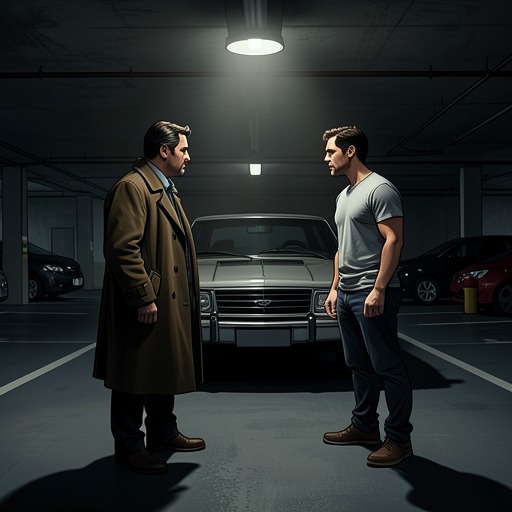
An engine starts as Ballard steps from the layby. A heavy black Lincoln Continental accelerates toward him from beneath the overpass, its white-walled tyres breaking through bottles and cigarette packs in the gutter before mounting the kerb. Ballard immediately understands that Vaughan will not stop and presses himself against the concrete wall. The Lincoln Continental swerves after him, strikes the rear wheel housing of the abandoned car, tears the open passenger door from its hinges, and slides sideways across the access road amid exploding dust and torn newspaper.
Vaughan does not lose control in a way that cancels his responsibility. His bloodied hands whirl at the steering wheel as the Lincoln Continental remounts the kerb on the opposite side, crushes a ten-yard section of wooden palisade, regains traction, and swings onto the motor road above. The car's path shows both violence and calculation: the first impact damages the abandoned vehicle, but Vaughan continues through the obstacle and escapes onto the motorway rather than stopping to help or confront Ballard directly.
Consequences and Aftermath
Ballard survives by flattening himself against the wall, but the attack leaves the abandoned car visibly transformed. Its passenger door has been crushed into the front fender, the metal welded together along the impact's arbitrary seams. Ballard compares those fused contours with Vaughan's scar tissue, recognizing in the wreck a mechanical counterpart to the injuries that have defined Vaughan's body and persona. He retches over acid mucus, a physical aftermath that joins the drug's residue to the violence of the attempted collision.
The event also clarifies Vaughan's relation to the narrator. During the drive, Vaughan appears to accept Ballard's authority, permits physical closeness, and shares a sexual encounter in which both men present their scars as signs of a common world. Once the acid wears off, however, Vaughan looks back while the Lincoln Continental crushes the palisade, calculating whether he can make a second pass. The possibility of repetition turns the attack from a single loss of control into a continuing threat and exposes the lethal underside of the intimacy they have just shared.
Narrative and Thematic Significance
The event reverses the usual direction of the book's collision imagery. Earlier injuries and wrecks are repeatedly treated as scenes in which bodies and automobiles generate new forms of desire; the account of Gabrielle's recovery presents her invalid car, auxiliary controls, braces, and altered body as a transformed erotic system. At the motor show, Vaughan guides Gabrielle through immaculate vehicles, while Ballard watches the damaged body and the machines confront one another. Ballard's later sexual encounter with Gabrielle similarly takes place among invalid controls, leg braces, straps, treadles, and the engineered contours of her car. These episodes establish the car as a prosthetic and erotic environment before the underpass attack turns that environment against Ballard.
The attack therefore exposes the limits of the narrator's erotic interpretation. Ballard has repeatedly understood scars, controls, deformities, and crashes as signs of an emerging sexuality, and his encounter with Vaughan carries that logic to an extreme in which wounds become the basis of physical union. Yet the same scarred body and the same car that permit tenderness also authorize aggression. Vaughan's bloodied hands are capable of guiding Ballard through a hallucinatory traffic field, touching him, and then steering the Lincoln Continental toward him. The event refuses to separate desire from the machinery of injury, but it does force the narrator to recognize that identification with Vaughan cannot guarantee mutuality.
As a scene, Vaughan's Attempted Run-Down of the Narrator produces a sharp value shift from apparent shared love and bodily recognition to abandonment, fear, and mortal danger. Its structure moves from the enclosed space of the passenger compartment, where Ballard relinquishes control and allows Vaughan's hand to rest on him, to the exposed access road, where Ballard must use the concrete wall as his only protection. The motorway remains the connecting medium throughout: first a visionary route populated by radiant vehicles, then a field of pursuit, and finally the elevated road onto which Vaughan escapes.
The event is also a concentrated expression of the book's recurring pattern of repetition and escalation. Vaughan has treated crashes as objects of study, photography, reenactment, and sexual fantasy; the underpass attack makes the collision personal by placing Ballard's body within the sequence. The narrator's earlier fascination with Vaughan's photographic archive and with injured bodies is answered by a scene in which he himself becomes the exposed subject of a moving vehicle. Surviving the attack does not resolve that fascination. It leaves Ballard beside a crushed car, looking at metal welded by impact and understanding that Vaughan's pursuit has crossed from shared fantasy into a direct, repeatable method of violence.