Vaughan's questionnaires
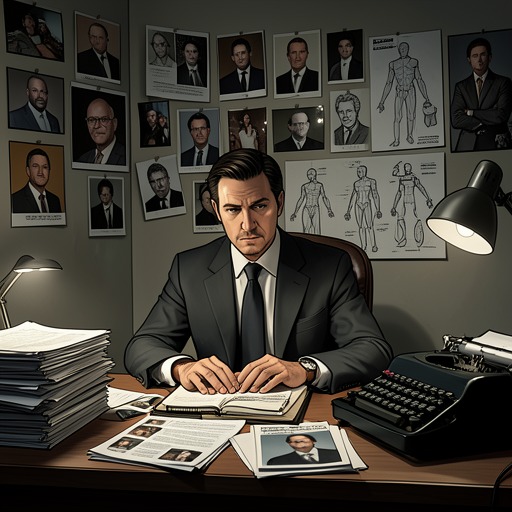
CrashVaughan's questionnaires are the documentary and imaginative core of Vaughan's attempt to systematize the automobile crash. They gather the responses of people connected to his technological, medical, media, and sexual milieu, then ask them to design hypothetical deaths for public figures. By joining celebrity images to meticulously specified wounds, the file transforms accidents into a controlled catalogue of impacts, exposing the way Vaughan's apparently scientific inquiry is also a machinery for erotic fantasy and violence.
Compilation and Scope
Vaughan presents the file to James Ballard while driving through London traffic, asking him to determine whether anything has been omitted. The completed forms represent a cross-section of Vaughan's world: two computer programmers from his former laboratory, a young dietitian, several airport stewardesses, a medical technician at Helen Remington's clinic, Seagrave and Vera Seagrave, a television producer, and Gabrielle. Their brief biographies establish a common condition: every respondent has at some point been involved in a minor or major automobile crash. The questionnaires therefore treat personal accident not as an exceptional biographical interruption but as a shared modern experience from which fantasies can be elicited.
The first imaginative task is broad and theatrical. Each subject receives a list of celebrities drawn from politics, entertainment, sport, crime, science, and the arts and is invited to devise a car crash in which one of them might die. The names seem to have been assembled from newspapers, magazines, television news, and documentaries, so the file absorbs the ordinary media circulation of public images. Its method is archival as well as psychological: recognizable faces become available surfaces on which respondents can project private scenarios of destruction.
The Injury Catalogue
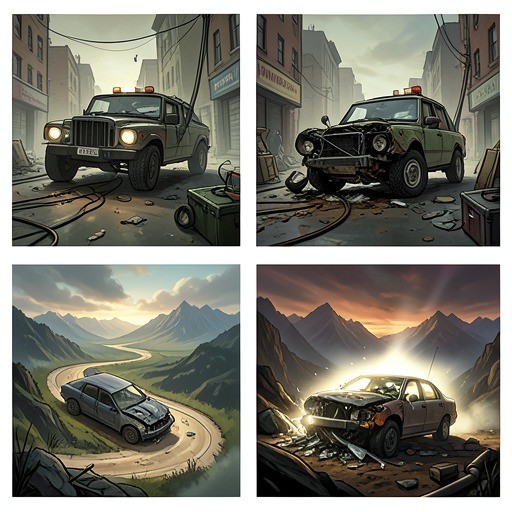
The violence imagined by the file is not left at the level of a general collision. Vaughan supplies an exhaustive range of possible mechanisms and bodily consequences: ejection from the passenger compartment, kneecap and hip-joint injuries, deformation in head-on and rear-end crashes, roll-over abrasions, amputations caused by roofs and door sills, facial injuries from dashboards and window trim, whiplash, burns from ruptured fuel tanks, steering-column impalements, seat-belt injuries, collisions between passengers, windshield ejections, and damage caused by mirrors, sun-visors, radiotelephones, cocktail cabinets, record players, latches, and manufacturers' medallions. The automobile appears in the file as an anatomy of hostile surfaces, each component capable of translating mechanical design into a precise wound.
Genital injuries receive the most sustained attention. The relevant photographs have been collected from forensic medical journals, plastic-surgery textbooks, internal medical monographs, and operating-theatre reports taken during Vaughan's visits to Ashford Hospital. The dossier thus borrows the authority of clinical documentation while redirecting it toward fantasy. Photographs of mutilated penises, sectioned vulvas, crushed testicles, deformed breasts, and damaged nipples are paired with the car parts that supposedly produced them: steering-wheel shrouds, handbrake units, windshields, door pillars, seat springs, dashboard medallions, and cassette-player toggles. Body and machine become matching fragments in a new currency of pain and desire.
The same procedure governs facial injury. A crushed nose is displayed beside a chromium model-year emblem; a sightless face is accompanied by the inset image of a rear-view mirror. These arrangements make the automobile's decorative and functional details resemble instruments of bodily inscription. The dossier does not merely record what a crash does. It teaches its users how to look at a body through the forms of the car, and how to imagine a wound as the completed union of human anatomy with industrial design.
Individual Responses and Vaughan's Design
The respondents' choices disclose different relationships to accident and fantasy. Vera Seagrave selects windshield ejection, roll-over, and head-on collision almost at random, as though the distinctions between them have little force. Gabrielle concentrates on facial injuries. Seagrave's answers are more focused and more disturbing: every hypothetical victim suffers severe genital wounds, and his chosen targets are five film actresses—Garbo, Jayne Mansfield, Elizabeth Taylor, Bardot, and Raquel Welch—rather than the politicians, sportsmen, scientists, and television figures available on the larger list. His selections turn the questionnaire into an imagined abattoir of sexual mutilation.
Vaughan's own annotations show the file becoming a working diagram rather than a neutral survey. Photographs of Jayne Mansfield, John Kennedy, Camus, and James Dean are marked in coloured crayon, with circles around necks, pubic areas, breasts, and cheekbones and section lines across mouths and abdomens. A photograph of the car in which Albert Camus died is reworked with labels such as the nasal bridge, soft palate, left zygomatic arch, glans penis, scrotal septum, urethral canal, and right testicle. The windshield opens onto the crushed bonnet and engine beneath a marked area identified with semen. Vaughan's handwritten question marks suggest a technician testing alternative death modes, accepting some as plausible and rejecting others as excessive; speculation is thereby given the appearance of an engineering calculation.
Elizabeth Taylor occupies the final position in the file. Her photograph shows her stepping from a chauffeured limousine outside a London hotel and smiling from the rear seat across her husband's shoulder. Vaughan's attention turns her public image into a set of measurable relations among leg stance, wound area, chromium door frames, and cocktail-cabinet lids. The celebrity is no longer simply a person represented by the media. She becomes the anticipated endpoint of a system that can mount the body in imagined postures and make the car the device for every possible conjunction of sex, death, and mutilation.
Relation to Vaughan's Other Records
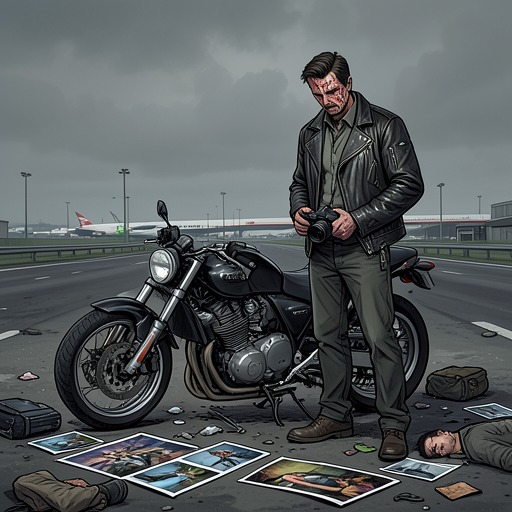
The questionnaires belong to a larger apparatus of accident documentation. Vaughan photographs crashed vehicles with a zoom lens, watches real collisions, and screens slow-motion films of test crashes at his apartment. He has also photographed James Ballard's arrival at Ashford Hospital and his recovery, following him through police, airport, parking, and domestic spaces. In that photographic album, Ballard matters less as an individual than as an anonymous body moving across polished car panels and vinyl seats. The questionnaires extend the same reduction into a different medium: where the camera fixes bodies and machines in images, the forms invite subjects to generate new crash images for themselves.
The dossier also shares the erotic charge of Vaughan's collision films. At the Road Research Laboratory, Vaughan watches a motorcycle and a car propelled toward impact while manipulating his penis beneath his clothing and ensuring that Ballard remains involved as a witness. The silent repetitions of test collisions first calm and then arouse Ballard, who begins to imagine himself at the controls of the impacting vehicles. The questionnaire file gives that repeated impact a verbal and graphic structure, allowing injury to be selected, compared, annotated, and recombined rather than merely observed.
When Ballard reads the completed forms, Vaughan eventually takes the file back and returns it to his briefcase. The gesture closes the archive at the moment when its implications have become visible. Outside, traffic is immobilized on the approaches to Western Avenue, and Ballard imagines the surrounding drivers in Vaughan's terms, as if they were already dead. The questionnaires have expanded from a private research project into a model of the whole traffic system: every ordinary driver is a potential subject, every vehicle a possible instrument, and every journey a rehearsal whose violent possibilities have already been classified.
Significance
Vaughan's questionnaires expose the unstable boundary between scientific inquiry and eroticized violence. Their vocabulary is medical, statistical, and technical, yet the material is arranged to produce fascination. Their authority comes from forensic reports, surgical textbooks, accident research, and personal interviews, but their ultimate purpose is to make wounds available to fantasy. The file therefore does not simply describe Vaughan's obsession; it demonstrates how modern forms of knowledge can organize desire by converting suffering into images, categories, and usable scenarios.
The dossier also makes the automobile crash reproducible. A real accident happens once, but the file can repeat its structures across celebrities, respondents, body parts, vehicle components, photographs, and annotations. In this sense, Vaughan's questionnaires turn trauma into a medium: they preserve it, circulate it, and invite further participation. Their most consequential effect is to make the crash seem less like an external catastrophe than like a hidden grammar of modern life, in which technology, celebrity, bodily injury, and sexuality are continually being joined and rehearsed.