A virus of murder
Curtain“A virus of murder” is Arthur Hastings’s metaphor for the sense that Styles’s violent past might somehow infect the present. Spoken after Hastings has confronted his own troubling impulses, the phrase links the house’s history to a wider question: whether repeated exposure to death and murderous intent can make violence feel like an atmosphere one might absorb, rather than a choice for which an individual remains responsible.
The phrase and its setting
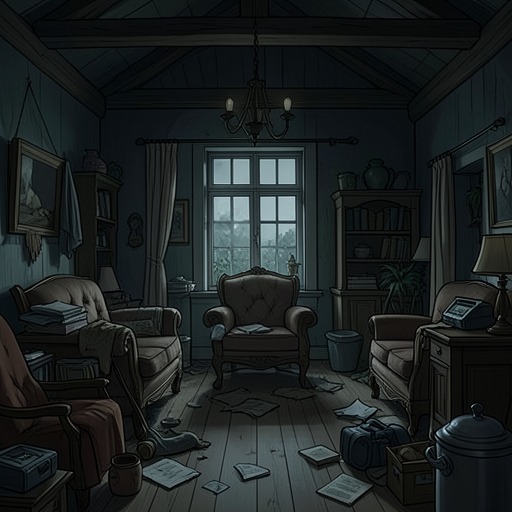
Hastings raises the idea while discussing his worries with Hercule Poirot. He has just felt relief that a plan of his did not succeed, and reflects that it is disturbing to discover how worked up a person can become. He wonders whether the old murder at Styles has left an “infection in the air,” then describes the house as having a bad history. The metaphor gives his fear a setting: violence seems to belong not only to particular acts, but to a place burdened by memories of them.
Poirot’s response
Poirot recasts the proposed infection as “A virus of murder” and calls it an interesting suggestion. His response acknowledges the force of Hastings’s thought without confirming a supernatural or contagious cause. He agrees that several people at Styles have deeply wanted someone else to die. In doing so, he grounds the metaphor in a history of human desire rather than an unseen agency: the house’s atmosphere comes from what its inhabitants have wanted and done.
The exchange also follows Hastings’s relief at having stopped short of an intended action. His question is therefore not an abstract theory about the house. It expresses anxiety that proximity to earlier violence, and the awareness of murderous impulses in the present, might unsettle a person’s judgment. Poirot’s immediate practical advice is to do nothing about Hastings’s concern regarding Judith Hastings and Major Allerton, keeping the discussion anchored in restraint rather than contagion.
Illness, suspicion, and judgment
The phrase’s implications sit beside the conflicting accounts of Barbara Franklin’s health. Nurse Craven suggests that Barbara could use her ill health to get her way, while also describing her as sleepless and exhausted. At the inquest, Dr John Franklin characterizes her condition as depression and rapidly changing moods, without organic disease; Nurse Craven says Barbara had repeatedly spoken of wanting to end her life and of feeling that she burdened her husband. These are witnesses’ accounts, not a single settled explanation of Barbara’s motives.
The coroner’s summing-up turns those accounts into a question of cause and intent. Barbara had died from physostigmine sulphate poisoning; the jury had to decide whether the poison was taken accidentally, deliberately, or administered by someone else. Poirot’s testimony that he had seen Barbara leave the laboratory with a small bottle, together with evidence about her despondency, helped frame suicide as a possibility. The jury ultimately found that she had taken her own life while temporarily of unsound mind. Read alongside Hastings’s metaphor, the inquest shows how an atmosphere of suspicion can gather around a death, while the verdict still depends on evidence and judgments about an individual’s state of mind.
Meaning and limits of the metaphor
The “virus” image makes Styles’s violent history feel capable of returning, but the exchange does not establish that murder literally spreads from one person to another. Poirot’s formulation is immediately tied to people who desired another’s death, while Hastings’s fear arises from his own recent experience of nearly acting on a destructive impulse. The phrase thus captures the pressure of recurrence without removing personal agency: the past may haunt the present, but the story identifies human choices, illness, and interpretation as the forces through which violence becomes consequential.