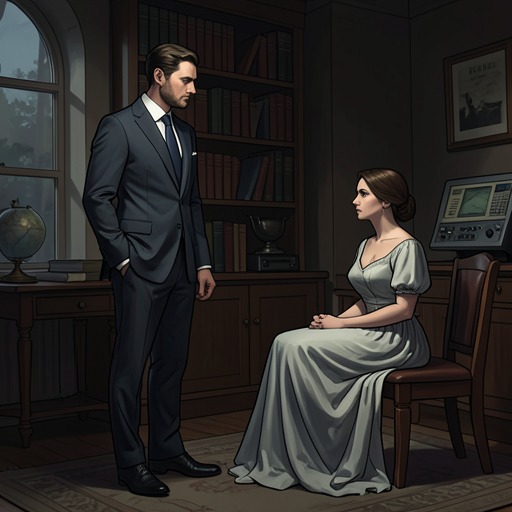
“I do not approve of murder”
Curtain“I do not approve of murder” is the principle against which Hercule Poirot measures his final and most difficult decision: to kill Stephen Norton because he believes Norton cannot be stopped by law or by any other means. The phrase is not presented as a simple rule that resolves the case. It becomes the measure of a conflict Poirot leaves deliberately unsettled, between his duty to protect innocent people and his conviction that a person should not take the law into his own hands.
The principle in practice
The phrase appears first in the moral context of Arthur Hastings’s suggestion that Stephen Norton’s troubling information be brought to Poirot. Hastings is curious about what Norton has seen but recognizes that it was acquired in a way the outside world would regard as dubious. Rather than decide alone what to do with it, Hastings proposes consulting Poirot. The suggestion anticipates the later contrast between seeking the detective’s judgment and the action Poirot ultimately takes himself.
When Poirot explains his presence at Styles, he reveals that his earlier warnings about a crime were not always references to the same crime. He had been certain that a crime would occur because he knew he would commit it. He describes the contradiction directly: the man who values human life and disapproves of murder has ended his career by committing murder. His self-questioning includes the possibility that his own confidence in his rectitude helped bring him to this dilemma.
The exception Poirot claims
Poirot argues that Stephen Norton was beyond the reach of the law. He says that Norton was safe from any means of defeat he could devise, while his work in life was to save the innocent and prevent murder. In that reasoning, killing Norton is not a rejection of the danger he presents but the only available way Poirot believes he can prevent further harm. The principle survives as a moral standard, but Poirot acts against it because he sees no other effective course.
His hesitation is part of the conflict. Poirot says he could see what had to be done but could not bring himself to do it; like Hamlet, he kept putting off the evil day. The attempted attack on Mrs Luttrell becomes the next attempt that makes delay untenable. Poirot’s account thus sets his action against a period of reluctance, rather than presenting it as a decision he reached easily or without moral cost.
Law, responsibility, and unresolved judgment
After explaining what he has done, Poirot refuses to settle the question of justification. He does not believe a person should take the law into their own hands, yet counters that, in this case, he is the law. He recalls that, as a young man in the Belgian police force, he shot a desperate criminal who was endangering people from a roof, and invokes the proclamation of martial law in an emergency. These comparisons frame his claim of exceptional authority, but they do not erase his uncertainty about whether the killing was right.
Poirot says that taking Norton’s life saved other, innocent lives, then returns to the fact that he still does not know whether his act was justified. His closing uncertainty gives the phrase its final force: it remains a conviction, not an answer capable of absolving him. The case ends with Poirot acknowledging both the consequences he believes he achieved and the moral question he cannot confidently resolve.