The beyond-reasonable-doubt standard
CurtainThe beyond-reasonable-doubt standard is the evidentiary threshold that turns uncertainty into a verdict without claiming certainty about what actually happened. In the novel, it governs both a criminal trial and a coroner’s inquest: it protects Mrs Etherington from conviction on circumstantial evidence, while testimony arranged around Barbara Franklin’s melancholy helps make suicide appear to be the most plausible explanation of her death.
The Etherington Trial
Leonard Etherington died after what was first thought to be food poisoning, but an autopsy established arsenical poisoning. His wife, Mrs Etherington, was arrested and charged with murder. The household contained weed killer, although it had been ordered long before the death; investigators had no other likely suspect, and an accident seemed highly improbable. The case against her was therefore compelling in its accumulation of circumstances, but it did not amount to direct proof.
The jury’s assessment was complicated by the account of the marriage. Leonard had unpleasant habits, took drugs and drank, and was described as peculiar and sadistic; his young wife had been desperately unhappy and badly treated. She had also formed a close, sympathetic friendship with a man returning to India, though there was no suggestion that the relationship had become an actual affair. He later became engaged to someone he had met on the voyage, and uncertainty remained over whether Mrs Etherington received the letter telling her this before or after her husband’s death. She said she had received it beforehand.
At trial, the judge’s summing-up emphasized that a guilty verdict required proof beyond any reasonable doubt. Sympathy for Mrs Etherington, arising from her husband’s character and treatment of her, formed part of the trial’s atmosphere, but the decisive legal issue remained the insufficiency of the circumstantial case to eliminate reasonable doubt. The jury acquitted her. The verdict established that guilt had not been proved to the required standard; it did not settle the question in the public mind.
The Franklin Inquest
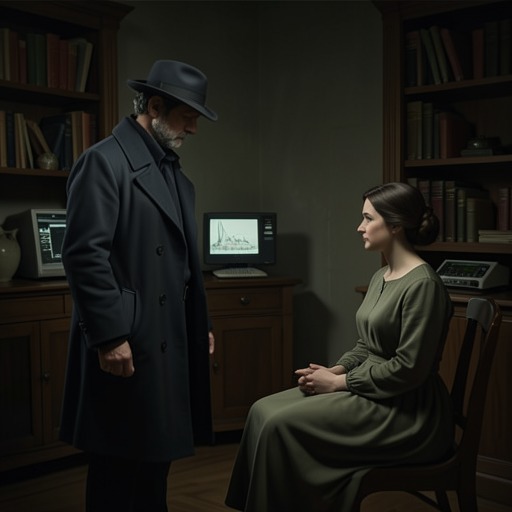
The same evidentiary problem returns after Barbara Franklin’s death. At the inquest, Hercule Poirot testified that on the morning of June 10 he had been sitting outside the laboratory and had seen Barbara come out with a small bottle in her hand. She looked startled when she saw him. His account supplied the jury with an apparently direct observation linking her to the poison, but its meaning depended on how the observation was interpreted.
The coroner also heard that Barbara had been in poor health and a bad nervous condition, with episodes of deep melancholy and a wish not to wake again. The medical evidence identified the cause of death as physostigmine sulphate poisoning. The jury had to decide whether she had taken the poison accidentally, deliberately, or because someone else had administered it. The original bottle had not been found; Nurse Craven had suggested that Barbara might have washed it and put it away in the bathroom cupboard, perhaps after taking it from there.
The coroner’s summing-up connected Poirot’s testimony and Barbara’s state of mind to the possibility of suicide. It also noted that her belief that she was obstructing her husband’s career seemed to be her own idea: Dr John Franklin appeared kind and affectionate and had never complained that her delicacy hindered him. With no evidence establishing when or by what means she had taken the poison, the jury nevertheless reached a verdict after a short delay. The scene shows how a plausible account can emerge from testimony and context even when significant details remain unproved.
Evidence, Interpretation, and the Reader
Across both proceedings, the standard separates a supported conclusion from an assertion of certainty. Mrs Etherington’s acquittal follows from the judge’s warning that suspicion, an unlikely accident, and the absence of another suspect did not remove reasonable doubt. In Barbara’s case, the inquest weighs a witness’s observation alongside medical evidence and signs of melancholy, while leaving the bottle’s whereabouts and the precise circumstances of ingestion unresolved.
The novel extends this concern beyond formal hearings. Arthur Hastings remembers seeing Stephen Norton raise his glasses toward a woodpecker on a grassy knoll and recalls Norton’s distress when Hastings tried to look through them. At the time, Hastings assumed Norton had seen something involving Judith Hastings and Major Allerton, because he was preoccupied with them. The memory later acquires a different significance: an observation can be genuine while the observer’s explanation of it is mistaken.
The locked-room appearance after Norton’s death makes the same distinction between facts and inference. Hastings tells Poirot that Norton’s door was locked, the windows shuttered, the key in Norton’s pocket, and that he had seen Norton enter and heard the door lock. Poirot’s later account identifies a concealed alternative: he had obtained duplicate keys after changing rooms, and could therefore have entered and left while leaving the room apparently locked from within. He also explains that he had used raised heels to seem taller and had worn a wig; the evidence of his limp, which was more pronounced than Norton’s, was another clue Hastings could have noticed. The apparently conclusive arrangement was not conclusive at all.
By placing a legal threshold beside these acts of observation and misinterpretation, the novel makes evidentiary judgment a recurring problem rather than a courtroom formality. A verdict can be responsible without resolving every suspicion, while a confident witness or an apparently sealed scene can still invite a false conclusion. The standard’s importance lies in that restraint: it requires judgment to stop where proof stops, even when uncertainty remains.