
Death of a Salesman
Death of a Salesman is a 1949 two-act tragedy by American playwright Arthur Miller, premiering on February 10, 1949, at the Morosco Theatre on Broadway. The play ran for 742 performances and won the Pulitzer Prize for Drama, the Tony Award for Best Play, and the New York Drama Critics' Circle Award—the first play ever to sweep all three major American theater awards. The story follows Willy Loman, a 63-year-old traveling salesman who returns home early to Brooklyn after failing to make any sales. For 36 years he has worked for the same company, but now he has lost his salary and works only on commission. His wife Linda tries to protect his fragile pride, but his two sons, Biff and Happy, have not fulfilled the promise he once saw in them. Biff, who has spent years working on farms out West, has come home to find direction, while Happy works as an assistant buyer in a department store but remains emotionally adrift. Through a series of memory flashbacks, Willy relives pivotal moments: the boys' adolescent admiration for him, his affair with a woman in Boston, the advice of his wealthy brother Ben, and the contrast with his neighbor Charley and Charley's son Bernard, who have achieved conventional success. The past and present blur, revealing Willy's deep self-deception and the gradual collapse of his identity. Desperate to leave a legacy, he decides to commit suicide by crashing his car, hoping the insurance money will provide for his family. But at his funeral, only his family and Charley attend; his sales colleagues and friends are absent.
At its core, Death of a Salesman is a devastating critique of the American Dream. Miller exposes the emptiness of a culture that equates personal worth with material success and social popularity. Willy Loman embodies the tragic gap between aspiration and reality: he believes that being 'well-liked' guarantees prosperity, yet he is discarded by the very system he served. The play also explores themes of familial obligation, betrayal, the burden of parental expectations, and the psychological toll of living in a society that demands constant self-promotion. Miller was inspired by the Great Depression, which ruined his father's garment business and forced the family into poverty. He also drew on the character of his uncle Manny Newman, a salesman who maintained an optimistic facade despite repeated failures. The play's innovative structure—a fluid blend of present action and memory, supported by expressionistic set designs (such as transparent walls and shifting lighting)—was groundbreaking for American theater.
Since its premiere, Death of a Salesman has become a staple of world drama. It has been revived on Broadway four times, each winning Tony Awards for Best Revival. The 1985 film adaptation starring Dustin Hoffman reached a wide audience, and Miller himself directed a Chinese-language production in Beijing in 1983, symbolizing the play's universal resonance. Scholars continue to analyze its commentary on capitalism, masculinity, and identity. The play's enduring power lies in its ability to confront audiences with uncomfortable truths about the cost of chasing a dream—and the human need for dignity and recognition. Willy Loman remains one of the most iconic, tragic figures in modern literature, a testament to Miller's belief that theater should be 'the most serious art form' for examining society's deepest contradictions.
The play has been the subject of extensive critical analysis since its premiere. John D. Hurell's 1961 collection Two Modern American Tragedies compiled early reviews and scholarly essays that debated the work's status as a modern tragedy, a discussion that continues to inform its reception. Scott A. Sandage's Born Losers: A History of Failure in America later situated Willy Loman within a broader cultural history of failure in the United States, examining how the character embodies anxieties about economic and personal inadequacy. A widely used scholarly edition, published by Penguin Books in 1996 and edited by Gerald Weales, includes the full text along with a selection of critical essays that trace the play's evolving interpretation across decades.
About the Author
Arthur Asher Miller (October 17, 1915 – February 10, 2005) was an American playwright, essayist, and social commentator, widely regarded as one of the greatest dramatists of the 20th century. He was born in Harlem, New York City, to Polish-Jewish immigrant parents. His father, Isidore Miller, owned a successful women's clothing factory employing 400 people, and the family lived in a Manhattan apartment overlooking Central Park. The Great Depression shattered their prosperity: the factory failed, and the Millers moved to a small house in Brooklyn. To support the family, young Arthur woke before dawn each day to deliver bread. This experience of sudden poverty and social insecurity shaped his lifelong empathy for ordinary people struggling against invisible forces. After graduating from high school, he worked in a warehouse to save money for college. He attended the University of Michigan, where he studied journalism and English, earning a B.A. in 1938. During college he began writing plays, and his first produced work, The Man Who Had All the Luck (1944), closed after only four performances. Discouraged but determined, Miller persisted.
His breakthrough came with All My Sons (1947), a drama about a manufacturer who sells faulty airplane parts, winning the New York Drama Critics' Circle Award and establishing Miller as a major voice. Death of a Salesman (1949) followed, securing the Pulitzer Prize, Tony Award, and Critics' Circle Award, and making him a household name. In 1953, during the anti-communist witch hunts led by Senator Joseph McCarthy, Miller wrote The Crucible, using the Salem witch trials as an allegory for political persecution. The play won a Tony Award and remains a staple of American theater. Other notable works include A View from the Bridge (1955), After the Fall (1964)—a semi-autobiographical play about his marriage to Marilyn Monroe—and The American Clock (1980). Miller married Mary Slattery in 1940; they had two children before divorcing in 1956. That same year he married Marilyn Monroe, a union that lasted five years and exposed him to intense media scrutiny. In 1962 he married photographer Inge Morath, with whom he had two children, including filmmaker Rebecca Miller. Miller's political activism was constant: in 1956 he was convicted of contempt of Congress for refusing to name suspected communists, but the conviction was overturned on appeal. He also served as a delegate to the 1968 Democratic National Convention.
Throughout his career, Miller received numerous honors, including the Pulitzer Prize, multiple Tony Awards, an Olivier Award, the Kennedy Center Honors, and the National Book Award. He continued writing into his late eighties, completing his final play, Finishing the Picture, in 2002. He died of heart failure at his home in Roxbury, Connecticut, on February 10, 2005, exactly 56 years after the premiere of Death of a Salesman. Miller's legacy endures through his plays, which are performed worldwide, and through his unwavering belief that theater must confront the most pressing social and moral questions of its time. His work continues to be studied, performed, and debated, cementing his place alongside Eugene O'Neill and Tennessee Williams as a pillar of American drama.
StoryFlow
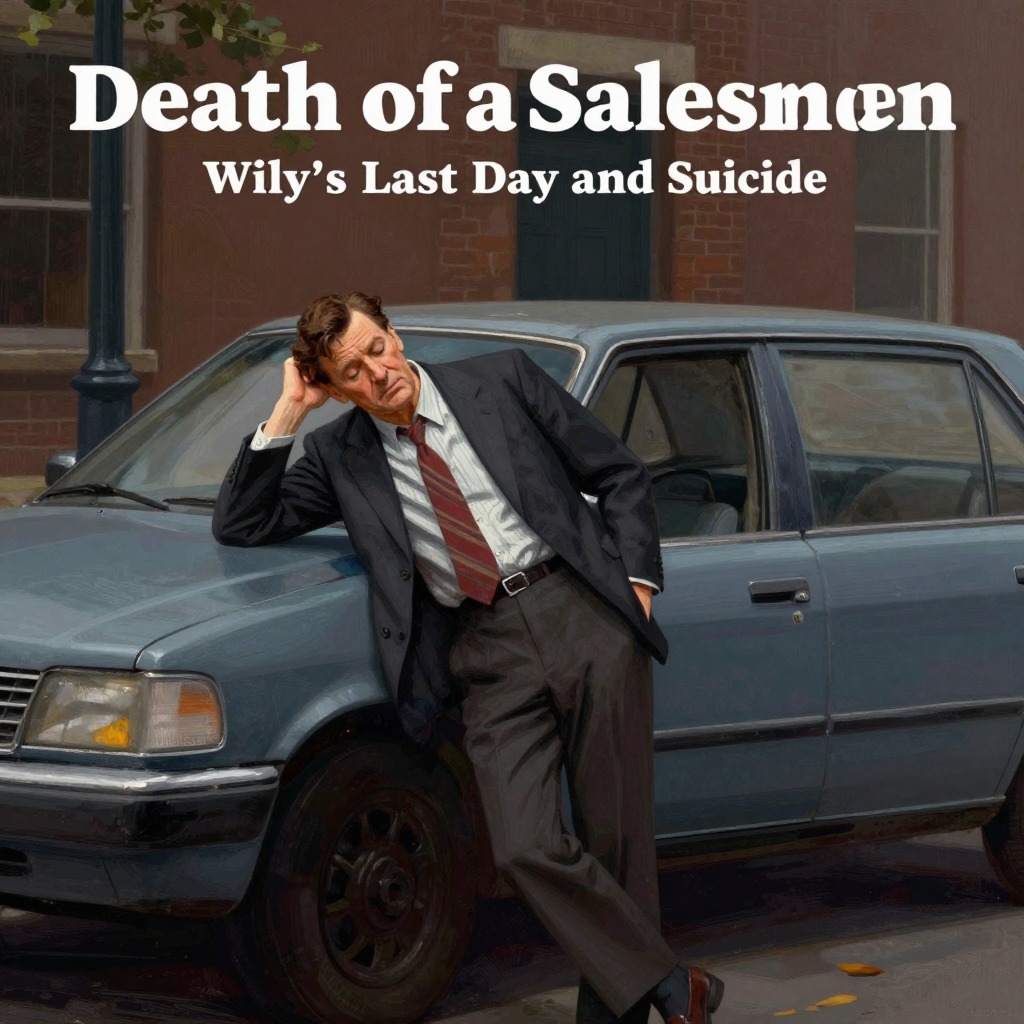
Willy's Last Day and Suicide
Traces Willy Loman's final twenty-four hours from his exhausted return home to his fatal car crash, driven by despair and a misguided belief in the insurance payout.
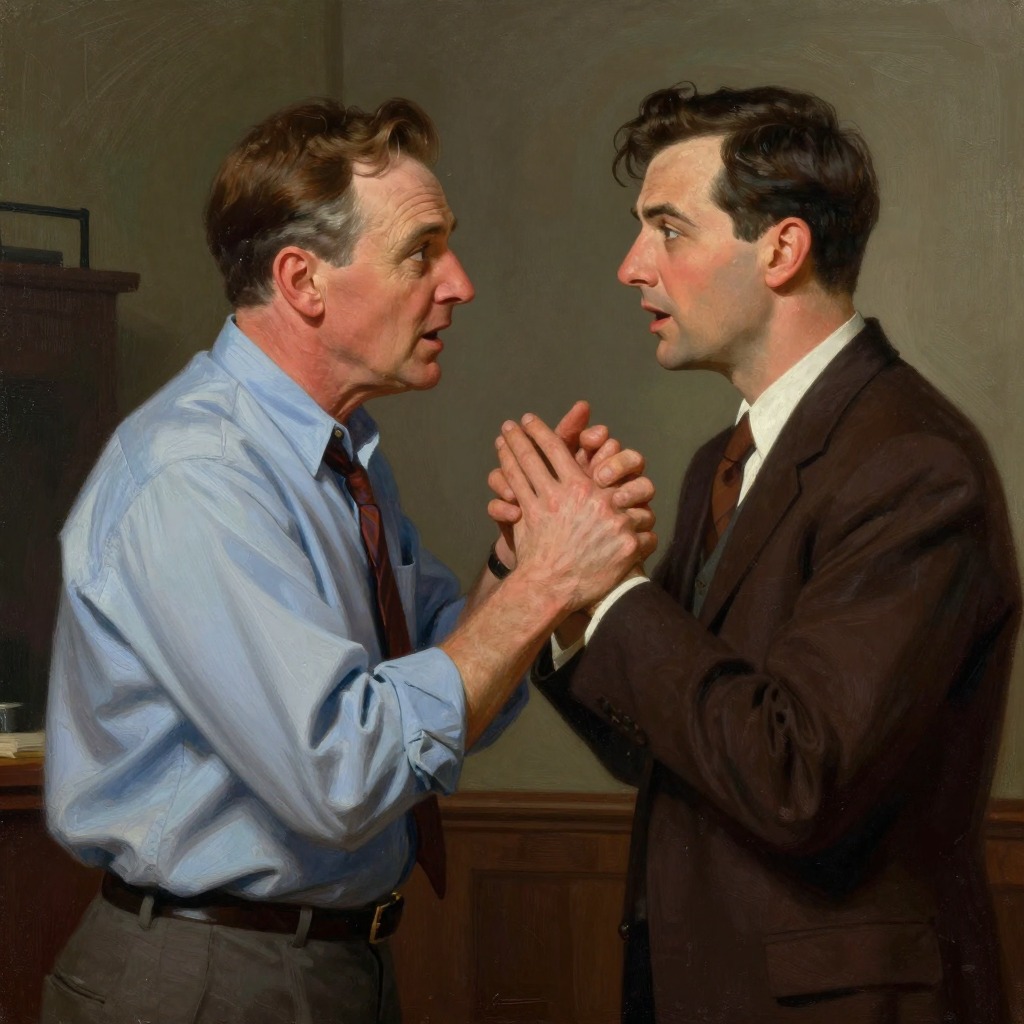
The Confrontation Between Biff and Willy
Chronicles the explosive father-son conflict that spans fifteen years, from Biff's discovery of Willy's affair to their final, cathartic argument.
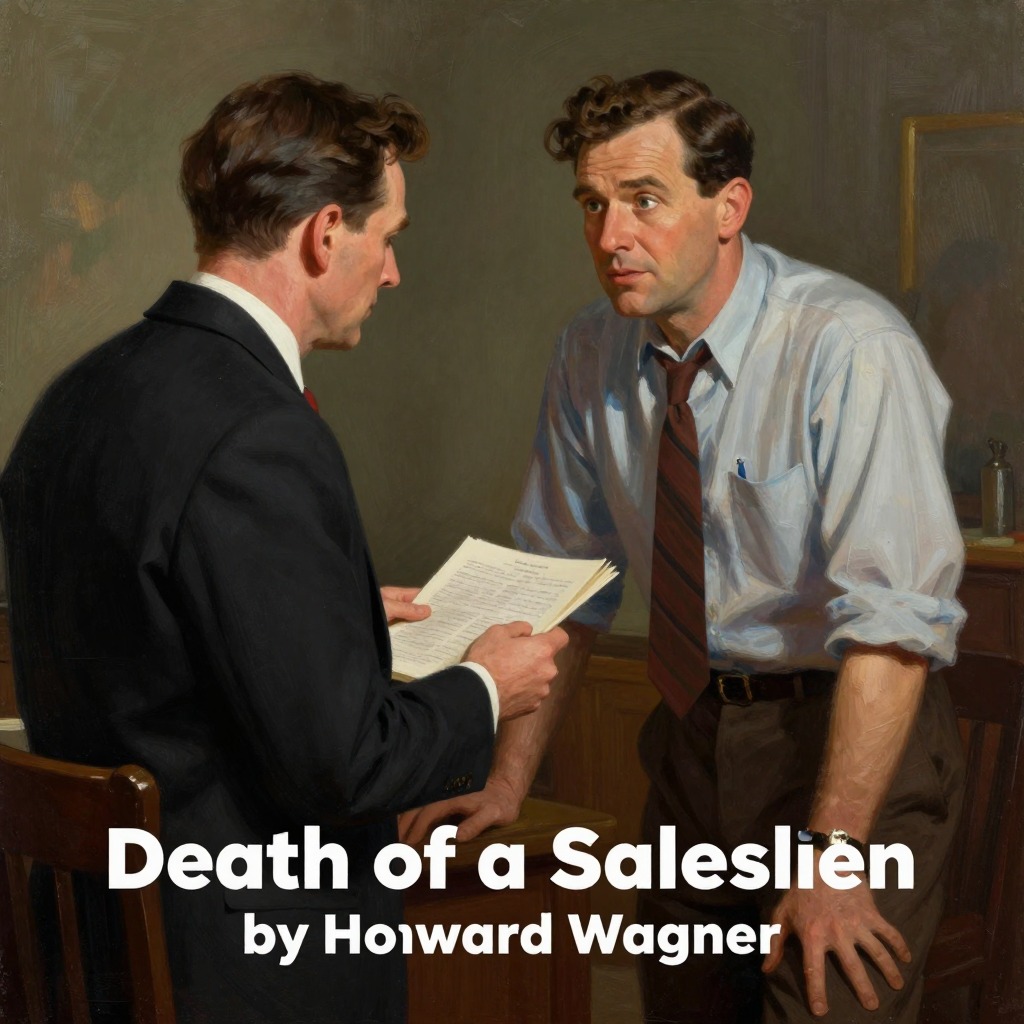
Willy's Firing by Howard Wagner
The pivotal scene where Willy Loman is fired from the Wagner Company after thirty-six years, marking the collapse of his professional identity.
