Ivan
DeceptionIvan is presented as a refugee from Prague whose account of his wife Olina’s departure turns marital betrayal into a contest over trust, sex, and storytelling. He describes her relationship with Andrew in furious, racially charged terms, then accuses Nathan of having slept with Olina and of exploiting her as material. But Nathan later distinguishes the accusation in his notebook from what Ivan actually told him. Ivan’s forceful testimony therefore reveals both the damage he attributes to the affair and the instability of the story through which that damage reaches the reader.
Identity and Background
Ivan is connected to Prague through his arrival from there and through Nathan’s later description of him as a refugee friend. His account also locates him in a life divided between countries: he contrasts his Czech identity with his experience in America, and imagines Olina returning to Prague if her new relationship fails. He predicts that authorities there would suspect her of being a spy, making the prospect of return feel not like a simple homecoming but like a new political danger. These statements are Ivan’s expectations and fears, not independently confirmed outcomes.
His sense of identity shapes the way he explains the marriage’s collapse. He says he trusted Olina as a Czech girl, then contrasts that trust with his contemptuous view of her as an American woman. The opposition exposes how quickly his account turns cultural belonging into a measure of loyalty: Olina’s departure is not only a private rejection but, in his telling, a betrayal of the person and identity he believed he knew. His self-description as a Jew and an American in England similarly presents identity as a source of contention, though the narrative gives no independent account of how he understands those affiliations beyond his own words.
Olina, Andrew, and the Marital Rupture
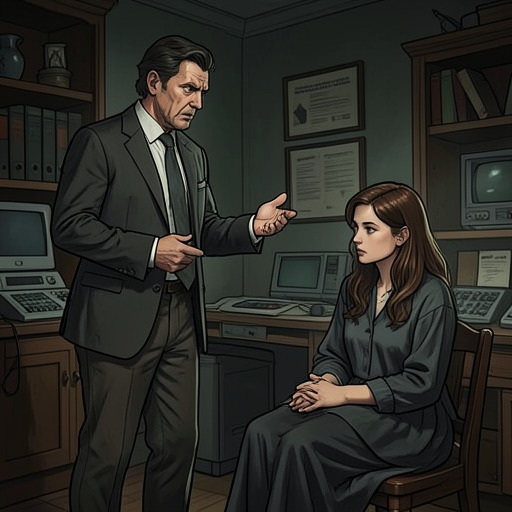
Ivan’s account gives the breakup a sequence of domestic reversals. Nathan returns to find that Olina has a friend, Andrew, staying in the spare room. Ivan objects to the arrangement and proposes that Andrew find a cheap motel, but agrees to include him at dinner. At the theater, Ivan notices Olina leaning toward Andrew and pulls her back toward himself. On the way home, he switches to Czech to tell her that Andrew must leave; Olina objects that speaking Czech in front of Andrew is impolite. Ivan then tells Andrew directly to leave the next day.
The confrontation produces a blunt reversal: Andrew tells Ivan that he has pushed too hard, and Olina says she loves Andrew and wants to marry him. Ivan reports that Andrew had been living with Olina in a motel about thirty miles from the city center, in a single room with a shower, and that Andrew had no regular work and relied on her unemployment benefits. He also says Olina had been fired after her productivity fell while her coworkers became caught up in the drama of her life. These particulars make the separation materially precarious as well as emotionally humiliating, although they remain details supplied through Ivan’s aggrieved account.
Ivan dwells on sexual comparison as a way of measuring his loss. He characterizes Olina as sexually inhibited in their marriage and contrasts that history with her pleasure with Andrew. His language is explicitly racist and reduces Andrew to his race and sexual body, while also dismissing him as uneducated and unsuccessful. Ivan lists Andrew’s expensive Hasselblad camera and truck alongside odd jobs and an alleged lack of money, using those details to portray him as both socially inferior and a threat. The contradiction is revealing: Ivan disparages Andrew, yet describes him as having won the intimacy Ivan says he could not achieve with his wife.
Injury, Anger, and Prediction
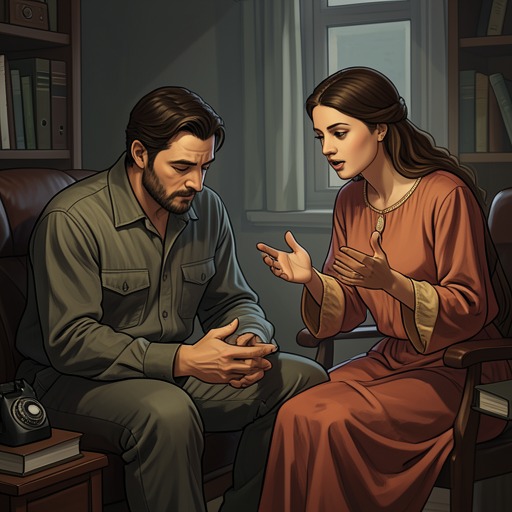
Ivan presents the affair’s consequences as physical and emotional crisis. He says the discovery brought him close to buying a shotgun and imagining shooting Andrew, though he does not say that he did so. He also reports severe chest pains, a mild heart attack, and a week in the hospital. The lawyer’s question about whether Ivan and Olina had a joint account further exposes the practical vulnerability beneath his emotional account: Ivan says he trusted her, and the marriage’s end raises questions about their shared finances.
His predictions about what will happen to Olina extend the quarrel beyond the immediate breakup. He expects Andrew eventually to leave her, believes she will have nowhere to go, and imagines her returning to Prague under suspicion from the authorities. The narrative does not verify these forecasts. They show Ivan trying to make sense of the rupture by projecting its consequences forward, even as his certainty is entangled with jealousy, resentment, and racial hostility.
Nathan and the Disputed Story
Ivan’s anger eventually turns toward Nathan. He accuses him of having slept with Olina four times in New York, when the men were supposedly close after Ivan arrived from Prague. Nathan denies having slept with her, and Ivan insists that Olina told him otherwise. He also claims that Olina found Nathan’s persistent questions irritating and emotionally unconventional. From Ivan’s perspective, Nathan’s method of intimacy is itself suspect: where other men listen in order to seduce, Nathan listens in order to draw out a woman’s story.
Ivan makes that distinction an accusation against Nathan as both friend and novelist. He argues that Nathan cannot resist a narrative, even when it comes from the wife of a refugee friend, and that this appetite compromises him in both roles. The charge connects the marital story to the book’s larger concern with the boundary between lived experience and literary invention: attention to another person’s account may be a form of intimacy, but it may also become a way of taking possession of it.
Nathan later clarifies that he and Ivan did have lunch after Olina left with Andrew, and that Ivan told him about what had happened. Nathan says Ivan did not accuse him of betraying their friendship with Olina; that accusation appeared in the notebook Nathan’s wife read. He explains that he made himself implicated in the notebook because simply being present did not create enough dramatic heat, and that compromising himself made the indictment more compelling. Ivan’s accusation thus cannot be read as a straightforward record of the lunch. It is part of a dispute about what Nathan invents, what he remembers, and what he is entitled to turn into fiction.