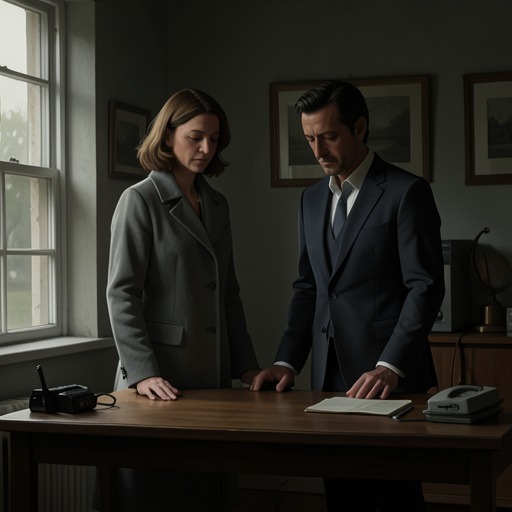
Rong Jinzhen and Di Li’s marriage
DecodedRong Jinzhen and Di Li’s marriage begins with a notebook handed over for inspection and culminates in a direct request: Di Li asks Rong Jinzhen to let her be his wife, he agrees, and they marry three days later. The account makes this apparently simple sequence difficult to fully know. The notebook preserves signs of their growing intimacy, but some of its most personal passages have been removed, leaving the narrator to reconstruct a relationship whose central words remain partly private.
The Notebook and What It Withheld
On the afternoon of the third day after his discharge from the hospital, Rong Jinzhen went to Di Li’s office to hand in his notebook. Di Li was a security guard, and inspecting notebooks as they were submitted was part of her duty: she had to check whether pages were missing or additional pages had been inserted. Rong Jinzhen told her that the notebook contained no work-related secrets, only personal ones, and invited her to read it and reply. The handover thus joined a routine security procedure to an unusually personal appeal. He placed a record of his private self before the person responsible for examining it.
The notebook itself is jumbled and sometimes obscure, but the narrator can trace the growth of Rong Jinzhen’s love for Di Li, especially in its later sections. Di Li had removed passages, which the narrator believes were likely intimate and emotional, perhaps even more difficult to decipher than the rest. He does not condemn her for taking them out; their relationship was hers as well as Rong Jinzhen’s. But their absence limits what an outsider can understand. When the narrator pressed her on whether Rong Jinzhen had plainly expressed his love, she hesitated before identifying words drawn from the final verse of the fourth song in the Song of Solomon. The passage’s garden imagery gives the notebook a language of invitation and intimacy, but it does not settle what the couple said to one another beyond the surviving text.
For the narrator, the missing passages make the notebook resemble a cipher: it contains traces of a relationship while withholding the key to its most private exchanges. He can understand Rong Jinzhen as a genius and formidable cryptanalyst, yet admits that his knowledge of Rong Jinzhen’s love and emotional life is incomplete. He speculates that someone may have wanted to keep this side of Rong Jinzhen from outsiders, or that Rong Jinzhen himself may have removed the passages. The account does not establish who took them out. That uncertainty is part of the event’s record, not a gap the narrator can confidently close.
Di Li’s Reading and Proposal
Di Li told the narrator that she read the notebook until the sun had gone down, then had to walk back to her dormitory in the dark. Her building was number thirty-eight, a three-storey red-brick structure; Rong Jinzhen lived in the specialists’ building, a two-storey building made of bluish-green brick. The two buildings stood in different directions. These precise details give the account a physical geography, but the decisive encounter occurs at Di Li’s building, after she has finished reading.
Rong Jinzhen was there, sitting and looking at her. He did not speak or ask her to sit with him. Di Li stood before him and said she had finished reading the notebook. He asked her to speak and said he would listen. She then asked him to let her be his wife. His answer was yes. Three days later they were married. The account supplies no elaborate proposal, negotiation, or description of a ceremony; its turning point is the exchange itself. The notebook has made private feeling legible enough for Di Li to act, while Rong Jinzhen’s brief assent changes the relation between them.
Di Li’s Recollection
The narrator finds the sequence almost impossibly easy, like an event from legend. That response marks the contrast between the compactness of the remembered scene and the obscurity surrounding the relationship that led to it. Di Li’s account identifies the concrete steps—reading, walking back in the dark, finding Rong Jinzhen waiting, speaking, asking, receiving his assent—but does not explain everything she felt as those steps unfolded.
When she recounted the marriage, she showed no apparent sadness or happiness, surprise or wonder. The narrator found her manner dreamlike and could not determine how she had felt then or how she felt while telling the story. Asked directly whether she loved Rong Jinzhen, Di Li answered, “I love him as I love my country.” The answer gives the narrator a statement of love, but not access to the private emotional history he has been trying to recover from the notebook. Her brief response stands beside the missing passages: explicit in its declaration, yet not an explanation of the couple’s intimate life.
Narrative Significance
The marriage is presented through several layers of mediation. The narrator reports what Di Li told him; Di Li’s remembered scene includes Rong Jinzhen’s request that she speak and his promise to listen; and the notebook offers another, incomplete record of their relationship. Each layer gives information while setting limits on what can be known. The narrator can describe the buildings, the duty of inspection, the dark walk, and the three-day interval before the wedding, but he cannot recover the passages Di Li removed or confidently interpret her feelings.
That tension makes the notebook more than an object exchanged before the marriage. It is both Rong Jinzhen’s invitation to Di Li and an archive whose missing pages protect the relationship from full public disclosure. The marriage becomes legible through a small number of surviving actions and words: the personal notebook, Di Li’s request, Rong Jinzhen’s assent, and her later declaration of love. Its apparent simplicity is therefore also a boundary. The narrator can tell how they married, while acknowledging that the inward story of their marriage remains partly encrypted.