Rong Xiaolai Donates the Family’s Last Commercial Property to the People’s Government
DecodedRong Xiaolai’s donation of the Rong family’s last commercial property to the People’s Government of C City was both a public act of support for the new government and a consequential surrender of the family’s final business asset. Although Jan Liseiwicz suspected that Rong Xiaolai was using financial hardship as an excuse to resist his plans for Rong Jinzhen, the family’s impoverishment was real: the gift came after land seizures and years of depletion, and left Rong Xiaolai unable to help fund Rong Jinzhen’s proposed studies abroad.
Background and Circumstances
A few months before the donation, the remnants of the Rong family’s property in Tongzhen had been seized during land reform. The family’s remaining possessions there were only a few dilapidated buildings in the old mansion. One commercial property still remained in the provincial capital, but the family’s resources had been steadily exhausted: inherited assets had been given away, spent, ruined, or divided until none remained.
Rong Xiaolai’s own savings had also been spent trying to save his daughter’s life. His salary had not kept pace with the rising cost of living, and he had lost every other possible source of income. By the time Rong Jinzhen hoped to study abroad, the family had no financial reserve from which to assist him.
The Public Gift
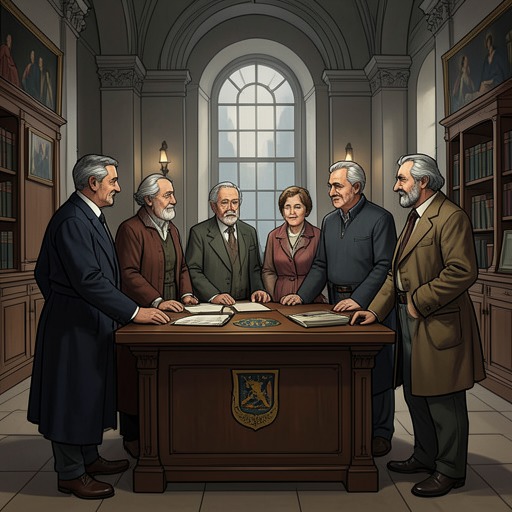
At a welcome ceremony for the new mayor, Rong Xiaolai presented the provincial-capital property to the People’s Government of C City. As a member of a prominent patriotic family, he made the gift as a demonstration of support for the newly established People’s Republic of China. The timing and public setting might have suggested that he was courting political favor, but the recipients themselves had chosen the occasion. They intended the example to encourage other wealthy and socially prominent families to support the new government.
The donation was therefore both personal commitment and public example. Rong Xiaolai accepted the recipients’ reasoning and gave up the family’s last commercial property, while the narrator presents the act as consistent with the Rong family’s patriotism rather than as opportunism. His support was connected not only to his understanding of the larger political situation but also to his experience of unfair treatment under the KMT government.
Consequences for Rong Jinzhen
Rong Xiaolai supported Rong Jinzhen’s wish to study abroad wholeheartedly, but after the loss of the property he had no means to help. This practical limit shaped the family’s response to Rong Jinzhen’s academic prospects: goodwill remained, but the resources needed to turn those prospects into travel and study were gone.
Jan Liseiwicz had left disappointed after doubting Rong Xiaolai’s account of the family’s finances. A couple of months later, a letter from Dr Gábor Szegő at Stanford University accepted Rong Jinzhen as a scholarship student and included a money order of $110 for travel expenses. Jan Liseiwicz had secured the offer by lobbying with a 3,000-word letter. When he brought the news to Rong Xiaolai, he saw how happy the older man was. The later scholarship made clear that Rong Xiaolai’s inability to pay had not been a pretext: he had supported the plan, but the donation and the family’s wider losses had left him unable to finance it himself.
Significance
The gift joins political conviction to material sacrifice. Its public visibility served the new government’s effort to win support from prominent families, while its private consequence was the loss of the Rong family’s final commercial asset. The event also clarifies the difference between opposition to Rong Jinzhen’s ambitions and an inability to provide for them: Rong Xiaolai did not withhold his support; poverty made it impossible to act on it.