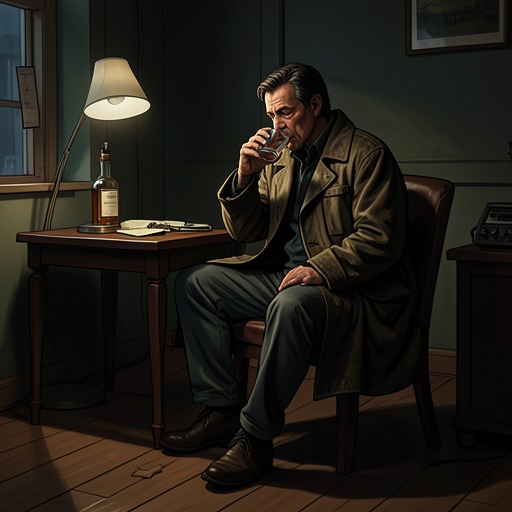
Alcohol and Self-Destruction
DevdasAlcohol and Self-Destruction is the pattern through which Devdas’s grief becomes a lived, repeated practice rather than a passing response to heartbreak. Drinking follows his failure to marry Parvati, accompanies his dependence on Chandramukhi’s room, and helps carry him toward destitution and declining health. It is at once a declared refuge, a way of remaining where he has nowhere else to go, and the principal sustained activity in a life otherwise marked by hesitation and withdrawal.
From Rejection to Repetition
Devdas’s drinking begins after he rejects Parvati and then recognizes, too late, that he loves her. By the time he returns to seek marriage, her marriage has been fixed elsewhere and she refuses him. The narrative makes his self-destruction follow not from an inability to feel, but from his failure to act when action might have changed their lives. Alcohol becomes the behavior that takes the place of a response to loss: heartbroken, he drives himself toward drinking and destitution rather than building a life beyond the failed relationship.
The pattern is striking because Devdas’s attachment to Parvati remains powerful but is often expressed negatively. His love appears through regret and self-damage more than through sustained effort to make a shared future possible. Critical discussion of the novel describes drinking as the only activity he pursues with any constancy. That persistence gives the habit a structural role: where other choices stall, the descent continues. Alcohol turns inaction into a repeated course of action, and makes the destruction of his own prospects the clearest direction his life takes.
The Room and the Contradiction
Chandramukhi sees the danger and tries to interrupt the habit. In her room, she warns Devdas not to drink more, telling him that he has only recently taken to it and will not be able to bear it. He answers, “I don't drink in order to bear it. I only drink because I am here.” The reply refuses the usual explanation of alcohol as a way to endure pain, yet it also reveals his dependence on the place and circumstances in which he is drinking. He says that he lacks the strength to leave, and that this is why he stays.
His presence there makes the habit inseparable from his uneasy relation with Chandramukhi. He says that he cannot touch her and feels repulsed, even as he remains in her room, looks at her, and talks to her. He insists that some sense remains to him, while his incoherence and behavior show how unstable that claim is. When Chandramukhi points out that many visitors do not drink, he reacts with delirious anger, imagining that he would shoot them if he had a gun. His outburst shows how thoroughly he has made alcohol part of his own justification: those who can be in the same place without drinking threaten the logic by which he explains his conduct.
Devdas imagines giving up alcohol only as a reason never to return to Chandramukhi’s room: “If I ever give up drinking—though I never will—then I will never come here again.” The declaration binds the prospect of recovery to separation from a person who loves him. He calls drink a friend in times of trouble and says he cannot let her go, but he also insists that he hates her and her kind. The contradiction is not resolved. Drinking lets him remain near Chandramukhi without accepting the intimacy she offers, while his insistence that he cannot leave keeps both the habit and their painful relationship in place.
Material Decline
The consequences extend beyond his private scenes with Chandramukhi. A report made two and a half years after his father’s death says that Devdas has gone through half his inheritance. He returns home to quarrel with his brother and obtain money, then leaves when he has it; the account connects the money to his drinking and his visits to prostitutes. Dwijodas is described as cautious with the estate, which prevents Devdas’s dissipation from consuming the whole inheritance more quickly. The report does not frame his decline as a single sudden collapse: repeated journeys for money and repeated drinking have made financial loss part of an ongoing pattern.
His physical appearance is described as having changed almost beyond recognition. The fair skin and bright eyes have given way to sunken eyes, hollow cheeks, unkempt hair, and a gaunt face. The same report says that he spends the day roaming the riverbank with a gun and shooting birds, sits under a berry tree when the heat makes his head spin, and drinks at home at dusk. Whether he sleeps or roams the streets at night is unknown to the observer. The detail sets his drinking within the rhythm of a day otherwise spent wandering: it is not an isolated episode but part of a life increasingly stripped of stability and care.
Significance in the Tragedy
The account of Devdas’s drinking makes self-destruction visible through concrete repetitions: he obtains money, leaves, drinks, and returns to the same diminished condition. His love for Parvati persists, but the narrative’s critical interpretation finds that it becomes palpable chiefly as a negative force in the depths to which he drives himself. Alcohol gives that negativity a recurring form. It does not repair the loss or release him from it; it lets him keep inhabiting his grief while his health, inheritance, and capacity to choose diminish.
The result is not presented as an admirable fall or as mastery over suffering. Devdas’s inability to stop, his refusal of Chandramukhi’s care, and his insistence that he will never give up drinking make the habit part of a larger pattern of dependence and isolation. His story finally invites pathos for a man who reaches destitution and dies uncared for, rather than awe at a romantic hero’s excess. Alcohol matters because it turns unfulfilled love into an observable course of self-destruction: each return to drink carries forward the consequences of choices he could not make when they mattered.