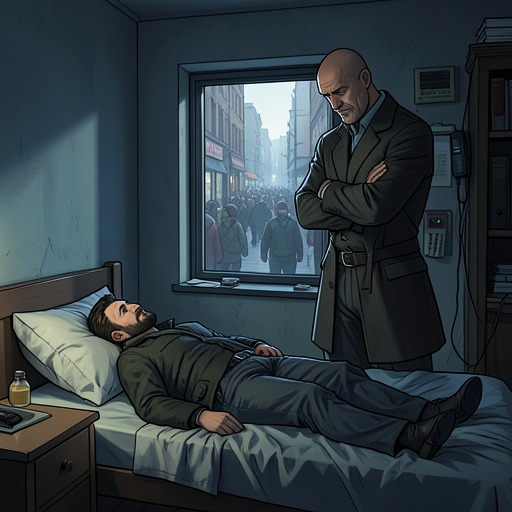
Loneliness and Absent Family Bonds
DevdasLoneliness in Devdas is not simply the absence of other people: it is the failure of affection, family ties, and companionship to become dependable care. Devdas recognizes that his mother, elder brother, Parvati Chakravarty, and Chandramukhi are all part of his life, yet feels that none of them truly has him. His final isolation gives that contradiction its starkest form, and the narrator turns it into an appeal for compassion toward anyone left to die uncared for.
Having Everyone, Belonging to No One
At a hospital in Bombay, after a year has passed, Devdas leaves leaning on Dharmadas. When Dharmadas suggests they go to Devdas’s mother, Devdas resists. He has spent the preceding days considering the people in his life: his mother, his elder brother, Parvati, whom he regards as more than a sister, and Chandramukhi. The thought ends not in reassurance but in the recognition that he has everyone and yet no one has him. The family and intimate bonds exist, but they do not amount to a home he can enter or a relationship in which he feels held.
This sense of disconnection is sharpened by the material traces of family that accompany him. After his death, two letters are found in his pocket: one from his elder brother, Dwijodas Mukherjee, saying that he cannot send more money, and one from his mother, Harimati Devi, asking how he is. The letters confirm that family connection has not vanished altogether; they also show how little that connection can do for Devdas in his final circumstances. A practical limit and a brief inquiry survive on paper, while he remains far from both correspondents.
Intimacy and Its Failure
The loneliness surrounding Devdas is bound up with relationships that matter deeply but do not settle into mutual security. His bond with Parvati begins in childhood and remains central to his life, yet their decisive conversations are marked by missed possibilities. At their last meeting, a conch-shell sounds while Devdas asks whether she can leave with him that night. The question comes too late to undo the lives they have entered separately; the sound marks the closing of their time together rather than a reunion.
The story also presents intimacy as vulnerable to injury. In an earlier episode, Devdas wounds Parvati. The fact sits uneasily beside the later tenderness and longing attached to their relationship: affection does not erase the harm between them, and closeness alone cannot guarantee care. The novel’s restrained treatment of such dramatic moments leaves their consequences for the reader to consider rather than explaining them away.
Chandramukhi’s love for Devdas provides another contrast between being loved and being able to belong. She falls in love with him, and he comes to care for her, but he cannot forget Parvati. His illness and departure from Calcutta leave Chandramukhi alone. The women’s attachment sustains much of the story, yet their devotion cannot overcome Devdas’s inward withdrawal or make his life reciprocal. His isolation is therefore not proof that nobody loves him; it is the painful distance between their love and his capacity to live within it.
The Last Night
Devdas’s final journey brings the theme into a concrete scene of separation. He reaches the zamindar household at night, unconscious and unable to meet Parvati. With the household asleep and no one else in sight, the coachman makes a bed of hay for him on the stone platform beneath a peepul tree. Devdas manages to hand the coachman a hundred-rupee note, but he cannot speak; the coachman ties the money into his shawl and stays beside him through the night. The shawl, the lantern, and the solitary attendant make care present, but only in a last, fragile form.
At dawn, people from the household find a gentleman dying under the tree. Bhuvan Babu sends for a doctor and comes himself; others gather, and the doctor says Devdas is near death. Parvati hears of the dying man upstairs but does not reach him. Someone gives Devdas a drop of water, and he dies after a few more breaths. The scene places public witnesses around him without restoring the intimate recognition he sought: people can gather, pity him, and perform a final act of care, but he cannot meet Parvati or speak to those who arrive.
The Meaning of Care
The book’s framing gives Devdas’s death an ethical meaning beyond the fate of one man. Its final appeal asks readers to feel pity for him and, more broadly, for anyone who might die alone. It imagines the minimum tenderness that should attend a death: a loving touch, a caring face, and a tear of remembrance. Against the earlier image of a man who has everyone but feels possessed by no one, this appeal makes care not a matter of status, wealth, or formal kinship, but a human obligation at the moment when a person can no longer ask for it.
The contrast is central to the novel’s pathos. Devdas is loved by Parvati and Chandramukhi, accompanied at the end by the coachman, and observed by a gathering of strangers; still, he dies without the farewell he had sought. Loneliness here is the painful mismatch between the presence of others and the presence one most needs. The narrator’s closing plea does not undo that failure. It asks that another person, even one unknown, should not be left without a final sign of tenderness.