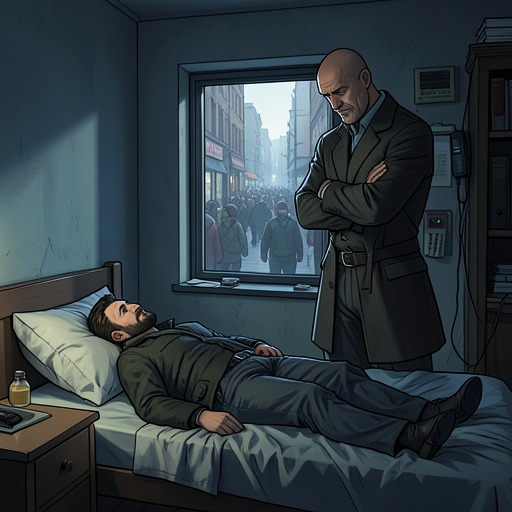
Chandramukhi's Life as a Courtesan and Her Departure from It
DevdasChandramukhi's life as a courtesan is first presented through the practical terms on which her house in Chitpore operates; her departure from that life, however, is neither a simple escape nor a return to dependence. Her encounters with Devdas unsettle her sense of herself, but she ultimately insists that she stopped her former work by her own decision. In Ashathjhuri, the money he sends her supports a new role among villagers who rely on her generosity.
The House in Chitpore
At nine o'clock one night, Chunilal brought Devdas in a hired buggy to a two-storied house in Chitpore. Devdas had not been keen to go out, and his resistance continued as Chunilal took his hand and pulled him inside. The house belonged to Chandramukhi, who came out to greet them. The setting makes her occupation legible before she explains it: this is her home and place of business, entered by men who have come with Chunilal.
Devdas responded to Chandramukhi with an aversion that he had not fully recognized in himself. Seeing her brought to the surface a hatred of women that had grown over the preceding days. He asked whether she took money, pressing the question before she could finish a polite response. Chandramukhi answered plainly that she did, because that was how they lived. Their first exchange thus places economic necessity beside Devdas's contempt: she names the material terms of her livelihood, while he treats the very place and its owner as repellent.
Chandramukhi was twenty-four and had spent roughly ten years becoming familiar with many kinds of men. Yet Devdas seemed wholly strange to her. His bluntness did not resemble the behavior she had encountered before. When she later recalled their first meeting, she stressed that his wealth was not what attracted her. What struck her was his boldness, and the contrast between his unusual manner and the many men who had already come and gone.
Attraction, Injury, and Departure
The encounter wounded Chandramukhi. She remembered Devdas turning away from her in revulsion and throwing money at her, an act she described as an unprovoked assault. She also remembered that she could not forget him afterward. His visits made her tense and fearful; when he did not come, she felt that nothing was right. She said that her attention had fixed on him, not as love or hatred, but as an attachment to something she could not dismiss as ordinary.
Over time, she felt that she had changed so greatly that her earlier self would no longer have recognized her. Devdas began drinking, although Chandramukhi had always hated alcohol and disliked drunkenness in her house. His drinking did not produce the anger she felt toward other drunkards; it made her miserable. In recounting this change, she links her departure from her former life to a widening shift in feeling, not to a sudden change in her circumstances alone.
When Devdas returned, he found that she had closed her business and asked how she would survive. Chandramukhi said she had gone bankrupt. She explained that she had wanted to see him once before leaving and asked where she should go. Her account of his earlier visit was still painful, but she also described the force of her own attachment: the insults and rejection had not erased her wish to draw closer to him. She touched his feet and asked forgiveness, acknowledging that she had continued to approach him even when he pushed her away.
A specific moral turning point lay in something Devdas had said about how much people tolerate, including insults and assaults. Chandramukhi said that the next day she stopped it all. Her account connects the end of her former work with a new recognition of what women were made to endure, while preserving her own agency in the decision. She did not present the change as an easy passage into another occupation. She said she wanted to live independently and comfortably, had never done a day's hard labor, and feared that further physical submission would damage her body.
A Choice She Claims as Her Own
Devdas warned that living near the city might tempt her to return and suggested that the human mind could not be trusted. Chandramukhi conceded that temptation was possible in general, but rejected his prediction about her. She said that she had given up those temptations of her own free will and had not regretted the decision at any point. Her confidence rests on her sustained experience of the choice, not on a claim that temptation could never exist.
The exchange also exposes the limits of Devdas's understanding. He generalizes that women are restless and fickle, while Chandramukhi answers from her own knowledge of the change she has made. Her departure is therefore more than a plot development prompted by her feelings for him. It is a decision she articulates and defends, even as Devdas remains central to the circumstances through which she explains it. The tension between his suspicion and her certainty keeps her from being defined solely by his judgment.
Ashathjhuri and a New Social Role
Two years after settling in Ashathjhuri, Chandramukhi lives in a ramshackle hut beside the river, near an ancient peepul tree whose hanging roots spread across the surrounding ground. The small dwelling has a kitchen-store room and a bedroom, and a shed beside it holds a black cow. The yard is swept daily by Rama Bagdi's daughter; thorny bushes border it, with a berry tree in the middle and a tulsi plant in one corner. Chandramukhi has had steps cut down from the hut to the river, and she alone uses them. During the rains, floodwater reaches the doorstep, and villagers raise the ground with shovels and spades.
The village has no genteel residents: its people include farmers, lower-caste families, milkmen, and cobblers. This setting differs sharply from the city house where Chandramukhi's livelihood depended on men coming and going. In Ashathjhuri, her daily place in the community is instead marked by neighbors' practical needs and the help they seek from her.
After settling there, Chandramukhi wrote to Devdas, and he sent money in reply. She lent it to villagers without charging interest. People brought her small sums of vegetables, milk, or grain in return; she did not insist on repayment, and many borrowers never returned the money. When someone did not repay her, she laughed that she would not lend to that person again. The threat is gentle rather than punitive: her lending continues to function as assistance rather than a commercial source of income.
Villagers kneel before her and ask her to pray for good rains. When the crops disappoint or taxes press on them, they return to borrow what she can spare. Chandramukhi continues to give, privately reflecting that Devdas's continued life means she need not worry about money. The money that began as a remittance thus circulates through the village as loans and aid, while her relationship with Devdas remains present in her new life at a distance.
Significance
Chandramukhi's trajectory contrasts two forms of economic and social relation: the paid encounters of her former house and the unpriced help she offers in Ashathjhuri. The narrative does not erase the material realities of either life. She initially explains that she takes money because people must live; later, she is careful about the bodily cost of returning to her former work and about her limited capacity for hard labor. Her independence is therefore practical as well as emotional, supported in part by money Devdas sends and expressed through the choices she makes with it.
Her change also complicates a story in which Devdas's rejection might otherwise define her. She remembers his cruelty in detail, but names her own attraction, her own decision to stop, and her own lack of regret. In the village, she becomes a lender and a person asked to pray for the harvest. Her departure from her former occupation does not make her life economically self-sufficient in a simple sense; instead, the narrative shows her converting assistance received into support for others, and locating a new measure of dignity in the freedom to decide how she will live.