Marriage Restrictions Based on Social Status
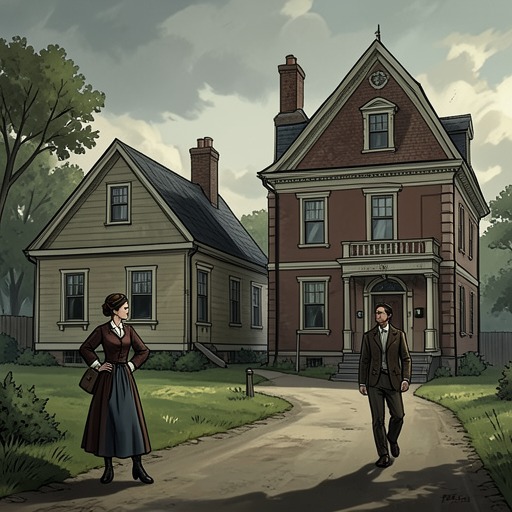
DevdasMarriage Restrictions Based on Social Status are presented as family power exercised through marriage negotiations, not as a formal code: the Mukherjee household treats Parvati Chakravarty's trading-family background and her family's proximity as sufficient reasons to rule her out for Devdas Mukherjee. Their refusal makes childhood closeness powerless against distinctions of rank and propriety, and turns an intimate possibility into a source of lasting regret.
Social position and the marriage question
Parvati's family is not wealthy, and the Chakravarty household is described as a trading household. The circumstances of a daughter's marriage also carry an economic dimension: the family custom is to receive a bride-price for a girl's marriage and pay one for a boy's. Nilkantha Chakravarty rejects taking money for Parvati, even though his own father had accepted a bride-price for a daughter. His refusal establishes that the family is not simply seeking to profit from an advantageous match; he does not want to sell his daughter. Yet rejecting that custom cannot remove the social distinction that will count against her in the Mukherjee household.
The urgency comes from Parvati's approaching adulthood. Her mother presses for a marriage, while her grandmother tests whether an alliance with Devdas might be possible. She points to the children's long familiarity: Parvati cried when Devdas left for Calcutta at about eight years old, and his letters delighted her. But the same closeness can be interpreted in opposite ways. Devdas's mother describes them as having grown up like brother and sister, treating intimacy as evidence of a familial bond rather than a promise of marriage.
How the Mukherjee household enforces the boundary
Devdas's mother understands the grandmother's indirect proposal and feels affection for Parvati. Her response is therefore not simple personal dislike. She sees the pathos of the suggestion, but regards the Chakravartys' trading status and their immediate proximity as decisive obstacles. In her view, bringing a bride from a trading family would be unacceptable, and marrying a neighbor would be indecent. The boundary is maintained through domestic judgment and the language of shame rather than through an argument about the young couple's character.
The first explanation offered is that Devdas is still studying and that his father opposes marrying him at that age. His father's experience with his eldest son, Dwijodas, supplies a practical rationale: an early marriage had interrupted Dwijodas's education. But the conversation at dinner makes the status objection explicit. When Devdas's mother reports the proposal, Narayan Mukherjee initially agrees that Parvati should marry soon, then objects when he learns that she was proposed for Devdas. His wife names both the trading household and the impropriety of neighbors marrying; he agrees that the family must not become a laughingstock. The appeal to education thus sits beside a more controlling concern with rank, social appearance, and the preservation of the household's standing.
The father's reference to the family's vast zamindari sharpens the material stakes without reducing the decision to money alone. The Mukherjees possess substantial landed wealth, while the Chakravartys are marked as traders; the former's wealth does not make the latter an acceptable match. What matters is not simply whether a bride's family has resources, but whether it belongs to a group the Mukherjees consider suitable. The episode distinguishes economic means from marriage status: property can secure the family's position while its rules of affiliation exclude a neighbor.
The refusal and its consequences
The rejection reaches Parvati in Devdas's letter after her secret nocturnal visit. He says that neither of his parents wants the marriage and that he cannot inflict a wound on them by opposing their wishes. He repeats the status judgment in direct terms: her family is not high-born, his mother will not seek an alliance with a trading household, and she considers a match between neighbors indecent. His account shows how the rule becomes effective even without a direct confrontation between the families: parental authority and the prospect of disapproval are enough to make resistance seem beyond him.
The letter also reveals the personal cost of treating social rank as decisive. Devdas acknowledges that Parvati's visit was a drastic act and recognizes the pain behind it, yet says he cannot feel the deep sorrow she might expect and asks her to forget him. The restriction therefore does not merely prevent a wedding. It leaves the emotional consequences unevenly borne: Parvati has risked her reputation and hopes for a future together, while Devdas makes his inability to defy his parents the explanation for withdrawing from her.
The later plot supplies a contrast, not a simple reversal. Parvati marries Bhuvan Chowdhury and enters a vast, old-money zamindar household, where she is received as its new lady. Her husband's eldest son approaches her as his mother and seeks her blessing; later she takes the initiative in bringing the household's estranged women together. These scenes show marriage assigning Parvati a new place within a wealthy family and a network of kinship duties. They do not establish that her earlier marriage was an equivalent alliance to the one refused by the Mukherjees, or that the social barrier has disappeared.
Significance within the novel
The restriction exposes the limits of romantic attachment in a world where marriage joins households and publicly marks their relative standing. Devdas and Parvati's childhood bond is visible to both families, but it cannot outweigh the Mukherjees' sense of who may enter their family. The mother's affection for Parvati makes the refusal more revealing: personal warmth can coexist with the enforcement of class boundaries, and sympathy does not necessarily become action.
The rule also gives social status a continuing emotional afterlife. Months after Narayan Mukherjee's death, Devdas remains restless at home and is repeatedly troubled by thoughts of Parvati. His mother, too, reflects that it might have been better if he had married Parvati when the subject first arose. That later regret does not undo the earlier decision. Instead, it shows the cost of allowing inherited expectations, family authority, and fear of ridicule to close a possibility that the people involved had once recognized. The marriage restriction operates as both a social boundary and a plot-making force: it separates the pair, shapes the marriages and duties that follow, and keeps the rejected alliance present in memory.