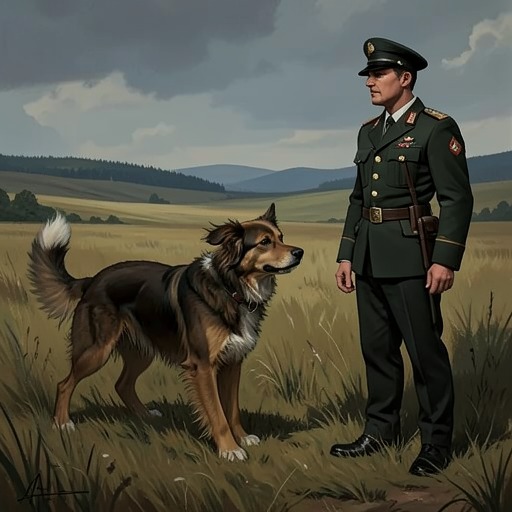
Dingo Attacks Soldiers
DingoDingo’s attacks on soldiers make a striking contradiction in his character: a creature described as fierce and predatory becomes an antimilitarist in action. The narrator presents no speeches or political organization behind the attacks. Dingo simply singles out military figures, and the narrator’s perplexity gives the episode its force: an animal’s repeated conduct looks like a political conviction, though its cause has not yet been established.
From Predatory Animal to Antimilitarist
The narrator introduces the attacks as a reversal. Dingo is characterized as a fierce warrior and pillager, qualities that might seem to align him with military violence. Instead, he has become, in the narrator’s phrasing, a dangerous antimilitarist. The contradiction is deliberately left visible: Dingo’s predatory nature does not translate into affection for soldiers or military power.
The narrator distinguishes this hostility from a human political movement. Dingo does not join an anarchist group, put up posters, or speak at revolutionary meetings. He acts alone, without explanations or rhetoric. His opposition is expressed as direct action rather than as an articulated doctrine.
The Pattern of the Attacks
Dingo attacks the military figures he encounters on his way. The narrator says that the more decorated, feathered, conspicuous, and high-ranking they appear, the more vigorously Dingo rushes at them. Rank and display therefore intensify the pattern: the attack is not described as indiscriminate aggression toward everyone nearby, but as behavior especially directed toward the visible emblems of military status.
The account does not provide a detailed sequence of individual encounters or describe their physical consequences. Instead, it establishes the repeated target and the apparent escalation according to uniform and rank. That restraint keeps attention on the pattern itself and on the narrator’s effort to understand it.
The Narrator’s Interpretation and Uncertainty
The narrator is initially troubled by Dingo’s conduct. He had believed his materialist outlook to be secure, yet the unexplained consistency of the attacks nearly leads him to imagine Dingo as a mysterious force or divine scourge. The local priest’s suggestion that Dingo is one of two incarnations of the devil in the district, with the narrator as the other, briefly gives the behavior a supernatural frame. The narrator presents this as a measure of his bafflement, not as an explanation he accepts.
He then says that he later learned the cause of Dingo’s change and insists that it was neither supernatural nor diabolical. The account at this point withholds that cause, making the attacks a question the narrative promises to resolve rather than a political position it has already explained.
Persistence and Significance
The hostility continues beyond attacks on soldiers. The narrator says that from then on Dingo also hated the placid rural constable, whose only notably military feature was an old, battered green kepi without braid. The contrast between this modest headgear and the elaborate uniforms that provoke Dingo’s strongest rush broadens the target from military pomp to a recognizable sign of authority.
The episode turns an animal’s repeated behavior into a comic and unsettling challenge to human political categories. The narrator calls Dingo an antimilitarist while emphasizing that Dingo neither argues nor organizes. The label describes what his actions resemble; it does not settle what he understands or why he acts. The narrative’s delayed explanation preserves that distinction between an observer’s interpretation and an animal’s unexplained conduct.