Dingo's Animal Hunts in Ponteilles and the Surrounding Countryside
DingoDingo's Animal Hunts in Ponteilles and the Surrounding Countryside mark the point at which Dingo’s predatory activity overwhelms the ordinary boundaries of village life. What begins with a destroyed poultry yard spreads through the narrator’s property, across Ponteilles, and into the surrounding farms. The sequence joins a concrete trail of animal losses to an escalating public alarm: Dingo is first identified as the culprit after villagers suspect wolves, then blamed for harms far beyond the attacks that can be directly attributed to him.
From the Poultry Yard to the Village
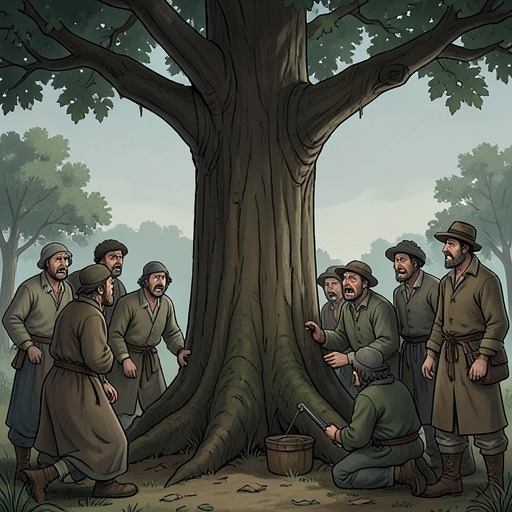
The episode opens with Thuvin waiting for the narrator, who has just returned from Paris. Seeing the gardener’s unusual agitation, the narrator assumes that the warning concerns another familiar nuisance. Thuvin instead reports that the poultry yard has been destroyed. The narrator initially doubts him, but the evidence is visible beneath the damaged shed: one hundred dead chickens have been laid out in rows according to size. Feeders, nesting boxes, and water containers have been overturned or torn from their places, while the enclosure itself has been left in disarray. The orderly arrangement of the birds makes the destruction appear almost methodical, though the narrator offers no explanation for it.
Dingo is away from the house that evening. The narrator later learns that he has spent the night around the fir trees where the turkeys roost. Two days afterward, Thuvin reports that the turkeys and peacocks are gone, along with the Siberian rabbits the narrator had given him. The narrator now responds with little more than resignation: by this point, he is beginning to grow accustomed to Dingo’s attacks. That change in response registers how quickly exceptional violence has become part of the household’s routine.
The losses then spread beyond the first group of animals. Ducks, geese, swans, and other waterfowl kept around the pond are attacked, followed by animals belonging to the narrator’s neighbors. Within a month, Dingo has ravaged the village’s poultry yards, hutches, aviaries, cages, and ponds. The narrator estimates that almost no living animals remain in Ponteilles, apart from its human inhabitants. The escalation is not a single isolated incident but a succession of attacks that successively empties different kinds of domestic enclosure.
A Rural Crisis and Its Attribution
The alarm soon reaches farms and fields beyond the village. Animals are found dead or injured across the countryside: sheep are attacked in their pens; pigs, goats, cattle, donkeys, and horses suffer losses or flee their restraints. Some animals drown in the Viorne, while three young half-bred horses are reported missing after falling into marl quarries. The narrator presents these incidents as reports circulating through a broad area, rather than as events personally witnessed. Their accumulated effect is nevertheless unmistakable: the countryside is described as terrorized, and the scale of the crisis is compared with nothing seen there since the war.
At first, people suspect a pack of wolves. The suspicion gives way to a name repeated across the countryside: Dingo. From farms a league away, the narrator receives increasingly distressed accounts, complaints, threats, and threatened lawsuits. The association between Dingo and the damage becomes so powerful that the villagers also blame him for unrelated setbacks. Crop disease, hail, storm damage, epidemics, family disappointments, failed enterprises, and rising prices are all folded into accusations against him. The narrator describes this as a collective need to give hardship a hated face. The distinction between documented animal attacks and broader misfortune attributed to Dingo is therefore central to the episode: the first grounds the villagers’ fear, while the second shows it expanding into scapegoating.
Confinement, Escape, and Repeated Hunts
In response to the danger and public hostility, the narrator chains Dingo in a room. The restraint proves ineffective. Dingo finds ways out of even tightly secured places, leaving behind the chain and collar and slipping away without attracting notice. At times he remains in the countryside for three or four days. During those absences, the narrator receives no direct news of him, only renewed cries and reports of further alarm. Confinement thus fails both practically and socially: it does not reliably stop Dingo’s excursions, and the public reaction continues to gather force in his absence.
Piscot resists the prevailing accusation. He insists that Dingo is gentle and cannot be responsible for the devastation, defending him when angered drinkers discuss the matter at Jaulin’s. Yet a later report complicates that defense. After the narrator has been away for eight days, Piscot recounts with admiration that Dingo has returned to the plain and destroyed all the companies of partridges. The narrator rejects Piscot’s account, proposing instead that poachers have caught the birds in nets. Piscot dismisses this alternative, convinced that such destruction could not have been achieved by poachers. The exchange leaves a pointed contrast: Piscot’s loyalty does not prevent him from recognizing Dingo’s capacity, while the narrator, faced with another accusation, still tries to explain the damage away.
The Hunt as Character and Social Crisis
The attacks have an earlier visible prelude at the narrator’s gate. Dingo watches the movement of the village street, but the passing sheep excite him in particular. Behind the bars, he becomes restless as the flock moves between its shepherd and accompanying dogs. His reaction connects the later attacks to a predatory impulse already suggested in his attention to livestock. The village dogs offer a further contrast: among the varied animals gathering near the square, the Bas-Rouges are described as the dominant and most admired type, while their noisy encounters sometimes end with wounded dogs being put down. Ponteilles is already a place where animals are watched, categorized, and managed; Dingo’s attacks make those familiar relations unstable.
That instability also tests the narrator’s effort to present Dingo with a more polished account of European life. He tries to guide him toward a gentler, more civilized ideal, but Dingo is not persuaded by vague assurances about France and its social order. The attacks expose the gap between the narrator’s civilizing language and the practical force of Dingo’s appetites. Elsewhere, the narrator characterizes Dingo as committed to tangible rather than abstract pleasures, treating beauty as inseparable from use and even from edibility. The hunts give that comic principle a destructive consequence: Dingo’s way of apprehending animals is not simply an opinion about taste but an action that changes the lives of householders, neighbors, and farmers.
The narrative’s changing scale makes the episode more than a record of animal losses. It moves from a carefully counted hundred chickens, to successive kinds of animals around the property, to the village’s depleted enclosures and the countryside’s reports of injured or missing livestock. Against this observable sequence, rumor spreads to encompass harvests, illness, and economic hardship. Dingo is both a real source of damage and the target of blame for troubles that have no demonstrated connection to him. The hunts therefore bind wildness to a social crisis: the animal’s repeated escapes intensify fear, while that fear enlarges the meaning of every misfortune in Ponteilles.