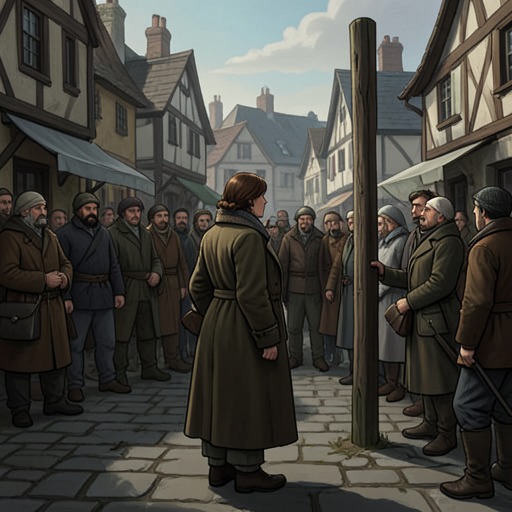
Jaulin Engineers His Mother's Fatal Fall
DingoJaulin Engineers His Mother's Fatal Fall is a village episode in which a staged household accident conceals deliberate violence. Jaulin loosens the threshold of the attic doorway so that his mother will fall when she approaches it. His effort to disguise the preparation as a repair, the deputy’s recognition of its purpose, and the village’s eventual acceptance of the explanation expose a social order willing to excuse a crime when its victim is old and considered a burden.
Background and Preparation
The episode begins when Jaulin, while shoeing a horse, happens to look up and see la mère Jaulin leaning out of the open attic doorway to look down into the street. The narrator links this sight to Jaulin’s idea, but does not explain it as a sudden impulse: the subsequent steps show him making the doorway unsafe and preparing an explanation for the work.
After la mère Jaulin has gone out for a walk, Jaulin climbs to the attic with tools. He works at the two stones that form the doorway’s threshold, loosening them and digging out the cement beneath so that the threshold will slope and move. His face is unusually grave, and his hand trembles slightly as he works. Those details register the strain of the act, while the careful alteration itself makes clear that the danger is being manufactured rather than discovered.
A Repair as Cover
As Jaulin works, maître Peleux, the deputy, passes by on his way to Cortoise with a cart of hay. Asked what he is doing, Jaulin says he is repairing the threshold because it is not secure and la mère Jaulin might one day fall. The explanation supplies a protective purpose for the very work that is making the doorway dangerous. Jaulin’s warning presents him as a concerned son, even as the audience has already seen him loosen the stones and undermine their support.
The deputy does not openly accuse him. Instead, he answers with a sarcastic remark, and the narration suggests that he may have taken pleasure in seeing through Jaulin’s concealed intentions. His knowing response makes him a witness to the plan’s outward signs, though the episode does not describe him intervening. Jaulin’s cover story is therefore not wholly convincing; it is simply allowed to stand.
The Fall and Jaulin’s Response
Two days later, a regiment of dragoons passes through the village on its way to take part in a campaign against strikes in the North. People have returned from the fields to watch, and the streets, doorways, and windows are full of onlookers. Jaulin, described as an ardent patriot, helps kindle the crowd’s enthusiasm as the regiment moves past.
From the attic, la mère Jaulin hears the unfamiliar commotion, goes to the door, and steps onto the loosened threshold. It gives way before she can steady herself, and she falls to the pavement at her son’s feet. The arrangement of the scene brings the prepared hazard, the village spectacle, and Jaulin’s public display of patriotism into the same moment. When he bends over his mother, he treats the fall as confirmation that she had been imprudent, repeating the excuse he had already offered for supposedly repairing the threshold.
la mère Jaulin is not yet dead. She remains unconscious for two days before dying, while Jaulin’s initial composure gives way to pallor, sweat, and a sigh of regret for the old woman. The narration records these outward signs without presenting them as a confession or establishing that he admits responsibility. His earlier preparation and his immediate appeal to her supposed carelessness, however, leave the reader with a clear contrast between what he arranged and what he says has happened.
Burial and Village Acquiescence
The entire village attends the funeral, with the mayor leading and the municipal council following in procession. Jaulin maintains a measured bearing, neither displaying excessive grief nor apparent joy. The deputy’s account of his conversation with the cabaretier has meanwhile made everyone aware of the circumstances surrounding the accident. Yet that knowledge does not lead to an accusation or punishment in the passage.
Instead, the villagers excuse the death by pointing to la mère Jaulin’s age—eighty-four—and the weight of caring for her. They also note how discreetly the deed was done. The same deed that the deputy had recognized as suspicious becomes, in the village’s judgment, evidence of Jaulin’s cleverness: he even gains additional esteem. The ending turns the apparent domestic accident into a portrait of collective complicity, in which awareness of the truth coexists with a practical readiness to accept the convenient story.