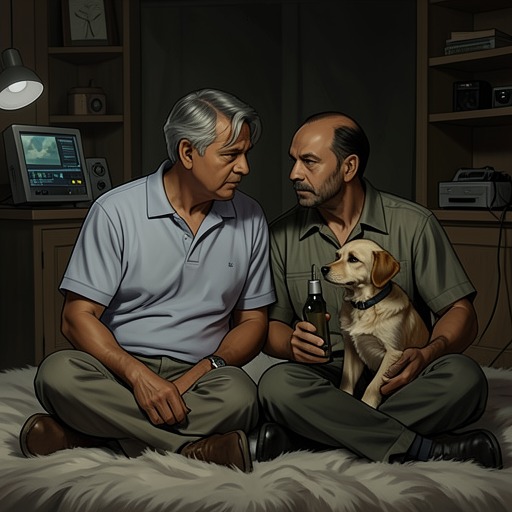
The narrator and Dingo
DingoThe narrator and Dingo are joined by an attachment that never fully reconciles affection with control. The narrator adopts Dingo as a tiny dog and comes to value him as a companion whose judgment seems more trustworthy than that of people; yet Dingo’s predatory independence repeatedly brings trouble into their shared life. The narrator’s efforts to make him conform fail, but neither the conflict nor its social costs dissolve the bond. Instead, their relationship makes the narrator confront the difference between loving an animal and demanding that it become human.
Adoption and First Impressions
Dingo arrives as a gift from the narrator’s friend, Sir Edward Herpett, who presents him as an exceptionally rare animal and accompanies the gift with an elaborate account of the dingo’s disputed classification. Herpett’s letter insists that the animal is no longer properly a dog, invoking scientific authorities and treating the dingo as a distinct kind between dog and wolf. It also promotes the animal as a fashionable possession for London society. The narrator receives this mixture of zoological certainty and social boasting with skepticism: Herpett may exaggerate as a traveler and tease as a friend, while the puppy at the narrator’s feet is so small that there seems little reason for alarm.
The first encounter is domestic and comic rather than fearful. As the narrator reads, the puppy yaps and tries to suckle the end of his slippers. Although Herpett’s account has emphasized inherited ferocity, the narrator believes that education may counter inherited tendencies. He adopts the animal and names him Dingo after his race. This beginning establishes a recurring tension: the narrator understands the dog through the language of upbringing and companionship, while Dingo’s conduct repeatedly makes his independent instincts impossible to ignore.
Affection and Trust
The narrator describes Dingo’s love as proud and undemonstrative rather than submissive. He values the dog’s affection precisely because it does not seem to erase Dingo’s personality. In the narrator’s account, Dingo accepts care without becoming servile, and this gives their attachment a quality he finds missing in many human friendships. The narrator reflects that human affection can conceal domination or self-interest; Dingo’s regard, by contrast, appears to him free of calculation.
That confidence is not presented as certain knowledge of the dog’s inner life. The narrator wonders whether Dingo appreciates his attempts to understand him, including efforts that fail to please, but acknowledges that he cannot know what Dingo thinks. His account therefore holds affection and uncertainty together: he interprets the dog’s behavior closely, while recognizing that the interpretation remains human. He ultimately treats Dingo’s love as its own reason, not as a reward that must be explained or earned.
Dingo is especially attached to the narrator’s wife, whose gentler and more attentive care the narrator considers better suited to animals. The narrator’s account of this preference does not diminish his own bond with Dingo; rather, it shows that the dog forms attachments on his own terms and is not simply an extension of his male owner. At home, Dingo turns the force of affection toward the people around him, even after becoming disillusioned with attempts to show tenderness beyond the household.
Dingo as the Narrator’s Guide
The narrator increasingly relies on Dingo’s responses to other people as a guide to his own conduct. He avoids people toward whom Dingo shows suspicion or hatred and accepts those to whom the dog displays affection. The practice is consequential: the narrator makes abrupt changes in his relationships and gives Dingo’s instincts authority over judgments he might otherwise make for himself. He later questions whether he was right to sacrifice people and attachments so readily, and whether Dingo’s advice spared him from humiliation or disappointment. He refuses to claim a conclusive answer.
What he does identify is the cost of this dependence. Following Dingo helps draw him into a state of profound social withdrawal, one he describes as a kind of happiness but also as often painful. The relationship thus works both as refuge and as a force that distances the narrator from other people. His trust is not merely sentimental: it changes how he moves through society, even as he remains unsure whether the resulting isolation has been worth its losses.
The bond is tested in Ponteilles, where Dingo watches the street from behind the narrator’s gate. The passing flocks of sheep arouse a marked excitement in him, and the narrator sees the animal’s hunting impulses gathering behind the barrier. The surrounding dogs, including the formidable Bas-Rouges, make the village street a noisy meeting ground where dogs sometimes fight. The narrator can observe Dingo’s responses, but neither his affection nor the household boundary makes those impulses disappear.
Independence and the Failure of Reform
The narrator wants to respect Dingo as an individual, but his respect has limits. He admires the dog’s generosity and independence while also wanting to discipline, refine, and ultimately suppress what he regards as dangerous instincts. He admits to a habit of meddling and of using grand ideals to give his interventions an appearance of principle. This self-criticism makes the conflict more than a simple difference between a well-meaning owner and a disobedient animal: the narrator recognizes that his project also serves his wish to keep daily life undisturbed.
He tries to lead Dingo toward a more conventional European way of living through indirect persuasion and consoling generalities. He presents France and its social order in idealized terms, urging Dingo to accept civic discipline and the supposed moral benefits of civilization. Dingo is not impressed. The narrator later reduces his demand to its starkest form: he wanted the dog to become a man, and Dingo obstinately refused. The failure belongs to the narrator’s ideal as much as to Dingo’s refusal; affection has not given the owner the right, or the means, to remake the animal.
The practical conflict becomes acute when Dingo kills the narrator’s two cats. The narrator understands at once that Dingo’s independence includes instincts with painful consequences for the household. Elsewhere, the aftermath of an attack on the poultry yard makes those consequences concrete: a hundred chickens have been killed, and the damaged equipment registers the scale of the destruction. These events intensify the strain between the narrator’s attachment and his desire to control Dingo. They do not, however, turn affection into simple condemnation.
Attachment Amid Conflict and Change of Place
After Dingo’s expeditions, his exuberance can meet the narrator’s disapproval without extinguishing their intimacy. The dog returns from hunting in high spirits and seeks contact; the narrator may want to scold him, yet passes a hand over his coat. The gesture does not excuse the harm or resolve their disagreement. It shows instead how affection persists alongside anger, and how the narrator’s emotional response cannot be reduced to approval of Dingo’s conduct.
Their surroundings eventually sharpen the difference between Dingo’s needs and the life the narrator has provided. In Paris, Dingo becomes listless amid crowded streets, houses, and diminished open space. Concerned that he may fall ill, the narrator rents a rustic house outside Veneux-Nadon, with a garden opening onto the Forêt de Fontainebleau and no fence separating the two. Dingo quickly becomes active and cheerful again, then spends most of his time in the forest, ranging far from the house. The move is an act of care, but it also acknowledges that companionship cannot thrive through proximity alone: Dingo needs room to run and live beyond the routines of the city.
The relationship’s significance lies in this unresolved accommodation. The narrator loves Dingo without claiming complete access to his thoughts, trusts his judgment while questioning the costs of doing so, and tries to restrain instincts that remain part of the animal he chose to adopt. Dingo, for his part, offers affection without surrendering his independence. Their bond survives not because the narrator succeeds in making Dingo obedient or human, but because attachment continues even where understanding and control fall short.