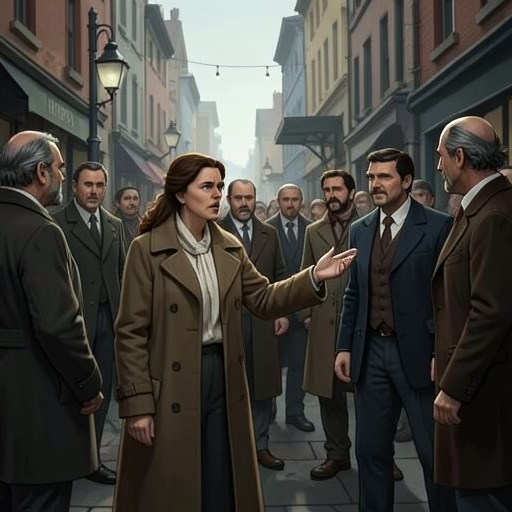
Éire Abu Society concert and Mrs Kearney's dispute over payment
DublinersThe Éire Abu Society concert and Mrs Kearney's dispute over payment bring a cultural enterprise to a halt over a clear contractual question: whether Kathleen Kearney is owed eight guineas for four concerts when the Society changes its programme. Mrs Kearney has helped shape the concerts and secured her daughter's engagement, but as the schedule falters she becomes the person insisting that the Society honor its written agreement. The contest ends not with a settlement but with Kathleen leaving before the second part of the Thursday performance, while the organizers and other participants turn against her mother.
The engagement and its terms
Mrs Kearney has cultivated connections around her daughter’s musical and cultural reputation. As the Irish Revival gains prominence, she encourages Kathleen’s involvement in the language movement; Kathleen and her sister exchange Irish picture postcards with friends, and she becomes known as a capable musician and supporter of the movement. When Hoppy Holohan proposes Kathleen as accompanist for four grand concerts at the Antient Concert Rooms, Mrs Kearney takes an active role in shaping the undertaking. She advises on the programme, including the order and presentation of performers, and helps draw up a contract stipulating eight guineas for Kathleen’s work across all four concerts.
Her involvement goes beyond securing the engagement. Holohan, inexperienced in the details of bills and programmes, consults her daily, and she helps arrange the items to keep the audience entertained. She also prepares for the concerts at her own expense: she buys blush-pink charmeuse for the front of Kathleen’s dress and takes a dozen tickets for the final concert to distribute to friends whose attendance is uncertain. This work and expenditure help explain why the later alteration of the programme seems to her not merely disappointing but a threat to the agreed payment.
The concerts fall short
The series is scheduled for Wednesday through Saturday. On Wednesday evening, Mrs Kearney arrives with Kathleen to find a sparse audience and idle stewards; the first concert begins late and is made up of performances the Society’s organizers themselves regard as weak. The audience dwindles, and the evening ends before ten. On Thursday, attendance is better, but Mrs Kearney notices that many seats have been filled with paper, giving the appearance of a fuller house. She also learns that Friday’s concert is to be abandoned so that the committee can concentrate its efforts on drawing a large audience for Saturday.
The cancellation changes the immediate stakes. Mrs Kearney tells Holohan that the contract was for four concerts and that cancelling one does not, in her view, alter the Society’s obligation. He directs her to Fitzpatrick, the secretary, who says he will raise the matter with the committee. The dispute is therefore not initially over whether Kathleen has performed badly or failed to appear: it concerns whether the Society can reduce or delay the contracted payment by changing its own schedule.
A contract becomes a public confrontation
As the Thursday programme continues, Mrs Kearney asks when Kathleen will be paid. Holohan says that Fitzpatrick is responsible; she replies that Kathleen signed for eight guineas and must be paid, and that if the matter is not Holohan’s business it is hers. His distance leaves her to pursue the claim with the secretary while the performance and the organizers’ plans continue around her.
The confrontation reaches its decisive point before the second part of the concert. In a corridor conversation, Holohan and Mrs Kearney return to the question of payment, but he again shifts responsibility to Fitzpatrick. Back in the dressing-room, the audience is clapping and stamping for the next performers while Kathleen has not yet gone on. Mrs Kearney’s position is categorical: Kathleen will not perform without the promised eight guineas. Holohan appeals to Mr Kearney and Kathleen as well as to the demands of the audience, but Mr Kearney remains silent, stroking his beard, and Kathleen looks down rather than entering the argument herself.
Fitzpatrick eventually arrives with banknotes. He counts four pounds into Mrs Kearney’s hand and says the other half will be paid at the interval. She points out that the amount is four shillings short. Kathleen nevertheless proceeds with the first item, accompanying Mr Bell. The exchange briefly restores the performance, but it does not settle the larger disagreement: the remaining four guineas are still withheld pending a committee meeting.
Withdrawal and aftermath
After the first part, Fitzpatrick and Holohan tell Mrs Kearney that the remaining four guineas will be paid only after the committee meets on the following Tuesday. They add that if Kathleen refuses to play in the second part, the committee will consider the contract broken and pay nothing. Mrs Kearney rejects this condition, insisting that her daughter already has a contract and must receive the full amount. Her demand is thus met with a counterclaim: the organizers treat continued performance as a condition of payment, while she treats the written fee as an obligation already incurred.
The dispute also becomes a contest over reputation and gender. Mrs Kearney complains that the committee assumes it can treat her daughter dismissively because she is a girl, and says she will make Dublin hear about the treatment if Kathleen is not paid in full. She regrets the trouble caused to the other performers but maintains that she has to defend her daughter’s rights. The episode places the contract beside the informal power of a committee, the audience, and the social circle gathered at the event: a written promise does not by itself determine which side can define the terms in practice.
Her insistence isolates her. After Holohan tells her to speak to the secretary and walks away, the people present condemn her conduct and approve of the committee’s decision. While she waits, Miss Healy agrees to play one or two accompaniments, making it possible for the second part to proceed without Kathleen. Mrs Kearney stands aside as the performers pass to the platform; when the music begins, she takes her daughter’s cloak and leaves with her husband. Kathleen follows her meekly. Mrs Kearney tells Holohan that she is not finished with him, and he answers that he is finished with her. The ending secures neither the disputed balance nor a reconciliation: the concert continues, but the working relationship between the Kearneys and Holohan is publicly broken.