Father Flynn found laughing in the confessional
DublinersFather Flynn found laughing in the confessional is a remembered episode in which the priest, missing when needed for a call, is discovered awake and laughing softly alone in the dark chapel. Eliza presents the discovery as the moment that led others to suspect his mind had failed, while the first-person narrator’s knowledge of the priest’s death gives her account an uneasy, unresolved frame.
The Search for Father Flynn
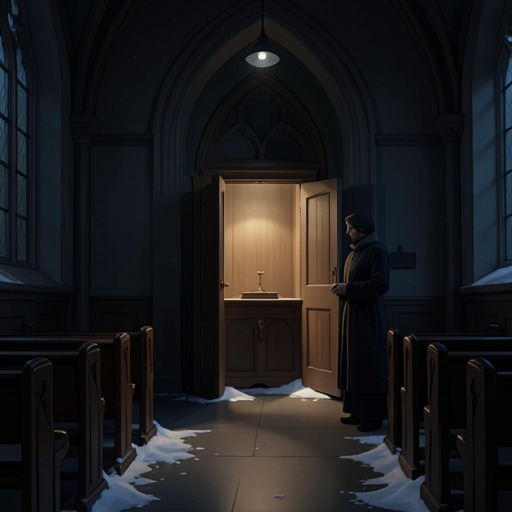
One night, Father Flynn was wanted to go on a call, but no one could find him. The searchers looked high and low without success. At the clerk’s suggestion, they tried the chapel: the clerk, Father O’Rourke, and another priest took the keys, opened it, and brought in a light to look for him.
They found Father Flynn sitting by himself in his confessional, awake in the dark and laughing softly to himself. The discovery is strikingly still: after the search through the surrounding spaces, the light reveals not an outward commotion but a priest alone in a place associated with confession.
Eliza’s Interpretation
Eliza identifies the incident as something that affected Father Flynn’s mind. She repeats the detail of his laughing to himself and says that seeing him there made those present think something had gone wrong with him. Her account supplies a community’s interpretation, not a diagnosis or an explanation of what prompted the laughter.
The episode is related through Eliza’s recollection rather than narrated as a scene witnessed by the boy. Her phrasing circles back to the same image—Father Flynn awake and laughing in the confessional—so that repetition gives the discovery weight while leaving its meaning unsettled. The evidence establishes neither what he was thinking nor whether the laughter had a particular cause.
The Dead Priest and the Unresolved Scene
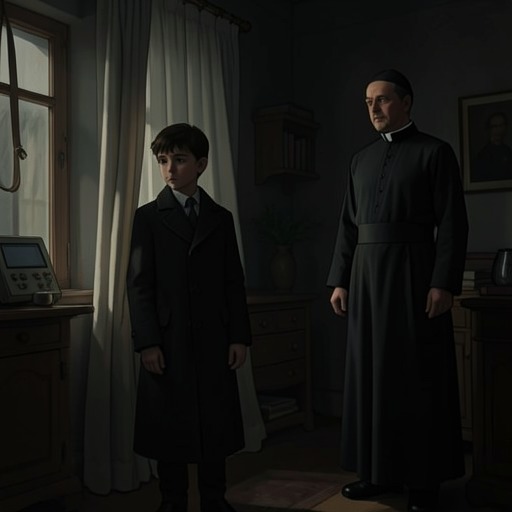
Eliza stops suddenly as if listening. The boy listens too, but hears no sound in the house; he knows that Father Flynn is lying still in his coffin, solemn and truculent in death, with an idle chalice on his breast. The remembered laughter thus returns in a room where the priest’s body is already present as a fact of death.
That contrast makes the discovery more than a report of unusual behavior: the living priest, alone and laughing in sacred darkness, is set against the dead priest, motionless beneath the chalice. Yet the narrative does not resolve the contrast into a clear account of illness, belief, or motive. The scene’s force lies in what the recollection and the boy’s knowledge leave together—an unexplained disturbance, and a dead man whose earlier behavior remains difficult to interpret.