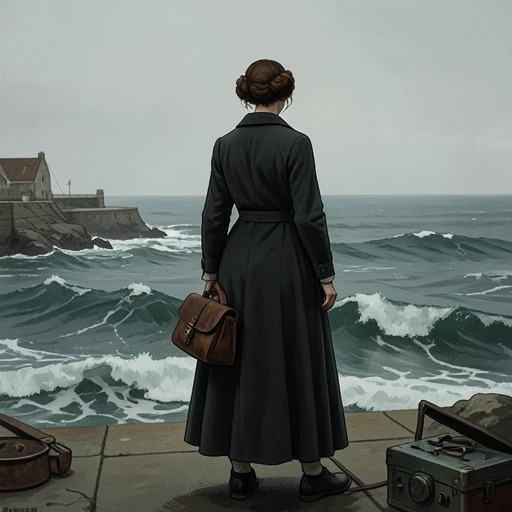
Eveline's aborted departure for Buenos Aires
DublinersEveline's aborted departure for Buenos Aires is the decisive reversal of her hoped-for escape: at the North Wall station, she grips an iron railing rather than follow Frank onto the boat. The passage turns the promise of a new life into paralysis, leaving Frank to go on without her and Eveline motionless amid the crowd.
Causes and Stakes
An urgent impulse had made Eveline believe she must escape. She imagined that Frank would save her and give her a life, perhaps even love; she also felt that she had a right to happiness. At the station, however, the choice was no longer an idea but an immediate act: the passage was booked, the boat waited at the quay, and going would mean steaming toward Buenos Aires the next day.
The decision presses against the memory of her mother's life. That vision had filled Eveline with terror, but it did not settle what she should do. As Frank spoke about the passage, she prayed for God to direct her and show her her duty. Her distress became physical nausea, and her lips moved in silent, fervent prayer. Escape and duty thus converge in a moment when she cannot make either claim decisive.
At the North Wall
The station is crowded with swaying people and soldiers carrying brown baggage. Through the shed doors Eveline sees the boat's black mass beside the quay wall, its portholes illuminated; a long, mournful whistle sounds into the mist. These concrete signs make departure imminent, while the scene's movement around her contrasts with her inability to answer Frank.
When Frank seizes her hand and urges her to come, Eveline imagines the seas of the world tumbling about her heart and feels that he is drawing her toward drowning. She grips the iron railing with both hands. His repeated summons meets an increasingly absolute refusal: she cries out in anguish, and the passage closes on her hands clutching the iron in frenzy.
Consequences and Significance
Frank rushes beyond the barrier and calls for Eveline to follow, even as others shout at him to go on. She does not cross after him. Instead, she faces him with a white, passive expression, described as that of a helpless animal; her eyes give no sign of love, farewell, or recognition. The ending records not a negotiated separation but a failure of response, leaving Frank on the other side and Eveline unable to make the departure she had imagined.
The scene's force lies in the collision between an anticipated rescue and its opposite. The boat, booked passage, and Frank's outstretched urgency promise movement, but the railing becomes the object she holds against it. Her imagined future is not disproved by an argument or replaced with a new plan: at the threshold of departure, terror and immobility decide what she cannot bring herself to say or do.