Father James Flynn's death
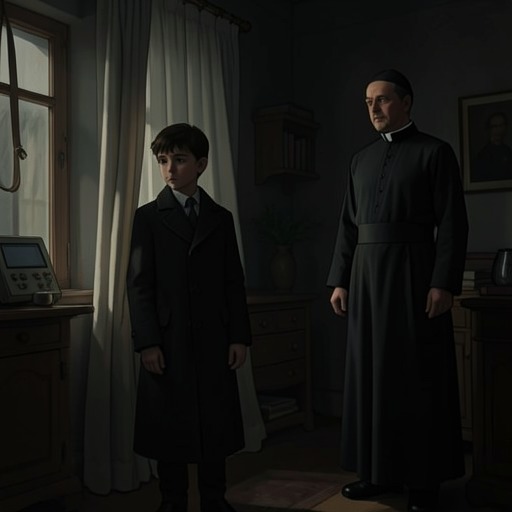
DublinersFather James Flynn’s death is announced by the boy’s uncle and confirmed the next morning by a funeral notice at the priest’s modest shop. When the boy visits the house of mourning with his aunt, the dead priest lies in his coffin, vested for the altar and holding a chalice. The scene settles the fact of death but not the questions surrounding it: ritual and familiar objects frame a body whose earlier presence has already unsettled the boy’s thoughts.
Announcement and Confirmation
The news comes indirectly. After Old Cotter has alluded to the priest’s death, the boy’s uncle tells him that his old friend is gone; when the boy asks who, the uncle answers, “Father Flynn.” The brief exchange turns an uncertain absence into a named loss, while the adult conversation around it has already left the circumstances of the death obscure.
The following morning, the boy goes to the little house in Great Britain Street. It is an unassuming drapery shop, known for children’s bootees and umbrellas and ordinarily marked by a notice offering to recover umbrellas. Now the shutters are up, and a crape bouquet is tied to the door-knocker. Two poor women and a telegram boy read the card pinned to the mourning ribbon; the boy joins them and reads a notice dated July 1st, 1895, identifying the Reverend James Flynn. Public mourning, commercial routine, and the formal notice converge at the shopfront to confirm what the uncle has said.
The House of Mourning
That evening, the boy’s aunt takes him to the house where the dead priest lies. Nannie receives them in the hall and leads them slowly up a narrow staircase, stopping at the landing to beckon them toward the open door of the dead-room. The aunt enters; the boy hesitates, and Nannie repeatedly gestures for him to follow. His entrance on tiptoe makes the viewing a cautious approach rather than a confident participation in the visit.
Inside, dusky golden light comes through the lace end of the blind, and the candles appear as pale, thin flames. Nannie leads the three visitors to kneel at the foot of the bed. The boy pretends to pray, but her muttering distracts him; he notices the careless hook of her skirt and the heels of her cloth boots, worn down to one side. His attention moves between the demands of mourning ritual and these small, ordinary details. For a moment he imagines that the priest is smiling in his coffin, then corrects himself when the group rises and approaches the head of the bed.
The Body and Its Ambiguity
The priest lies solemnly in his coffin, dressed as if for the altar, his large hands loosely retaining a chalice. The sacred vestments and vessel preserve the visible forms of his clerical identity even in death. Yet the body is described as truculent, grey, and massive, with cavernous nostrils ringed by scant white fur; the room is marked by the heavy odor of flowers. The scene gives the boy a definite image of the dead priest, but not an explanation of the earlier unease that has gathered around him.
That uncertainty shapes the event’s significance. Before the visit, the boy’s thoughts have returned to the priest’s grey face and to an imagined, murmuring confession; at the coffin, he first mistakes the dead man’s expression for a smile and then sees that he is not smiling. Death therefore confirms the priest’s absence without resolving the boy’s unsettled impressions. The movement from rumor to notice to funeral viewing is also a movement from adult words to public evidence and finally to an intimate, imperfect act of witnessing: the boy sees the body, but his attention remains divided between prayer, physical details, and the image he cannot quite settle.