The Morkan sisters' annual dance
DublinersThe Morkan sisters' annual dance is a long-running family gathering held at the home of Kate Morkan, Julia Morkan, and Mary Jane Morkan on Usher's Island. It assembles relatives, old friends, pupils, and choir members around music, food, and formal hospitality. The celebration gives Gabriel Conroy the occasion to deliver a speech about the older generation, but its most consequential turn comes after the guests begin to leave, when Gretta Conroy is arrested by a song and Gabriel sees that her inward life reaches beyond the evening's convivial surface.
A household and its annual gathering
The dance is described as an established event in the Morkan family’s calendar: for years it has gone off in splendid style, and it has never fallen flat. Its history reaches back roughly thirty years, to the period after the death of the sisters’ brother Pat, when Kate and Julia left their former home in Stoney Batter and moved to the dark, gaunt house on Usher's Island with their niece, Mary Jane. The gathering therefore joins an evening’s entertainment to a longer history of family life and continuity.
The guest list reflects the sisters’ overlapping social and musical worlds. Family members and old friends attend alongside members of Julia’s choir and pupils of Kate and Mary Jane, including Mary Jane’s more advanced students. The sisters’ work and connections help sustain the occasion: Mary Jane teaches piano and gives an annual pupils’ concert at the Antient Concert Rooms; Julia remains a leading soprano at Adam and Eve’s; and Kate teaches beginners on the old square piano at home. Their modest household nevertheless takes care over food and drink, and its annual dance is both a social occasion and a display of hospitality.
Preparation falls unevenly across the household. Lily, the caretaker’s daughter, is run off her feet as she ushers arriving gentlemen into the pantry and helps them with their overcoats. Kate and Julia have arranged the bathroom upstairs as a dressing-room for the women, but continue to call down the stairs to ask who has arrived. Their attentiveness helps establish the evening’s mix of warmth and fuss: hospitality depends on practical work, while the hosts are particular about the house and its guests.
Guests, music, and the evening’s social tensions
The sisters’ concern about two late arrivals makes the event’s social expectations visible. Long after ten o’clock, Gabriel and Gretta have not yet appeared, and the sisters are also anxious that Freddy Malins may arrive drunk. They fear that his condition could be difficult to manage in front of Mary Jane’s pupils. Gabriel eventually arrives with Gretta, and his joking explanation that she has taken a long time to dress eases his entrance into the gathering, but the hosts’ waiting has already shown how much the evening depends on its guests behaving acceptably.
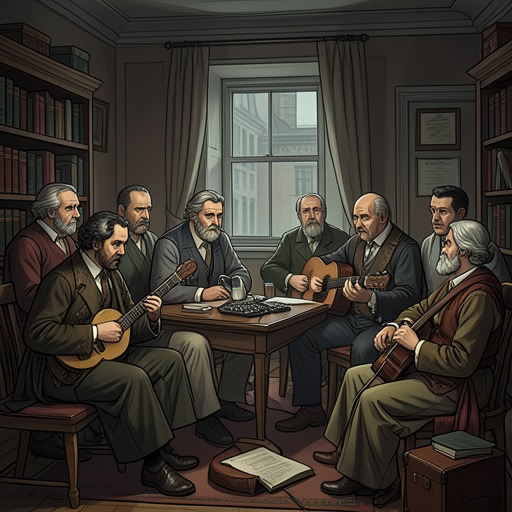
The dance brings together different generations through performance. Mary Jane plays for the company, and the reception is especially enthusiastic when she finishes. Later, Mr Browne escorts Julia to the piano for her song, “Arrayed for the Bridal.” Julia sings with a strong, clear voice and executes the embellishments with confidence. The applause gives her visible pleasure; Freddy Malins, still clapping after the others have stopped, crosses the room to praise her. The moment gives an older performer a public place in the festivities, even as the event’s younger and older generations share the same room.
The music does not erase disagreement. During a dance, Gabriel is partnered with Molly Ivors, who wears an Irish device and motto and abruptly tells him that she has a grievance with him. Their exchange unsettles him and follows him into his preparations for the speech. As he reviews his planned remarks, he considers praising his aunts’ generation for hospitality, humour, and humanity in contrast with what he calls the newer generation’s seriousness and education. The speech is thus shaped partly by the evening’s own conflict: Gabriel turns a personal challenge into an argument about generations and cultural values.
Supper and Gabriel’s speech
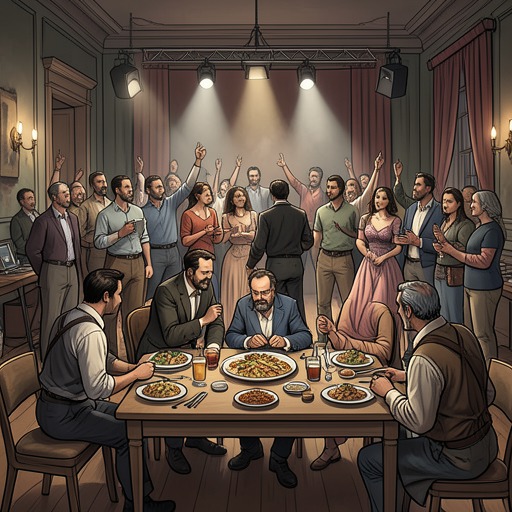
At supper, Gabriel takes his place at the head of a heavily laden table and carves the goose. The meal’s abundance is carefully set out: a ham and spiced beef accompany the goose; jellies, blancmange, fruit, figs, almonds, custard, chocolates, celery, port, sherry, stout, and ale fill the table and surrounding room. Gabriel feels at ease in the role of carver, a familiar and practical form of authority before he must assume the more exposed role of speaker.
The evening’s talk turns solemn before the speech. As fruit and sweets are passed around and the guests are offered port or sherry, conversation subsides; the sisters look down at the tablecloth, and small noises give way to quiet. Gabriel rests his trembling fingers on the cloth and looks up toward the chandelier. His attention briefly wanders beyond the room to the snow outside, the quay, and the park, before he begins. The pause makes the speech a formal centrepiece, but his nervousness also complicates the confident public role he has taken on.
Gabriel opens by presenting his annual task as a pleasing one for which he fears his speaking abilities may be inadequate. The speech’s planned contrast between his aunts’ generation and the younger, more serious generation grows from his earlier encounter with Molly Ivors and his wish to defend the older women. The dance therefore gives him both an audience and a reason to arrange the evening’s social tensions into a polished public argument.
Departure, song, and the private ending
After the gathering, Gabriel does not immediately go out with the other guests. In the dark hall he looks up the staircase and sees Gretta standing near its top, listening. From where he stands, he cannot see her face clearly. He interprets her stillness and the colours of her clothes as an arresting image, imagining that a painter might call it “Distant Music.” The moment shifts his attention away from his speech and the company toward his wife’s absorbed listening.
When the hall door closes, the song and piano become clearer. Gabriel asks the others to be quiet and listens to a male singer whose distant, hoarse voice carries a sorrowful song. The words he can hear begin, “O, the rain falls on my heavy locks.” Gretta remains fixed on the music, while Gabriel watches her and tries to identify what has captured her. The dance’s performances, initially part of shared entertainment, now open onto a memory and feeling that are not his own.
The annual gathering consequently ends on a contrast between public sociability and private inwardness. Its carefully maintained traditions bring the household and its circle together, and its meals, songs, and speeches give the guests common ground. Yet the closing scene turns that shared occasion into the setting for Gabriel’s discovery that Gretta’s response to the song is connected to a life beyond the evening and their marriage. The dance’s warmth is not undone, but it can no longer contain everything that its music has awakened.