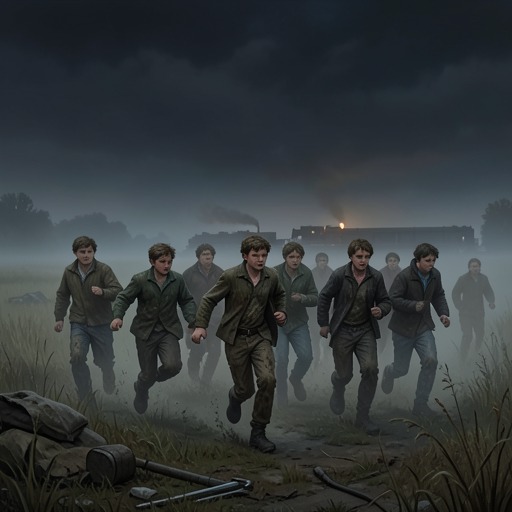
The boy's encounter with the strange man in Ringsend
DublinersThe boy’s encounter with the strange man in Ringsend is the disturbing climax of the narrator’s truant outing with Mahony: a stranger’s nostalgic talk about boyhood gives way to an obsessive delight in punishing boys for romantic interests, and the narrator’s fear culminates in a call for help disguised as a joke. The episode turns an idle adventure into a confrontation with adult menace, while exposing the narrator’s uneasy mixture of self-protection, pride, and dependence on his friend.
The Stranger’s Approach
The boys are resting on a bank in a field when the narrator notices an older man approaching. Shabbily dressed in a greenish-black suit and a high-crowned hat, with an ashen-grey moustache, he passes them, then turns back after walking some distance and retraces his steps. Tapping the turf with a stick, he moves slowly enough that the narrator initially thinks he is searching the grass. He stops beside them, offers a greeting, and sits down carefully.
At first, the man presents himself as a harmless conversationalist. He talks about the weather and the changing seasons, then declares that schoolboy days are the happiest time of life and that he would give anything to be young again. He asks whether the boys have read Thomas Moore, Sir Walter Scott, and Lord Lytton. The narrator pretends to have read all the books named, allowing the stranger’s talk to continue while keeping his own responses guarded.
From Nostalgia to Threat
The conversation changes when the man returns and sits beside the narrator again. Mahony has spotted the cat he chased earlier and runs after it across the field; the stranger watches before turning his attention to the boy who remains. He calls Mahony rough and asks whether he is often whipped at school. The narrator nearly objects that they are not National School boys to be whipped, but holds back.
The stranger then develops his views on corporal punishment with unnerving insistence. A rough, unruly boy, he says, needs a proper whipping; a slap on the hand or a box on the ear will not suffice. As he speaks, the narrator notices his bottle-green eyes beneath a twitching forehead. The stranger’s earlier praise of boyhood now sits beside a wish to discipline it through violence.
His monologue becomes more disturbing when he singles out boys who talk to girls or have a sweetheart. He says he would whip such a boy repeatedly, especially if the boy lied about having a sweetheart. He describes the imagined punishment at length, with a voice that grows almost affectionate and seems to plead for the narrator’s understanding. The threat is not an enacted assault, but the stranger’s relish and fixation make the conversation feel personally dangerous.
Escape and Its Aftermath
When the man pauses, the narrator stands abruptly. He pretends to fix his shoe for a few moments so that he will not reveal his agitation, then says he must go and bids the stranger good-day. He walks up the slope calmly, but his heart beats quickly with fear that the man may seize him by the ankles. At the top, without looking back at the stranger, he calls loudly for “Murphy”—the false name he and Mahony had agreed to use if asked their names.
The narrator has to call a second time before Mahony sees him and answers. Mahony runs across the field as if coming to help. The narrator’s relief is accompanied by penitence: he is ashamed of the paltry stratagem and recognizes that he has always despised Mahony a little. The encounter therefore changes the emotional balance between the boys. The companion whom the narrator had treated with condescension becomes, in the moment of fear, the person whose return he eagerly awaits.
Narrative Significance
The scene is structured around a reversal in the stranger’s apparent character. His opening nostalgia for schooldays seems conventional and benign; his return to the boys and his elaborate account of whipping reveal a disturbing preoccupation beneath that reassuring surface. The narrator’s guarded silence, involuntary glance at the man’s eyes, and physical fear register the shift before he can explain it. By withholding any further account of the stranger’s intentions, the episode keeps its menace unresolved and concentrates attention on the boy’s response.
The invented name “Murphy” first serves as a precaution against disclosure, then becomes the signal through which the narrator summons Mahony without openly admitting that he needs help. That small deception ends not in triumph but in shame and gratitude. The episode’s final emphasis is less on an external resolution than on a private reassessment: confronted with an adult’s threatening speech, the narrator discovers the value of a companion he had considered beneath him.