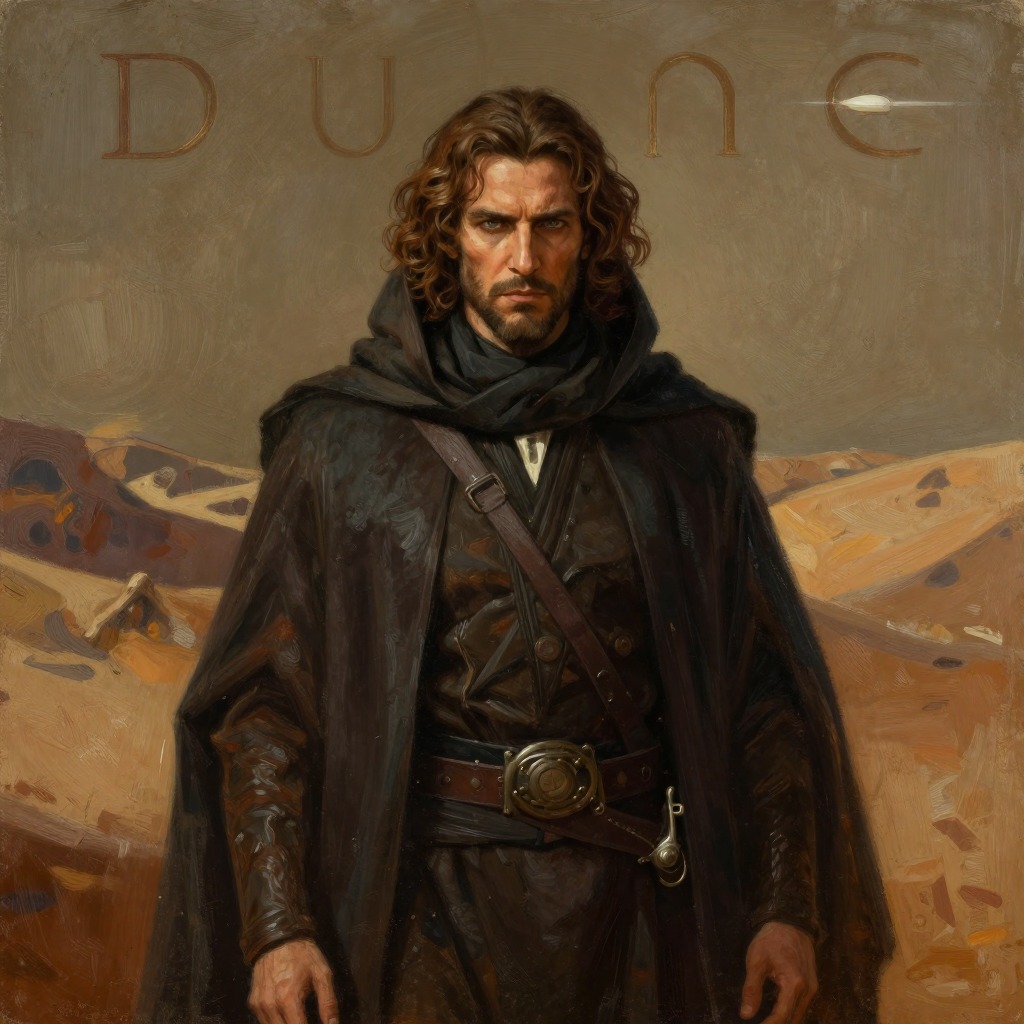
Mentat
DuneThe Mentat is a central institution in the Imperium of Dune, a human being trained from infancy to perform the functions of a computer. Following the Butlerian Jihad, which outlawed 'thinking machines,' humanity was forced to develop its own mental capacities to fill the void. The Mentat is the result: a 'human computer' capable of immense logical analysis, data processing, and strategic prediction. Mentats are not merely calculators, however; they are conditioned to be aware of their own emotional biases, though this conditioning is often imperfect. The role is both a profession and a form of identity, shaping the lives of those who undertake it, from the loyal Thufir Hawat to the treacherous Piter de Vries, and even the young Paul Atreides, who discovers he has the potential to become one.
Origins and Purpose
The Mentat arose from the ashes of the Butlerian Jihad, a crusade against machines that 'counterfeit a human mind.' As the Reverend Mother Gaius Helen Mohiam explains to Paul, 'The Great Revolt took away a crutch. It forced human minds to develop. Schools were started to train human talents.' The Mentat is one of the two chief survivors of these ancient schools, alongside the Bene Gesserit. While the Bene Gesserit focus on politics and breeding, the Mentat emphasizes 'almost pure mathematics' and logic. The Mentat's purpose is to serve as an advisor and strategist to the Great Houses, providing the analytical power that machines once offered. They are trained to process vast amounts of data, to see patterns and possibilities that ordinary minds miss, and to present their conclusions with a certainty that can be both invaluable and dangerous.
Training and Abilities
Mentat training is a lifelong process that begins in infancy. As the Duke Leto Atreides tells Paul, 'Mentat training had to start during infancy and the subject couldn't be told because it might inhibit the early...' The training involves developing mnemonic skills, focusing awareness, and sharpening sensitivities to the point where the Mentat can 'compute' on the basis of 'fractional minutiae.' Thufir Hawat, the Atreides Master of Assassins, exemplifies this, able to analyze a situation with 'the curse of being a Mentat. You can't stop analyzing your data.' The Mentat's abilities are not limited to pure logic; they also involve a deep understanding of human nature, as Hawat demonstrates when he deduces the Baron's plans and the nature of the Fremen. However, the training is not without its costs. Mentats are often portrayed as emotionally detached, and their reliance on logic can make them vulnerable to manipulation, as seen with Piter de Vries, whose 'twisted' Mentat abilities are warped by his sadistic nature.
Key Mentats in the Narrative
Thufir Hawat is the quintessential loyal Mentat, serving three generations of Atreides. His dedication is absolute, and his skills are formidable, yet he is not infallible. His suspicion of Lady Jessica, planted by the Harkonnens, nearly destroys the Atreides from within. Hawat's fate is tragic: captured by the Baron, he is forced to serve his enemy, his body impregnated with a latent poison that requires a regular antidote. His death, sacrificing himself to save Paul, is a final act of loyalty that redeems his earlier doubts. Piter de Vries, in contrast, is a 'twisted Mentat,' a product of the Tleilaxu, whose brilliance is corrupted by his love of pain. He serves the Baron with cunning and venom, but his instability makes him a liability, and he is ultimately killed by the Duke's poison tooth. Paul Atreides himself is revealed to have Mentat potential, a fact that his father tells him with pride. Paul's training, combined with his Bene Gesserit upbringing and his prescient abilities, makes him a 'super-Mentat,' capable of seeing the future as a 'computation of most probable futures.' This combination of skills sets him apart from all other Mentats, making him the Kwisatz Haderach, the one who can be many places at once.
The Mentat's Role in Politics and War
Mentats are indispensable to the political and military machinations of the Imperium. They serve as advisors, spies, and assassins, their logical abilities making them invaluable in the complex game of kanly, the formal feud between Great Houses. The Baron Harkonnen relies on Piter de Vries to devise his schemes, while the Duke Leto trusts Thufir Hawat to protect his family and plan his campaigns. The Mentat's ability to 'see' the implications of data is a form of power in itself, as Hawat demonstrates when he analyzes the Harkonnen attack on Arrakis, calculating the immense cost and the strategic implications. The Mentat's role is not merely reactive; they are also proactive, anticipating enemy moves and devising counter-strategies. This makes them targets as well as assets, as the Baron's desire to 'woo' Hawat shows, seeking to turn an enemy's weapon into his own.
The Mentat and the Human Condition
The Mentat represents a fundamental tension in Dune: the desire for pure logic versus the inescapable reality of human emotion. Mentats are trained to suppress emotion, to see it as a 'cloud' that obscures reason. Yet, as the narrative shows, emotion cannot be entirely eliminated. Hawat's loyalty, Piter's cruelty, and Paul's grief all shape their decisions, often in ways that logic alone cannot predict. The Mentat's quest for certainty is ultimately futile, as the future is always uncertain, and the 'error factor' is a constant companion. This is perhaps best expressed by the First Law of Mentat, which Paul quotes: 'A process cannot be understood by stopping it. Understanding must move with the flow of the process, must join it and flow with it.' The Mentat, therefore, is not a machine but a human who has learned to think in a particular way, and who must constantly struggle to reconcile the demands of logic with the demands of the heart.