The Great Convention
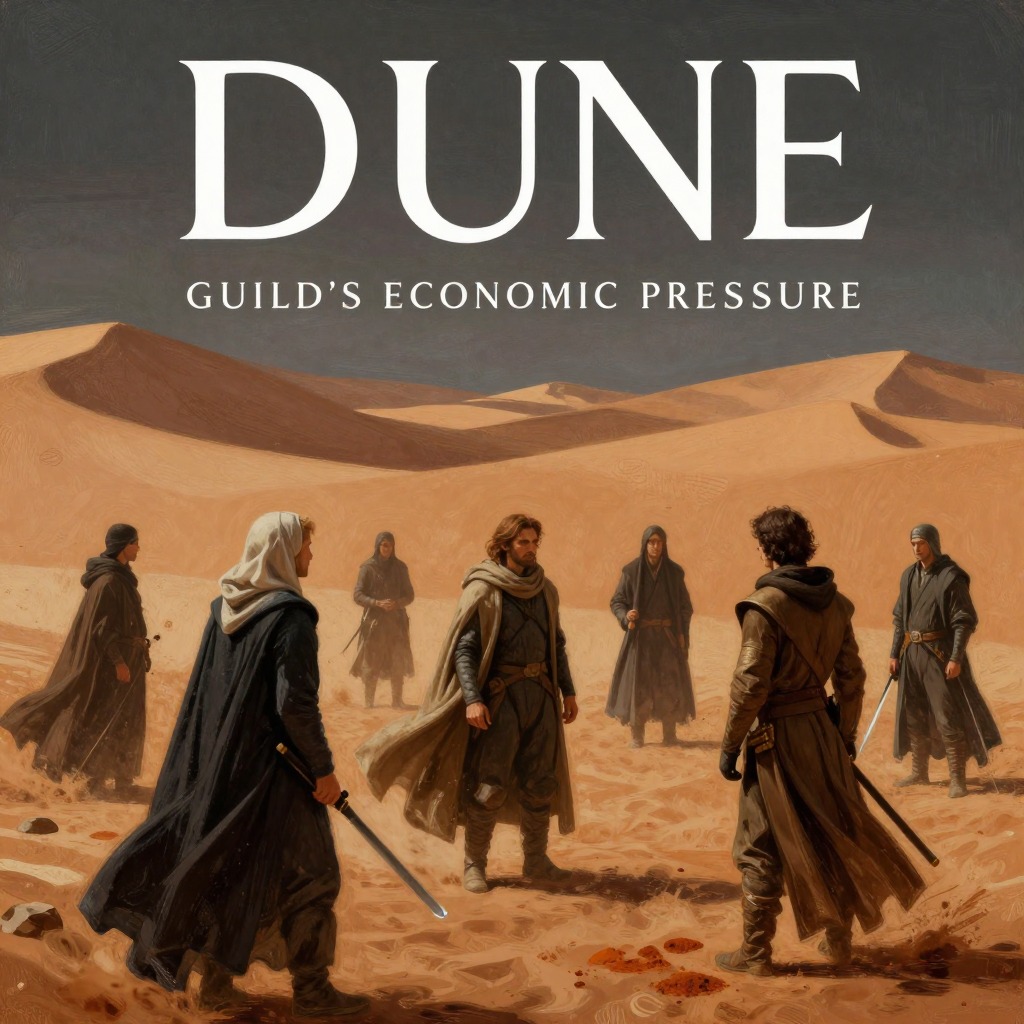
DuneThe Great Convention is the foundational legal and political framework of the Imperium in Frank Herbert's Dune. It is a universal truce, a set of rules designed to prevent the total annihilation of humanity through the unchecked warfare of the Great Houses. Its power is not derived from a single enforcement body but from a delicate balance of power between the three pillars of Imperial society: the Spacing Guild, which holds a monopoly on interstellar transport; the Landsraad, the assembly of the Great Houses; and the Padishah Emperor, who rules from the Golden Lion Throne. The Convention's most critical rule, and the one that most directly shapes the novel's plot, is the absolute prohibition against the use of atomic weapons against human targets. This rule is so fundamental that its violation would invite 'planetary obliteration,' a threat that hangs over every major conflict in the story.
The Prohibition on Atomics and Its Enforcement
The Great Convention's central tenet is the ban on atomic weapons. This is not a mere suggestion but a law whose violation carries the ultimate penalty. As Duke Leto Atreides explains to his son Paul, the Convention's language is clear: 'Use of atomics against humans shall be cause for planetary obliteration.' The threat of this collective punishment is what keeps the Great Houses from resorting to such weapons in their feuds and wars. The enforcement mechanism is not a standing army but the mutual self-interest of all parties. If one House were to use atomics, the others would unite to destroy it, as the very fabric of their civilization depends on this prohibition. This understanding is so ingrained that even the most ruthless actors, like the Harkonnens, are careful to observe the forms of the Convention, even as they plot to destroy their enemies through other means. The Baron Vladimir Harkonnen, for instance, is careful to avoid any action that could be seen as a flagrant violation, preferring to use treachery and overwhelming conventional force to achieve his goals.
The Convention as a Political Tool
The Great Convention is not merely a set of rules; it is a political tool that can be manipulated by those who understand its nuances. The rules are designed to protect innocent bystanders and limit the scope of conflict, but they also create opportunities for legalistic maneuvering. The Convention's rules are often invoked to justify or condemn actions, and its language is subject to interpretation. For example, when Paul-Muad'Dib plans to use atomics to blast a hole in the Shield Wall during the final battle for Arrakis, he is careful to frame his action as a use of atomics against a 'natural feature of the desert,' not against humans. This hair-splitting is a calculated move, as Paul understands that the 'hair-splitters up there will welcome any point' to avoid a catastrophic conflict. He uses the Convention's own language to justify his actions, demonstrating that the law is a weapon that can be wielded as effectively as any army. This episode highlights the Convention's dual nature: it is a genuine barrier against total war, but it is also a set of forms that can be obeyed in letter while being violated in spirit.
The Convention and the Balance of Power
The Great Convention is the glue that holds the Imperium together, but it is also a reflection of the underlying power dynamics. The Convention's rules are only as strong as the willingness of the Great Houses to enforce them. The Emperor, Shaddam IV, is able to use the Sardaukar to attack House Atreides because he does so in secret, disguising his soldiers in Harkonnen livery. This is a violation of the spirit of the Convention, but it is done in a way that maintains the 'forms' and avoids open defiance. The Emperor's actions are driven by his fear of Duke Leto's growing power, a fear that is rooted in the Duke's potential to create a fighting force as strong as the Sardaukar. The Convention, in this context, is a tool of the powerful, used to maintain the status quo and prevent any single House from rising too high. The Duke's plan to use the Fremen as a desert power is a direct challenge to this order, as it would give him a military force that could rival the Emperor's own. The Convention, therefore, is not a neutral arbiter of justice but a mechanism for preserving the existing hierarchy.
The Convention's Role in the Final Conflict
The Great Convention's rules are central to the climax of the novel, as Paul-Muad'Dib uses them to force the Emperor's surrender. After his victory on Arrakis, Paul does not simply execute the Emperor; he invokes the Convention to legitimize his claim to the throne. He offers the Emperor a choice: submit to his demands or face the consequences. Paul's power comes not from his military might alone but from his control over the spice, the most valuable resource in the universe. He threatens to destroy the spice production on Arrakis, a move that would cripple the Spacing Guild and plunge the Imperium into chaos. This threat is a form of 'atomic' blackmail, but it is done within the framework of the Convention, as Paul is not using atomics against humans but against a resource. The Emperor, faced with this existential threat, is forced to negotiate. Paul's demands are framed in the language of the Convention, as he seeks to legitimize his rule through a marriage to the Princess Royal, Irulan. This political marriage is a way to 'weld peace out of this moment' and to enlist the support of the Great Houses of the Landsraad. The Convention, in this final act, is not a barrier to Paul's ambition but a tool he uses to achieve it, demonstrating that the law is ultimately what the powerful make of it.