Christmas
EileenChristmas is the season against which Eileen Dunlop measures disappointed hopes, family estrangement, and the possibility of escape. Across her recollections, it offers familiar signs of warmth—food, drink, decorations, gifts, and religious observance—but these rituals rarely deliver the care they promise. At Moorehead, the holiday becomes another instrument of institutional control; in Eileen’s family, it is a brief, alcohol-soaked interlude in an otherwise unhappy home. The final Christmas Eve she spends in X-ville coincides with her departure, making the season both a recurring source of pain and the setting for a break with her former life.
Childhood Christmases
At the Dunlop family home, Christmas did not transform the ordinary conditions of Eileen’s childhood. Meals were meager and uncomfortable, and her parents argued at the table in front of Eileen and Joanie. On holidays, however, alcohol was abundant. Eileen remembered helping her parents prepare mixed drinks, tasting the sweet ingredients as she carried them between the kitchen and the living room. She associated these occasions with records playing and a fire burning while Joanie entertained the guests by dancing to Elvis. The lively details coexist with Eileen’s position as a dutiful child who still expected that something good might arrive.
The expectation was repeatedly disappointed. Eileen hoped for gifts such as a microscope or paints, but Christmas morning generally brought only a dollar bill for each child from Charlie Dunlop, sometimes accompanied by socks or pencils from Eileen’s mother. A store-bought sponge cake was one of the few pleasures she recalled from year to year. The modest gifts and limited food stand in contrast to the holiday’s promise of abundance, while the children’s hopes reveal how much emotional meaning Eileen invested in the day.
Christmas also brought relatives into the home, but not a wider sense of belonging. Eileen’s aunt Ruth took little interest in the children and brought practical, inexpensive gifts; her insistence on prayer stood against Eileen’s mother’s drunken impatience. Eileen nevertheless remembered her mother as seeming less difficult at Christmas, when she might secretly make Eileen laugh. After Eileen’s mother died, Eileen and Charlie silently agreed to stop observing the holiday. Eileen once gave him a tie, a gift she later regarded as cruelly useless given his circumstances; Joanie sometimes sent a card but did not invite Eileen to her own parties. The holiday’s family rituals thus narrowed rather than repaired the distance between them.
Christmas at Moorehead
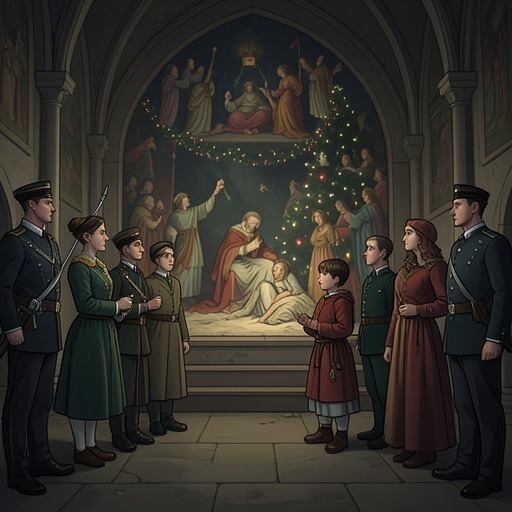
In her work at Moorehead, Christmas appeared first as a set of seasonal tasks. One year, after visiting hours, Eileen was asked to decorate a pine tree in the waiting room. The ornaments had been packed away in a sagging cardboard box: aging metal balls, plastic holly, tinsel, and paper snowflakes made by boys in earlier years. The snowflakes’ carefully written names and the effort of arranging the decorations gave the work a quiet, methodical quality. Eileen found it easy to lose herself in the task, even as the holiday stirred her longing for a life rescued from misery.
The prison’s seasonal observances did not create a refuge from its ordinary discipline. Church volunteers decorated the halls with pictures of Jesus and Santa Claus, and Dr. Frye encouraged the boys to sing carols and make cards. These activities repeatedly went wrong: the boys were humiliated by singing, mocked one another, and turned cards into vehicles for insults and threats. Staff confiscated the cards and circulated them before Eileen was told to file them. The contrast between the decorations’ reassuring purpose and the boys’ hostile responses makes the institution’s version of Christmas feel less like fellowship than another rule-bound performance.
The same contradiction governed visitation. Mothers waited in the prison hallway, where only one visit could take place at a time, and the visits themselves were limited to seven minutes. During one, a twelve-year-old boy who had burned down his family’s house began to cry when he saw his mother. Randy blocked her attempt to pass him a handkerchief, and Eileen repeated the rule that visitors could not give children anything. The mother’s scarf revealed burn scars, a visible reminder of the pain carried into the visiting room. Eileen understood that the restrictions did not simply protect the children; they helped keep them deprived. The holiday therefore exposed the human cost of Moorehead’s procedures even as Eileen enforced them.
Hope, performance, and disappointment
Christmas exerted a particular force on Eileen because she believed that sustained suffering and goodness might eventually be rewarded. She recalled wishing for angels to lift her out of her circumstances, as in a movie, and expecting a miracle that never came. At Moorehead, the worn decorations and old paper snowflakes intensified this wistfulness: the holiday’s recognizable symbols returned each year, but repetition did not bring renewal. Her later refusal to acknowledge Christmas reflects the pain of having hoped so often for a different life and having found no transformation in the ritual itself.
The season also shaped the face Eileen presented to other people. At work she practiced a composed expression in the mirror and maintained her professional manner amid scenes of distress. During visitation, she followed the rules and spoke reassuringly even when she knew the explanation she gave was false. Christmas did not suspend this emotional performance. Instead, its demand for cheer sharpened the contrast between outward ceremony and private misery, from the prison’s decorations to the family gatherings sustained by drink.
The final Christmas Eve in X-ville
On the Christmas Eve that Eileen later identified as the last of her life in X-ville, she had $647 in savings and a gun that had belonged to Charlie. The gun, once associated with his authority and fears, gave her a sense that escape was possible. She expected to leave her father and return later that night; she also imagined drinking with him the next morning and taking her mother’s remaining pills, expecting them to make her sleep for much of the day. His response to her plans for a Christmas party was to mock her appearance and tell her to be home for dinner. Eileen did not feel obliged to stay with him: the holiday’s customary family obligation had little power against her decision to go.
That day, a call from Rebecca Saint John carried an intensity Eileen had rarely experienced in friendship. Eileen understood friendship as a form of love demonstrated through sacrifice, and she believed Rebecca had awakened a feeling unlike anything she had known before. In retrospect, however, Eileen recognized that Rebecca’s approach was strategic as well as affectionate: Rebecca believed Eileen could be useful to her. This later understanding complicates the holiday’s promise of connection. Eileen’s longing for a true friend made her receptive to Rebecca, but their relationship did not become the secure rescue Eileen had hoped for.
By the night’s end, Rebecca was gone and did not arrive to leave with Eileen. Eileen helped Charlie to bed after he drank gin, said goodnight, and closed the door. She then looked at herself in the bathroom mirror, felt certain that it was time to go, and said goodbye to the family home. She knew the house mattered to her and expected that leaving it would bring grief in the weeks and months ahead, but she departed without a grand farewell. Christmas, once the annual occasion for expecting a miracle, now marked an act of self-directed departure. Its significance lies not in reconciliation or festive renewal, but in the point at which Eileen stops waiting for the holiday to change her life and leaves X-ville herself.