Dodge Coronet
EileenThe Dodge Coronet is Eileen’s worn family car and, for a time, her only means of getting beyond the confines of X-ville. Its dents, rust, faulty exhaust, and odd contents make it more than a neutral vehicle: it is a material refuge on which Eileen’s hopes of privacy and escape depend, even as its defects put her at risk.
Physical Condition and Private Keepsakes
Since Charlie Dunlop had become unfit to drive, Eileen drove his old Dodge Coronet, a matte-green, four-door car marked by scrapes and dents. Salt and ice had rusted holes through its floorboards. The account gives its damage no glamour: this was a car worn down by years of use, and its mechanical condition could not be separated from its usefulness to Eileen.
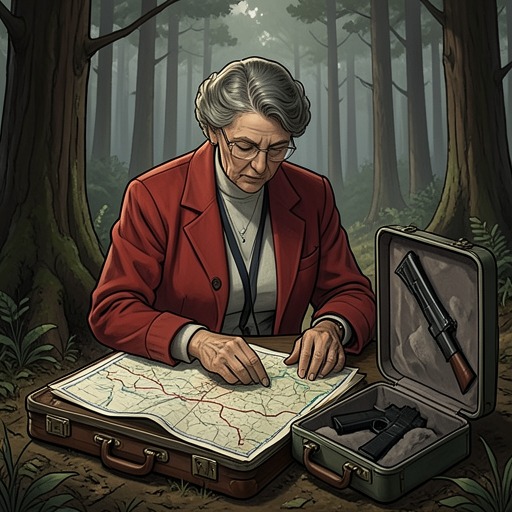
The glove box held an unlikely collection: a broken flashlight, a map of New England freeways, a few green nickels, and a dead field mouse Eileen had found frozen on the porch. She had picked the mouse up by its tail and put it away, then sometimes checked on it through the winter, watching for signs of decomposition that were invisible in the cold. Eileen recalls that keeping it there seemed to make her feel powerful; she treated it as a small totem or good-luck charm. The car thus carried both practical remnants and a private object invested with meaning.
Mobility and the Prospect of Escape
The Dodge Coronet mattered because it let Eileen leave the family home. She describes being relieved to have somewhere to go rather than spend the evening pacing the attic or watching Charlie drink. The car gave that departure a concrete form: freedom was not yet a new life elsewhere, but the ability to get out of the house and move through town on her own.
Eileen’s sense of possibility extended beyond X-ville. Boston, with its brick buildings and ivy, suggested to her that other young people might live more freely. She had visited once with her mother, who was seeing a doctor, and later began to imagine that New York City could offer a solution to life in X-ville. On a summer drive down the coast, however, the car ran out of gas, leaving her stranded on a country road about an hour from home. An older woman gave her a dollar and a ride to a filling station. The episode exposed the distance between imagining escape and being able to manage its practical demands.
The map in the glove box sits beside another part of that aspiration: Eileen was responsible for depositing Charlie’s pension checks, and she saved money in cash in the attic. She considered withdrawing money from the Dunlops’ savings under the pretext of buying a car. The Dodge Coronet was already available to her, but its presence did not resolve the material obstacles to leaving; money, fuel, and a safe vehicle all mattered.
The Car in Eileen’s Daily Life
Eileen also used the Dodge Coronet while watching Randy. She drove to his home and parked across the street, crouching behind the steering wheel and keeping his house in view through the side-view mirror. The car let her remain nearby without approaching him, extending her private, sustained observation of his life. On another trip, she hoped to see him or follow the sound of his motorcycle through X-ville. When he was not home, she changed plans and went to the cinema instead.
The car’s appeal was inseparable from a serious mechanical problem. Eileen knew that something was wrong with its exhaust, which made her sick while driving. She nevertheless delayed dealing with it and sometimes lowered the windows even in severe cold. She was afraid that making a fuss might cause the car to be taken away. Its defect therefore sharpened its importance: the vehicle was dangerous, but losing it seemed worse to Eileen than continuing to use it.
Her driving had a different character from Charlie’s. He had driven the car carelessly, mounting curbs, taking corners too fast, running out of gas, and scraping it against delivery trucks and buildings. Eileen describes herself as a careful driver who did not speed or run red lights. At night she drove slowly, watching the town pass as though it were a movie. The familiar streets and warmly imagined homes she passed made her feel that other people had more comfortable lives, while the act of driving allowed her to look at those homes from a temporary distance.
Mechanical Risk and Narrative Significance
That distance never made the Dodge Coronet a dependable escape machine. During one winter drive home from Randy’s, Eileen veered into a snowbank after nearly falling asleep at the wheel; her foot had slipped from the pedal, and the impact was slight. On the Sunday she drove toward Boston, melting ice made the roads slick. She initially drove with the windows open to avoid the exhaust, then closed them against the cold. In traffic approaching the city, the fumes and fatigue made her woozy. After briefly resting her head on the steering wheel, she woke to cars streaming past and honking, then struggled to stay alert as a police car pulled her over.
The contrast defines the car’s place in Eileen’s story. It carries her away from the house, to Randy’s, and toward Boston, but its exhaust, lack of fuel, and unreliable performance repeatedly expose how fragile that mobility is. Its map points outward while its broken flashlight and dead mouse remain in the glove box; its doors open onto a wider world, yet the car itself bears the wear of Charlie’s past use and the hazards of Eileen’s present dependence. The Dodge Coronet makes escape imaginable and physically possible, without making it safe or assured.