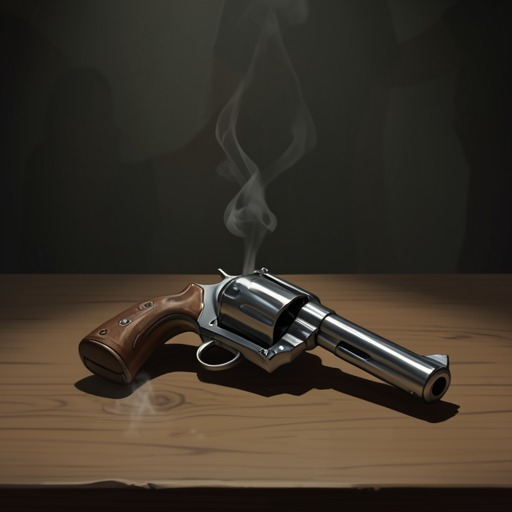
Smith & Wesson Model 10
EileenThe Smith & Wesson Model 10 is Charlie Dunlop’s revolver, passed to Eileen Dunlop shortly before she leaves X-ville. It moves from the background of her father’s police career and troubled retirement into Eileen’s everyday possession, where it becomes both a source of confidence and a means of threatening Rita Polk. Eileen keeps it during her first weeks away, then disposes of it by throwing it from the Brooklyn Bridge. Its changing place in her life links the household she leaves to the escape she is trying to make.
Identity and Transfer
The revolver had belonged to Charlie Dunlop throughout his years on the police force. Eileen recalls that it had seemed to occupy a place at the family dinner table alongside her parents and Joanie. After Charlie retired, he carried it in a holster beneath his clothes as he moved around the house. In Eileen’s recollection, the gun was therefore not a new presence: it had long been part of domestic life, even when no one was handling it.
Eileen had never held it, or any firearm, before Charlie gave it up. During a visit by a police official, Charlie handed the gun to the official, who placed it in Eileen’s open hands. She later identified it as a Smith & Wesson Model 10, with a four-inch barrel and a weight of nearly two pounds. The wooden handle was marked with the family name. Its substantial weight and cold surface made the transfer a startling physical experience for her, despite years of familiarity with the weapon’s presence in the house.
Charlie did not ask Eileen to return it after the official left. She put it in her purse and locked the front door behind her. At first she was unsure what to do with the weapon; in the car she considered putting it in the glove compartment, but a frozen mouse there made her leave it out. She drove with the gun on her lap. The recollection makes the decision concrete and unceremonious: the weapon passed into her keeping amid the ordinary disorder of the car, rather than through a planned act of preparation.
From Household Presence to Personal Possession
The gun’s effect on Eileen becomes clear as she drives to work at Moorehead. She describes feeling calmer and soothed by having it, although she recognizes that her hangover may also have made her feel less alert. Instead of leaving her purse locked in the car, she brings it inside and sets it openly on her desk. Reaching toward the purse gives her a mixture of fear and excitement. An object formerly carried by her father now sits within reach at her workplace, visible in a setting where she otherwise follows institutional procedures closely.
On Christmas Eve, Eileen takes the revolver from beneath her pillow. She has six hundred forty-seven dollars saved in her jewelry box, and she regards the gun and the money together as resources for getting free. The weapon’s earlier associations with Charlie’s authority and his imagined threats have not disappeared, but Eileen now interprets it as something that might clear a path for her. She privately imagines taking it out with Rebecca, even fantasizing about shooting at trees or at the moon and stars. These plans are imagined, not reported actions; they reveal how readily possession of the gun enlarges her sense of what might be possible.
Use in Rebecca’s Plan
The revolver enters Rebecca’s plan when the two women are considering how to obtain a signed confession from Rita Polk. Eileen brings the gun from her purse and places it on the table. Rebecca examines the possibility of using it to make Rita believe that her life is in danger, reasoning that fear might make her stop denying what happened. Rebecca then covers Eileen’s face with a scarf so Rita will not recognize her from Moorehead, and directs her to hold the weapon with both hands.
In the cellar, Eileen uses the gun as a threat while Rebecca presses Rita to explain the events in her home. Eileen later judges her own handling of the situation as poorly controlled and recalls that the scene was improvised. Even so, the weapon has the intended effect of frightening Rita. Eileen’s account describes intimidation, not a shot being fired: within the events recounted here, the gun’s force lies in its visible presence and the danger it seems to promise. Its role changes again, from private reassurance to an instrument in a joint attempt to compel a confession.
The episode also exposes a contradiction in Eileen’s new confidence. She had associated the gun with freedom and with the ability to make her way out of X-ville, yet in Rebecca’s cellar it becomes a means of exerting control over someone else. The same object that seemed to open possibilities for Eileen helps Rebecca stage a threat. The revolver does not simply give Eileen independent power; its use is shaped by Rebecca’s plan, their shared performance, and the fear they create in Rita.
Disposal and Significance
Eileen keeps the Smith & Wesson Model 10 for a few weeks after she runs away. She eventually throws it off the Brooklyn Bridge. The brief period of continued possession gives the gun a defined endpoint: it travels with her beyond X-ville, but does not remain part of the life she is making elsewhere. The account does not describe her firing it, and it does not give a further reason for the disposal; those limits leave the final act distinct from the earlier scenes of threat and imagined possibility.
Across its appearances, the revolver shifts from an inherited feature of Charlie’s household and policing past, to an object that calms Eileen, to a tool in Rebecca’s confrontation with Rita, and finally to something Eileen relinquishes. Its material details matter to that progression: the unfamiliar weight in her hands, the marked wooden grip, and the purse in which she carries it make a distant family object physically present in her decisions. The gun connects the home Eileen leaves with the escape she undertakes, while its eventual disposal marks the end of its practical place in her possession.