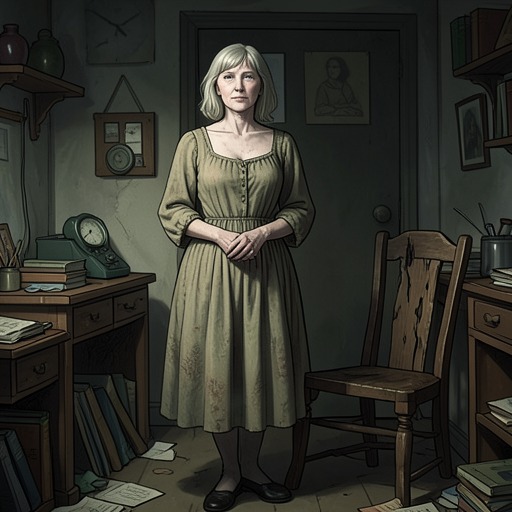
Dunlop home
EileenDunlop home is both Eileen Dunlop’s family house and the domestic world she must leave in order to escape X-ville. Its rooms organize a life shaped by her care for Charlie Dunlop, his alcoholism and arbitrary demands, and the ordinary tasks through which Eileen sustains the household. At the end, the house is not simply a place she abandons: its furnishings and worn details make departure a painful break with the only home she has known.
Setting and Physical Layout
The house stands in a town Eileen describes as brutally cold in late December. Snow covers the yards and rises to the first-floor windowsills; each morning, she salts the narrow path from the porch to the street. Icicles hang above the front door. The winter setting makes the house’s threshold a recurring practical concern, while also giving the building a distinct place in Eileen’s memory of her last days there.
The scenes establish a domestic interior by moving among the kitchen, foyer, living room, upstairs landing, attic, and Eileen’s mother’s bedroom. The kitchen contains Charlie’s chair and an often-open refrigerator. The foyer, where coats hang and bottles and newspapers can accumulate, is part of the route from the front door into the house. The living room windows are so dirty that Eileen can barely see through them from outside. Upstairs, the attic is where she takes a bottle of gin and sleeps; the stairs connecting it to the rest of the house have also been the site of a fall during one of Charlie’s delusional episodes. These are not presented as neutral rooms so much as the familiar places through which Eileen measures the household’s disorder and her own attachment to it.
A Household Governed by Care and Unpredictability
Although Eileen is an adult and has no formal curfew or official house rules, living with Charlie means responding to his rages and humiliating, shifting demands. He treats her independence as disloyalty and expects her to function as his nurse, aide, and concierge. Her domestic responsibilities include procuring gin; she sometimes walks to Lardner’s for it. The house is rarely without alcohol, and Charlie’s brief efforts to improve or sober up do not last. Projects such as organizing the basement or insulating the attic are abandoned, leaving their unfinished traces in the home.
Charlie’s condition reaches beyond the private rooms. When he leaves the house, he may behave in ways that bring the X-ville police to return him home. Eileen dreads the doorbell and the familiar encounter in which an officer brings her intoxicated father back while Charlie complains about her and searches for alcohol. The officers do not meaningfully interrupt the household pattern: they leave, and Eileen remains responsible for him. The house is therefore both the destination of these returns and the place where their consequences continue.
Eileen’s own actions show how thoroughly she has adapted to this arrangement. On one morning she enters through a living-room window after Charlie ignores the front door. She knows there is no official rule barring her from the house, but his moods have made ordinary access and ordinary conversation feel uncertain. Later, after an exhausting day, she considers whether to help him, then decides not to stop for gin. That moment of refusal is small, but it marks a shift in how she understands her obligations: his needs no longer automatically determine every errand she undertakes.
Rooms as Memory and Shelter
The house’s spaces preserve Eileen’s memories in a notably material form. Looking back on childhood, she recalls the furniture, its arrangement, and seasonal changes in the backyard more readily than people’s faces. She remembers people as shadows leaving a room. This emphasis makes the house less a backdrop than the surviving structure through which her past can be recalled: familiar objects and rooms remain legible even where personal memories seem indistinct.
The attic becomes a temporary retreat on a night when Eileen takes her purse and gin upstairs and places her gun beneath her pillow. The gesture is linked in her recollection to childhood vulnerability and uncertainty about what may have happened while she slept. In the same broader history, Charlie once falls on the attic stairs while moving through the house in a state of delusion, and Eileen takes him for medical care. The attic and stairs thus belong to both the repetitive work of looking after him and Eileen’s effort to secure a private space for herself.
Her mother’s bedroom holds a different kind of memory. After Eileen’s mother has died, Eileen recalls the weight of her in the bed and the coldness of her hands. On a later night, she hears Charlie sleeping behind the closed bedroom door and does not enter to retrieve the remaining pills. The room brings together bereavement, the limits of Eileen’s care, and the household’s continuing presence after her mother’s death.
Leaving the House
Near the end of Eileen’s life in X-ville, she leaves the house by the shoveled path to meet Rebecca Saint John. The departure begins as a purposeful movement out into the street, but the decision to leave becomes final only later. On her last night at home, she finds the kitchen empty of Charlie, eats a simple meal, and goes upstairs. She takes gin and her purse to the attic and sleeps with the gun beneath her pillow. The objects she carries and the room in which she waits register how departure has become a practical necessity rather than a passing impulse.
When Eileen returns to the house, Charlie is there but Rebecca Saint John is not coming. After helping her father drink gin and settle into bed, Eileen recognizes that there will be no grand reunion or dramatic farewell between them. She goes to the bathroom and sees herself as changed; from that point, the gun and money in her purse make leaving immediate. Before going, she pauses over the house’s rooms and details—the chairs, shelves, lamp, walls, floorboards, and banister—and understands that leaving hurts precisely because the place has been her home. She departs without carrying away the shoes she briefly considers bringing back for her father. Dunlop home remains behind as the setting of Eileen’s care, confinement, memory, and decisive break with her former life.