X-ville
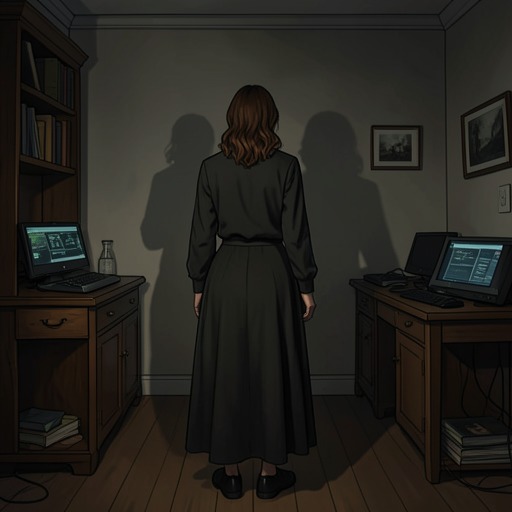
EileenX-ville is the New England town where Eileen Dunlop was born and raised, and the place she must leave in order to begin a different life. In her retrospective account, it is both an intimate map of home—its streets, rooms, and familiar public buildings—and a landscape of social division and entrapment. The town’s winter-bound geography gives her departure a concrete route, while its neighborhoods and institutions make visible the life she has spent years trying to endure.
Setting and Geography
X-ville is presented through contrasts rather than a comprehensive town description. Eileen’s neighborhood is orderly and carefully maintained, with tree-lined streets and houses tended with civic pride. Closer to the ocean, poorer residents live among smaller, less well-kept homes and yards crowded with toys and rubbish. Eileen has driven past that district only a few times before her final journey, and her response is divided: the residents’ hardship attracts and frightens her, while their surroundings sharpen her shame about her own sense of disorder and failure.
The coastal area is also the part of town associated with Rebecca Saint John’s home. When Eileen drives there, the narrow streets, modest houses, chain-link fences, and few cars differ sharply from the more comfortable neighborhood she knows. Rebecca’s apparent wealth makes her residence there seem puzzling to Eileen, who assumes that someone with means would prefer a more central and sophisticated place such as Boston or Cambridge. The mismatch between Eileen’s assumptions and the street she encounters exposes how little she understands either Rebecca or the town beyond her own familiar surroundings.
Winter gives X-ville a particularly strong physical presence. In the December of Eileen’s planned disappearance, several feet of snow remain in yards and along windowsills; thawing slush hardens again as temperatures fall. Eileen salts the narrow path from her family home to the street, while icicles and snow-covered roads mark the season’s hazards. The weather does not merely frame the town: it slows travel, covers familiar ground, and accompanies the difficult passage from her private life to the road out.
Neighborhoods, Work, and Public Life
X-ville’s divisions are social as well as geographical. Eileen feels estranged from the tidy neighborhood around her family home and regards its Lutheran residents as judgmental, despite their occasional practical help. Neighbors sometimes tend the unmaintained lawn and hedges, ostensibly as gestures of appreciation for her father’s former public service and sympathy for Eileen’s circumstances. Yet the Dunlop house remains conspicuously separate from neighborhood rituals: it has no Christmas lights, wreath, or illuminated tree, and children do not come to its door at Halloween. Eileen buys candy anyway, then eats it herself in the attic. The small episode makes the household’s isolation part of the town’s visible seasonal life.
Eileen’s work at Moorehead, a private juvenile correctional facility she understands as a prison for children, is another part of her daily existence in X-ville. She is twenty-four and earns fifty-seven dollars a week as a kind of secretary. The facility’s visiting procedures bring her into contact with incarcerated boys and their mothers, but the rules and staff culture reinforce the town’s atmosphere of constraint rather than offering meaningful connection. Eileen enforces restrictions on visits and searches women visitors, even as she privately recognizes the distress around her. At work she maintains a carefully controlled expression, concealing her sensitivity and unease behind what she calls her death mask. Moorehead therefore functions not only as her workplace but as an institution through which the town’s hierarchy and neglect become tangible.
The X-ville Police Department is woven into both family life and public geography. Eileen’s father, formerly a police officer, receives pension checks sent through the department. Officers also bring him home when his drunken behavior takes him into public spaces. Eileen remembers the uneasy routine of a policeman at the door, her father’s complaints, and the officers’ departure without resolving the household’s deeper problems. On the morning she leaves, the police station becomes one of the landmarks she deliberately passes. The building’s windows, lights, and interior remain part of the route she must acknowledge before she can put the town behind her.
Routes of Escape and Return
For years, Eileen imagines leaving X-ville without discussing the desire with anyone. Boston suggests that life elsewhere might be possible, while New York City becomes the focus of a more elaborate fantasy: she pictures arriving with enough money to rent a room and allowing a new future to unfold. She saves cash in the attic and considers taking money from the family savings. A trip along the coast, during which her car runs out of gas about an hour from home, further connects escape with the practical risks of travel; an older woman gives her a dollar and a ride to a filling station, advising her to plan ahead.
Eileen eventually prepares a route from X-ville to Rutland and studies a map of the town before driving to Rebecca’s home. The map becomes more than a navigational aid in her later recollection: she keeps it for years, and it comes to represent childhood, home, and the distress she is leaving. Her route through snow toward Rebecca’s neighborhood crosses the division between her orderly residential area and the poorer streets nearer the ocean. That movement makes the town’s geography part of her changing allegiance: she is no longer simply imagining departure but moving through X-ville toward a choice she has not yet fully understood.
The escape itself does not follow the plan as she first conceived it. On Christmas morning, Eileen leaves Mrs. Polk in the passenger seat of the Dodge, goes into the family home, and gathers her gun and the cash she has saved. She does not empty her father’s bank account or cash her final paycheck. After saying goodbye to her father, she shuts the house behind her and drives through deserted streets past the elementary school, X-ville High, town hall, the police station, Main Street, and the post office. Rather than taking in the town as one complete scene, she registers its buildings and street details in passing. She turns away from the Christmas carols on the radio and continues north. Although she had planned to reach Rutland, she never does; she later reaches New York City on Christmas Day.
Narrative Significance
X-ville is both the setting Eileen seeks to escape and the place that remains central to the story she tells about herself. Her older narration revises the judgments she made as a young woman: the town once seemed to contain her entire life, yet her account also recognizes that leaving it did not solve every problem or deliver her directly to safety. It gave her a chance to start over, not a guaranteed passage to happiness.
The town’s map and landmarks preserve this tension. Eileen can remember the family home as a collection of rooms and familiar objects, and can recall the precise route by which she drove away, while also insisting that she became a ghost in X-ville and did not return to claim the house. The departure is therefore not an uncomplicated rejection of home. X-ville is the origin of her isolation, her imagined escape, and the identity she later leaves behind; its streets remain the physical record of the threshold she crossed.