Erosfera
EmmanuelleErosfera is the central expression for the total universe of love toward which Emmanuelle is led. It names not merely sexual activity, but an ideal of conscious, liberated pleasure in which bodily experience becomes a philosophy of life, freed from taboo and presented as natural, expansive, and optimistic.
Definition and Philosophical Horizon
The term appears within a world that describes Emmanuelle as obeying a law of unrestricted erotic openness: she may make love at any hour, in any circumstance, with whoever asks and whom she finds desirable, whether one person or several. Erosfera therefore signifies the fullest realization of this principle. Its horizon is associated with the courageous affirmation of pleasure already advocated by Dionysius in Ancient Greece, linking Emmanuelle’s erotic education to an older philosophical and cultural tradition rather than treating it as an isolated scandal.
The expression also carries an implicit contrast with the restricted, refined European neocolonial society in which the young woman arrives in Bangkok. Against that setting of social limitation, Erosfera proposes an enlarged field of experience. The body is not treated as a source of shame or merely as an instrument for another person’s desire; it becomes the means through which pleasure is discovered and understood.
Emmanuelle’s Education into Erosfera
Erosfera is reached through instruction rather than sudden revelation. Mario, an Italian described as a master of the arts of love, guides Emmanuelle while she gradually files away her reservations. His role makes the expression inseparable from an educational process: Emmanuelle must learn to recognize pleasure, interpret her own bodily responses, and move beyond inherited prohibitions before she can enter the universe the term designates.
This process is framed as a movement from hesitation toward erotic self-awareness. The book’s emphasis falls on practice that is “deeply conscious,” so liberation does not mean mere impulsiveness. Erosfera implies an attentive relation to the body and to desire, in which experience is converted into knowledge. Mario’s teaching consequently gives the expression a double force: it is both a destination in Emmanuelle’s development and a theory of how that destination can be approached.
The Body, Language, and the World Around It
The concept is introduced alongside concrete scenes that make erotic knowledge bodily and sensory. Before arriving in Bangkok, Emmanuelle travels with only a small honey-colored leather toiletry case as hand luggage; she does not intend to change clothes, write, or read during the journey. Her attention is directed instead toward the padded seat, the intimate enclosure of the compartment, and the charged presence of other bodies, including a young French-speaking flight attendant whose appearance invites comparison with her own.
The journey’s language is itself unstable and cosmopolitan. The flight attendant speaks French, while a fellow traveler addresses Emmanuelle in English and asks whether she is continuing to Tokyo. She refuses to give him her name or an address, leaving their encounter suspended between disclosure and withdrawal. These exchanges show Erosfera operating across national and linguistic boundaries, while also preserving a limit: erotic openness does not abolish Emmanuelle’s ability to choose what she will reveal.
Setting and Material Form
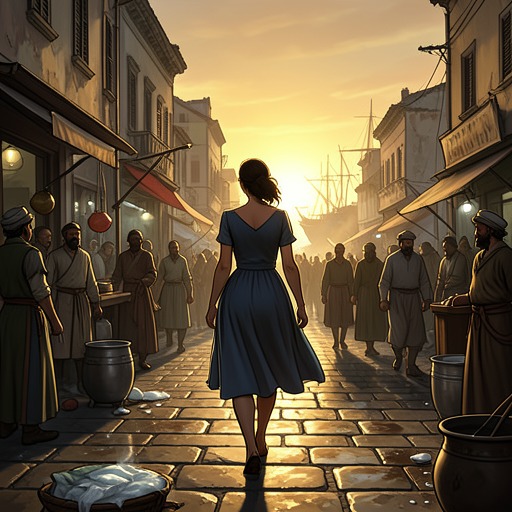
The Bangkok setting gives Erosfera a distinctive spatial form. Mario receives Emmanuelle in a red leather sofa beneath Japanese lamps, while a native servant brings drinks on a tray and kneels to place it on a long leather table. Mario’s wooden house stands over a dark, restless canal and combines the appearance of a forest refuge with luxurious furniture and tapestries. Through the salon, Emmanuelle sees boats carrying sweet drinks, durians, coconuts, and bamboo containers filled with cooked rice moving among vine-covered islets.
The house’s mingling of luxury, nature, commerce, and ritual makes it an apt material image of the concept. Nearby copper bells repeat two notes in the wind; a distant gong calls monks to sleep; a woman begins a lullaby for a child. Erosfera is thus not presented as an abstract doctrine detached from place. It is embedded in a Bangkok of waterways, domestic sounds, religious rhythms, and layered cultural signs, where erotic philosophy enters a world broader than the European restrictions against which it is implicitly measured.
Literary and Historical Significance
The expression gives the novel its governing promise: sexual liberation can become a comprehensive vision of human existence. The work’s framing material identifies the book’s original title as Emmanuelle. La leçon d'homme and describes it as a text that was published clandestinely in France in 1959, provoking scandal in a period marked by severe puritanism. Within that history, Erosfera names the ideal behind the provocation—the affirmation of integral love rather than a simple catalogue of transgressive acts.
Its significance is therefore both narrative and cultural. Narratively, it marks the end toward which Emmanuelle’s encounters and Mario’s instruction are directed. Conceptually, it transforms erotic experience into a language of freedom, bodily knowledge, and optimism. The later account of the mysterious author Emmanuelle Arsan likewise presents the novel as an enduring hymn to integral love, explaining why Erosfera remains the clearest single term for the book’s attempt to imagine pleasure as a complete sphere of life rather than a forbidden fragment of it.