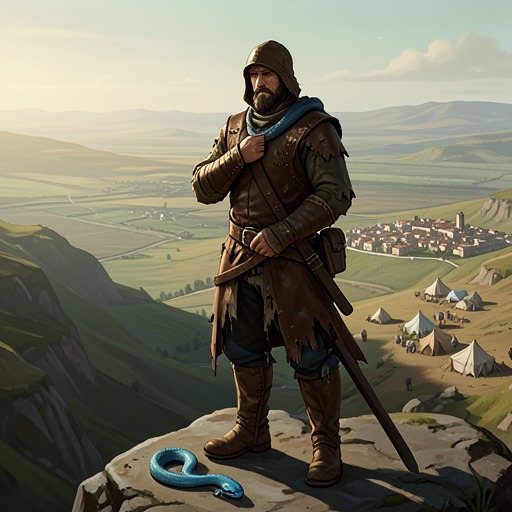
Eragon discovers Saphira's egg
EragonEragon discovers Saphira's egg at the moment an ordinary hunt is violently interrupted by the arrival of an object that belongs to a larger, nearly forgotten history. The blue stone's unexplained appearance places choice at the center of the discovery: Eragon does not yet understand what he has found, but his decision to keep it sets the rest of his life on a new course.
Causes and Setting
The discovery occurs after Eragon has spent three days working toward a successful hunt. In the dusky moonlight, he moves confidently through the forest toward a glen where he expects deer to rest. At the glen he strings his bow, prepares three arrows, and selects a doe at the edge of a herd of roughly twenty animals. The scene initially presents Eragon as a capable hunter within the familiar world of Palancar Valley, guided more by knowledge of the terrain than by constant attention to the tracks.
The decisive interruption comes just as Eragon creeps within range and takes a final steadying breath. An explosion shatters the night, sending the herd into flight and turning the planned hunt into an encounter with the unknown. A fiery gust passes his cheek, and his hurried arrow misses the fleeing doe by a finger's breadth. The failed shot is therefore not merely a missed opportunity for food: it is the immediate cost of an event that redirects Eragon's attention from the deer to the object that has appeared behind him.
Appearance and Immediate Discovery
Where the deer had been, a large circle of grass and trees smolders. Many pine trees have been stripped of their needles, the surrounding grass has been flattened, smoke carries the smell of burning, and mist coils through the scorched area. At the center lies a polished blue stone. Its placement in the blast radius makes it appear both delivered and dangerous, while the absence of any further movement leaves Eragon with no visible explanation for what has happened.
Eragon waits several minutes, watching for danger, before lowering the tension of his bow. He first nudges the stone with an arrow and jumps back when nothing occurs; only then does he pick it up. The stone is oval and about a foot long, dark blue with thin white veins spread across its surface. It is unnaturally smooth, cool and frictionless beneath his fingers, weighs several pounds, and yet feels lighter than its size suggests. These physical details make the object resistant to ordinary classification: it resembles a stone, but its polish, arrival, and strange weight mark it as something fashioned or transported by forces beyond Eragon's experience.
Choice and Plot Function
Eragon finds the object beautiful as well as frightening. He wonders where it came from, whether it has a purpose, and whether it arrived by accident or was meant for him. Stories have taught him to treat magic and those who use it with caution, so his first response is not wonder alone but hesitation. He considers leaving the stone because carrying it will be burdensome and because it may be dangerous.
The choice is settled by a modest, practical calculation rather than by a conscious heroic vow. Eragon nearly drops the stone, but decides that it might at least pay for food, and places it in his pack. That gesture changes the value of the object from an unexplained threat into something he has accepted responsibility for. The discovery's dramatic force lies in this contrast: an event of apparently supernatural scale is answered by a decision rooted in immediate material need. The future Dragon Rider begins not with mastery or certainty, but with caution, curiosity, and a shrug.
Afterward, Eragon leaves the exposed glen and makes camp beneath the upturned roots of a fallen tree. He eats a cold dinner of bread and cheese, wraps himself in blankets, and falls asleep thinking about what occurred. The discovery thus follows him beyond the clearing; even before its nature is revealed, it has entered his private consciousness and unsettled the ordinary rhythm of his life.
Connection to Dragon Rider History
The later history told by Brom gives the discovery a significance Eragon could not have recognized in the glen. Brom describes the Dragon Riders as an ancient order formed to protect and guard the land. For thousands of years they succeed, using immense strength and power for good while peace allows cities, towers, and prosperity to flourish. Their golden age depends on cooperation among humans, elves, dwarves, and dragons, making the lost order not merely a military institution but the organizing force of a flourishing world.
Brom also recounts how that order collapses from within. Galbatorix, after losing his first dragon and blaming the Riders for the loss, turns resentment into revenge. He recruits a sympathetic Rider, helps lure and kill an elder, then murders his own accomplice. Later he enters the citadel of Ilirea, now called Urû’baen, through a gate left unbolted by Morzan and steals a dragon hatchling. With the black dragon Shruikan and the Thirteen Forsworn, Galbatorix destroys the Riders and overthrows the elves. Against this background, the blue stone is not an isolated magical curiosity: it is the return of a power and relationship that Galbatorix's reign has nearly extinguished.
The name Eragon itself extends the discovery into an older layer of history. Brom explains that an elf called Eragon once found a dragon egg during the long and bloody war between elves and dragons. That discovery helped end five years of conflict that both sides later regretted. Eragon's own finding of the egg therefore repeats, while transforming, an earlier act of discovery: the name inherited by a farm boy becomes attached to the renewal of a bond capable of altering the balance between races and powers.
Consequences and Narrative Significance
The blue stone's importance is also foreshadowed by the geography surrounding Eragon's world. Vroengard, the ancestral home of the Riders, remains a looted and empty shell haunted by strange beasts, with the abandoned city of Dorú Areaba at its center. The map's image of that ruined island places Eragon's discovery within a landscape where former glory has become absence. What looks like a single stone in a forest carries the pressure of that vanished civilization and the possibility that its legacy is not wholly dead.
The discovery ultimately initiates Eragon's transformation from hunter into Dragon Rider through his connection with Saphira. Much later, when Eragon is mentally endangered, the being called Osthato Chetowä, the Mourning Sage, and Togira Ikonoka, the Cripple Who Is Whole, tells him to trust Arya and go with her to Ellesméra. The message praises him for ridding the land of a great evil and insists that he is greater than he knows. That recognition reaches back to the blue stone: the act that began with uncertainty in a deer glen has become the first step toward a deed no one else could have wrought.
The event therefore functions as a discovery plot, a threshold crossing, and a reversal of expectation. Eragon enters the forest seeking a doe and leaves the glen carrying an object whose purpose he cannot name. The hunt fails, but the failure becomes the condition of his calling. By choosing not to abandon the stone, Eragon unknowingly accepts the egg, the bond, and the historical burden of the Dragon Riders; the personal and political story that follows is already contained in that small act of taking it home.