The Teirm records burglary
EragonThe Teirm records burglary is a decisive intelligence operation in which Eragon, Brom, and Jeod enter Teirm Castle illegally to examine shipping records for Seithr oil. What begins as an attempt to locate the Ra’zac becomes a study of how commerce, bureaucracy, smuggling, and political violence are entangled: the records offer a possible trail, yet their breadth also shows that the Empire can conceal its agents inside ordinary trade. The burglary therefore advances the immediate hunt while widening the threat around the Varden and its allies.
Causes and Background
The investigation begins with physical evidence rather than reliable testimony. After Eragon finds a metal flask bearing the Ra’zac’s silver insignia, a drop of its clear liquid burns through his skin. Brom identifies the substance as Seithr oil, the dangerous material carried by the killers who attacked Garrow’s home. He proposes using Teirm’s shipping records to trace the Empire’s purchases and determine where the Ra’zac may be hiding. The object transforms revenge from a blind pursuit into a supply-chain investigation.
The wider commercial situation makes the search urgent. Merchants connected to Jeod have been targeted for months: ships carrying their goods disappear, and no sailors survive to identify the attackers. The attacks are selective rather than ordinary piracy, forcing merchants to send cargo overland, raising costs, and disrupting businesses that rank among the largest in the Empire. The sailors’ suspicion that magic is responsible reflects the mystery surrounding the violence, while the pattern suggests that trade routes are being monitored for political purposes.
Jeod explains that the records are kept in the castle and ordinarily handled only by Brand, Risthart’s administrator of trade. Traders are excluded because the authorities fear they might falsify figures and deprive the Empire of taxes. This official concern with accounting creates the very barrier the investigators must cross: the documents are treated as state property, and the truth about the Ra’zac is buried among the same seals, cargo entries, and fiscal routines that regulate commerce.
The Break-In
At sunset, Eragon prepares for the operation by leaving Zar’roc behind, since the sword would slow him and he is reluctant to use it. He carries his bow and quiver instead, intending to rely on magic or an arrow if someone must be disabled. The choice presents the burglary as a stealth mission rather than an armed assault, while also showing Eragon trying to control the violence associated with his pursuit of the Ra’zac.
Jeod gains access through a small gate in the castle wall by persuading a drunken guard that they have legitimate business inside. After the guard opens the door, Jeod leads the others into the keep and quickly moves them toward the records room. Brom then places his hand against the locked door and speaks an unfamiliar word; the lock releases with a faint click. Magic is used not as spectacle but as a quiet practical tool, enabling entry into a room protected by ordinary institutional security.
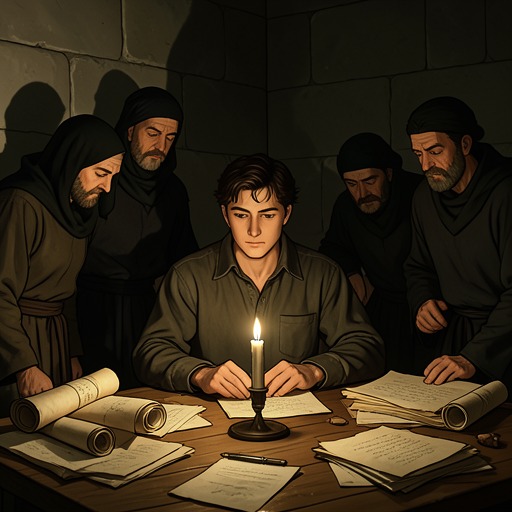
The records room is squat and crowded, with wooden racks piled high with scrolls and a barred window in the far wall. Jeod locates the shipping records for the previous five years and explains that the wax seals on their corners identify their dates. He spreads a length of parchment on the floor, sets out ink and a quill, and instructs the others to ignore tax-only documents while recording every reference to Seithr oil. The method is painstakingly administrative: the burglary depends less on dramatic theft than on sorting, comparing, and preserving information.
Eragon’s illiteracy makes the work especially difficult. He has admitted that Garrow never taught him to read, and the cramped script on the scrolls differs from the printed material Brom has begun teaching him. He therefore contributes by watching the door while Brom and Jeod examine the documents, participating in the investigation even as the written archive exposes his exclusion from formal knowledge. His position changes gradually from helpless outsider to useful observer, but the scene keeps literacy tied to power and access.
The investigators narrow the material by looking for ships sailing in northern waters, yet the work remains slow. They move down the rack, recording each shipment they find. When Eragon warns that soldiers are approaching, Brom refuses to abandon the search and orders the work completed. They scan the final scrolls furiously, return it to the rack, gather the parchment, ink, and pen, and seize the torch before fleeing. The operation succeeds only narrowly, with the evidence copied rather than removed.
Discovery and Immediate Consequences
Their escape begins just as soldiers reach the corridor. The door has not been properly locked, and three armed men appear as Brom is trying to secure it. One guard demands to know why they attempted to enter the records room. Eragon tightens his grip on his bow and prepares to run, while Jeod claims that they lost their way. The scene reverses the investigators’ temporary control: a silent archive becomes an exposed crime scene, and their survival depends on improvisation rather than the authority of the evidence they have gathered.
The records fail to provide a single obvious destination. Jeod reports that Seithr oil has been shipped to every major city in the Empire during the previous five years, apparently under orders from wealthy jewelers. The trail is therefore both valuable and frustrating. It confirms the scale of the network but refuses to identify the Ra’zac by itself, forcing Brom to reason from logistics: their base must be a substantial crossroads, large enough to conceal them and active enough to make unusual provisions for their mounts unremarkable.
On that basis, the investigators eliminate northern possibilities. Brom and Jeod consider Teirm, Gil’ead, and Ceunon; Teirm is ruled out by Jeod’s knowledge, Narda is too small, and Ceunon is too isolated. Gil’ead remains as the most plausible location. The burglary thus produces not certainty but a narrowed hypothesis, converting a vast imperial map into a specific direction for the next stage of the pursuit.
From Records to Surveillance
The operation’s significance expands when Brom continues the investigation beyond the stolen notes. He learns that the cases of Seithr oil move from a warehouse to the palace. He then disguises himself as a bard, enters the servants’ quarters, and spends hours entertaining maids while asking questions. Information travels through informal human networks as well as official ledgers; servants, overlooked by the court, know details that guarded records do not disclose.
The combined evidence points toward the palace and reveals the limits of the original burglary. Commercial documents can show movement, but they cannot by themselves explain who commands that movement or where the cargo ultimately goes. Brom’s inquiries therefore supplement the archive with performance, conversation, and impersonation. The investigation moves between literacy and oral exchange, between fixed records and the unstable but revealing knowledge of people who work around power.
Political and Narrative Significance
The burglary also belongs to a larger crisis inside the Varden. Ajihad later explains that the Empire seems to know where Arya will be ambushed and where messengers to Carvahall are traveling. Merchants who aid the Varden suffer repeated attacks, and every ship they send out disappears. Because the dwarves cannot supply everything the Varden needs, the destruction of these commercial networks threatens the resistance materially. Ajihad therefore suspects that a traitor, or several traitors, is providing information from within their ranks.
The records-room sequence makes this suspicion tangible. Trade is not a neutral background to the conflict: shipments, warehouses, ships, taxes, and palace routes form an information system through which the Empire can punish allies and support the Ra’zac. The burglary answers secrecy with counter-secrecy, but its danger also demonstrates that the investigators are moving inside an enemy-controlled structure whose ordinary paperwork conceals extraordinary violence.
The episode further connects the investigation to competing forms of historical memory. Brom’s public storytelling preserves the history of the Dragon Riders through performance, while books such as The Domia abr Wyrda preserve written accounts that the Empire once condemned and burned. Eragon’s admission that he cannot read places him between these traditions: he first receives history through Brom’s voice, then begins acquiring the skill needed to enter archives himself. Later, in the dwarven library, the written legacy of kings, scholars, songs, and stories is presented as a civilization’s most precious possession. Against that background, the Teirm burglary is not merely a theft of access; it is Eragon’s dangerous passage into the documentary world that governs the war.
The event’s decisive value shift is from uncertainty to actionable suspicion, not from ignorance to complete knowledge. The Seithr oil trail identifies the scale of the Empire’s network, narrows the likely location to Gil’ead, and leads Brom toward the palace, yet it also reveals that the enemy’s reach extends through merchants and shipping routes. The investigators leave with more direction and more danger. Their copied records become a fragile counter-archive: a small piece of information extracted from a system designed to make resistance visible, punishable, and difficult to sustain.