Magic
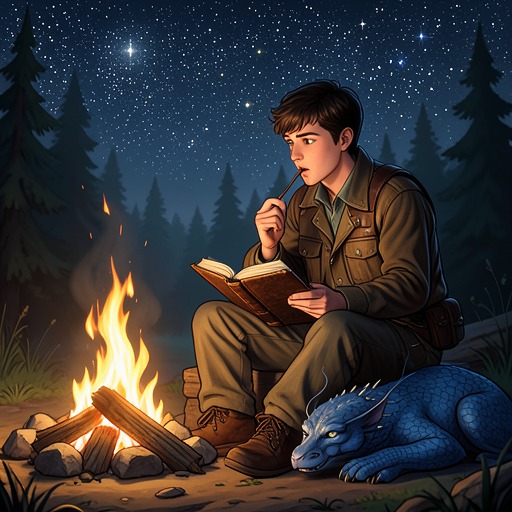
EragonMagic is the force that turns knowledge of the world into action, and its decisive significance lies in the limits that keep power from becoming a simple solution to every danger. Brom explains that it follows rules as definite as those governing the rest of the world: a spell draws on the caster’s bodily energy, depends on the words the caster knows and the images the caster can conceive, and may kill when the task exceeds the strength available. Magic therefore becomes both an instrument of liberation and a discipline of restraint, especially for Eragon as he begins to discover that his connection with Saphira has opened a perilous new identity.
Definition and the True Nature of Things
Magic is tied to the Ancient Language, whose words describe the true nature of objects rather than merely their visible or commonly recognized qualities. Brom uses fire as the clearest example: its essential name is brisingr, and a person strong enough to speak that name can direct fire according to intention. Eragon’s first successful use of the power produces blue flame and obeys his will, but the unusual color is presented as a personal variation rather than a universal property of the spell.
The relationship between word and effect is not mechanical. Beginners must usually state exactly what they want the magic to accomplish, while a master can speak a seemingly unrelated word and still produce a different result by perceiving a connection invisible to others. Brom describes this as an art of association and practice, not merely a vocabulary of commands. Eragon’s achievement in directing fire is consequently difficult precisely because it combines verbal knowledge, imagination, and control before he has learned how dangerous that combination can be.
Magic also has a distinct place within the history of the Dragon Riders. Every Rider could use it, though not with equal strength, and the Riders concealed that ability because openly displaying it would have complicated their dealings with ordinary people and weakened their advantage over enemies. The king’s magical power is therefore not proof that he is a conventional wizard or sorcerer; Brom identifies it instead as a consequence of being a Rider. The distinction matters because magic is not one undifferentiated supernatural practice. A sorcerer such as a Shade relies on spirits, a magician possesses power without spirits or a dragon, and witches or wizards obtain effects through potions and spells. Eragon’s power belongs to the Rider tradition and is inseparable from the dragon-bonded order that once governed the land.
Costs, Limits, and Forbidden Uses
The fundamental cost of magic is energy. Brom compares magical exertion to physical labor: using a spell consumes as much strength as performing the same task with arms and back. Eragon feels exhausted after destroying Urgals, and Brom identifies that exhaustion as evidence that the spell nearly exceeded the energy in his body. If a magical act demands more energy than the caster possesses, the result is death rather than a harmless failure.
The danger is intensified by the irreversibility of a released spell. Once the caster commits to a task and lets the magic go, the power cannot be recalled even when its cost becomes fatal. A magician must therefore know personal limits without ever being able to measure every consequence with certainty. Brom’s practical rule is that magic should be reserved for tasks that cannot be accomplished by ordinary means. The rule turns caution into a survival skill: mundane effort is slower or harder, but it does not carry the same concealed risk of draining the life from the person who attempts it.
Healing demonstrates that magic does not abolish ordinary effort. Brom’s injured arm could possibly be healed with the right word, yet he refuses to let Eragon attempt it because magical healing would consume as much energy as allowing the wound to mend naturally. Cuts, bruises, and perhaps broken bones lie within the range Brom considers possible for a developing practitioner, but even a beneficial result may be irrational if its energetic price leaves the healer helpless or dead.
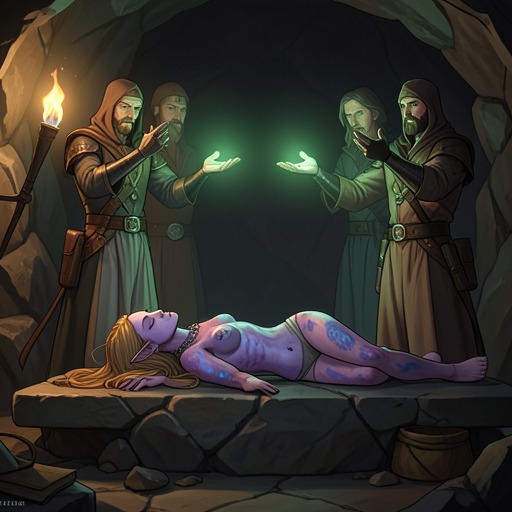
Resurrection marks the clearest prohibition. When Eragon asks whether the dead can be brought back, Brom warns that the Riders forbade such attempts for their own safety. Beyond life lies an abyss where magic has no purchase; reaching into it causes strength to flee and the soul to fade into darkness. Wizards, sorcerers, and Riders have all failed and died at that threshold. The prohibition is therefore not a matter of doctrine alone but a boundary confirmed by repeated catastrophe, establishing death as a limit that power cannot safely cross.
Historical Power and Its Corruption
Magic belongs to a lost political and cultural order as well as to individual practice. During the Golden Age of the Riders, each Rider possessed the strength of ten men, was effectively immortal unless killed by a blade or poison, and used power in the service of protection and guardianship. Under their tutelage, cities and towers were built from living stone; peace enabled wealth, flourishing lands, and prosperity among humans, while the elves remained allies and the Dwarves friends. Magic thus appears first as a civilizing force, embodied in architecture, security, and cooperation among peoples.
The same tradition was vulnerable to corruption from within. Galbatorix, accepted by the Riders after his testing revealed great power, later turned his grief over the death of his dragon into hatred of the order. He used dark secrets learned from a Shade to inflame another Rider against the elders, helped lure and kill an elder, and then slaughtered his accomplice. After stealing a dragon hatchling through Morzan’s assistance, he learned forbidden magic in hiding; with his black dragon, Shruikan, fully grown, he and Morzan fought the Riders they encountered. Twelve other Riders joined them from motives of power or resentment, forming the Thirteen Forsworn, and the Riders fell beneath their assault. Magic’s history therefore contains a structural irony: the power created to guard civilization also gives a determined enemy the means to destroy its guardians.
Its older history reaches even further back, into the conflict between the elves and the Dragons. An elven youth killed a dragon while treating it as an ordinary animal, and the Dragons retaliated against the elven nation. The resulting war lasted five years and might have continued much longer if an elf named Eragon had not found a dragon egg. That discovery created the possibility of communication and reconciliation between the two peoples, eventually leading to the order that would become the Riders. Magic is consequently connected not only with individual spells but with the historical settlement of a conflict caused by failure to understand another kind of being.
Objects, Places, and Inherited Knowledge
The material culture surrounding magic preserves the memory of its former practitioners. Brom unveils Zar’roc, a Rider’s sword wrapped in cloth: its gold, teardrop-shaped pommel contains a ruby the size of a small egg; its hilt is wrapped in silver wire; its wine-red sheath bears a black symbol; and its iridescent red blade is eternally sharp and will never stain. The weapon feels to Eragon like an extension of his arm, combining the lethal purpose of battle with a terrible beauty. Rider swords were presented by the elves after training, and their colors traditionally matched the Rider’s dragon. Zar’roc therefore functions as both a weapon and a surviving material link to a shattered magical institution.
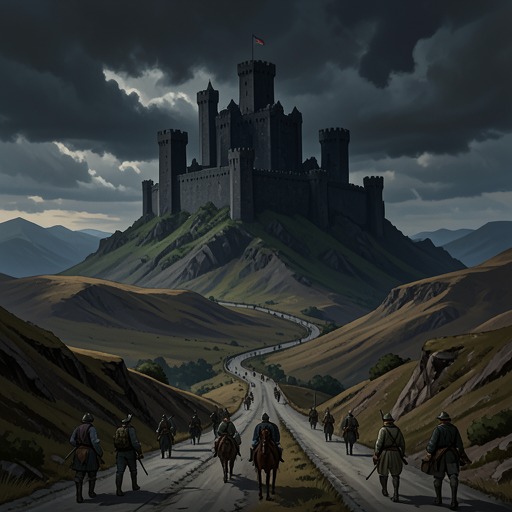
The map of the world gives that history a geography of ruins. Vroengard, the ancestral home of the Riders, is described as a place once glorious but now looted, empty, and haunted by strange beasts; at its center stands the abandoned city of Dorú Areaba. Urû’baen, by contrast, is the seat from which Galbatorix rules with Shruikan beside him. The opposition between these places makes magic’s political transformation visible: the former home of a protective order has become a ruin, while the conqueror’s center of power occupies the heart of the Empire.
Knowledge of magic is often partial, delayed, and guarded. Brom refuses to reveal where he learned to use it, saying only that his teacher was very good and that he can pass on at least some of those lessons. His reluctance frustrates Eragon, who feels thrust into a world governed by unexplained rules, but it also reflects the danger of teaching power without judgment. Magic is transmitted through apprenticeship, memory, and selected disclosure rather than made universally available. Its secrecy protects practitioners, yet it also leaves the inexperienced vulnerable to experiments whose consequences they cannot calculate.
Magic and the Expanding World
The book gradually replaces the appearance of miracle with a more exacting understanding of power. Eragon initially encounters magic through a dangerous act performed before he knows what he is doing, and Brom’s questioning forces that event into a system of costs and categories. Saphira’s recognition that Brom is himself a magician confirms that magical knowledge is not merely ancient lore; it is embodied in hidden teachers and living practitioners. Eragon’s education begins when amazement gives way to responsibility.
At the same time, the narrative does not reduce magic to a closed technical system. Its laws are clear enough to make risk intelligible, but mastery depends on imagination and on perceiving relationships between words and things that ordinary observers cannot see. The world retains an element of wonder because understanding increases the field of possibility without removing uncertainty. That tension is visible in the distinction between a beginner who must specify an effect and a master who can use an indirect word as a focal point for a larger transformation.
Magic also opens the plot beyond the immediate struggle with Urgals and the Empire. After Eragon’s confrontation with the Shade, the hidden figure Osthato Chetowä, also called Togira Ikonoka, identifies himself as the Mourning Sage and promises answers. He directs Eragon to trust Arya and go with her to Ellesméra, where he will be found, and tells Eragon that he is greater than he knows because he has rid the land of a great evil. This promise does not erase the established limits of magic; instead, it places Eragon’s developing abilities within a larger inheritance whose teachers, ruins, enemies, and unresolved secrets still shape the future of the world.