The rescue of Arya from Gil'ead
EragonThe rescue of Arya from Gil’ead is the turning point that transforms Eragon’s captivity into an active mission of liberation. Weak from imprisonment and an enforced fast, Eragon nevertheless refuses to abandon the elf he has seen in the prison. With Murtagh’s help, Saphira’s intervention, and a desperate escape across the city, he frees Arya from Durza’s fortress and carries her away into the night. The rescue therefore joins several kinds of reversal: prisoner becomes rescuer, hunted fugitives become attackers, and Eragon’s personal obligation becomes part of the wider struggle against Galbatorix’s Empire.
Causes and Stakes
Eragon’s opportunity begins when his magic returns after hours of frustrating absence. He speaks the command “Nagz reisa!” and sends the blanket from his cot flying, then uses magic not to smash the cell door but to manipulate its internal mechanism into the unlocked position. The moment measures his growth: the power that once nearly exhausted him when he killed the Urgals at Yazuac now leaves him only slightly tired. Yet escape alone is not enough. Eragon knows that the elf is imprisoned somewhere in the fortress and chooses the more dangerous objective of finding her, even while his confused thoughts remind him that he could flee through the cell window.
The stakes are enlarged by Eragon’s bond with Saphira. He realizes that contacting her should have been his first act after recovering his strength and finally reaches across the distance. Her answer comes quickly: she is over Gil’ead, while Murtagh is already on his way. This establishes the rescue as a coordinated action rather than a solitary magical feat. Eragon’s need for help also reveals the limits of his power. He can open a lock and fight, but he is still weakened, unarmed, and uncertain whether a major spell will leave him standing.
The Prison Break
A squad of six soldiers discovers Eragon outside his cell and charges. Although he raises his glowing gedwëy ignasia and prepares to pronounce a fatal spell, he is saved from facing all six alone when a ragged, bearded Murtagh appears with a bow. Murtagh’s arrows strike three soldiers before they understand the source of the attack. Eragon then uses “Thrysta!” against another, while Murtagh drops a second with an arrow through the neck. Eragon’s insistence that the last soldier not be killed shows that rescue, even under extreme pressure, remains morally distinct from indiscriminate violence.
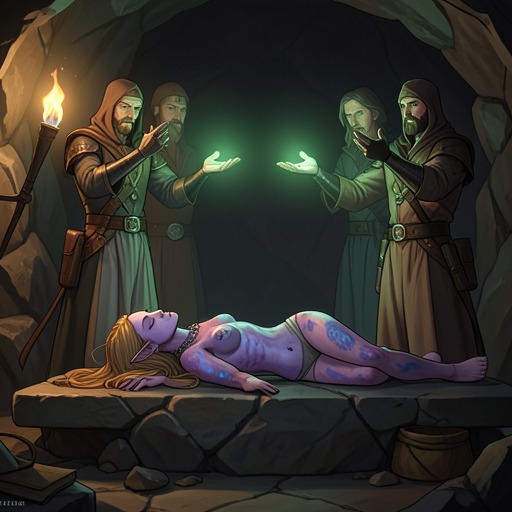
Murtagh has taken a guard’s ring of keys, and Eragon uses it to open Arya’s cell. Moonlight falls across her face, presenting her first as an image of contained strength: tense, upright, and carrying herself with a queen’s demeanor. Her dark green, almost black eyes meet Eragon’s, but the encounter ends in collapse rather than recognition through speech. Arya trembles and loses consciousness, leaving Eragon to catch her; the elf is surprisingly light, and the scent of freshly crushed pine needles surrounds her. The physical act of catching her makes the rescue immediate and burdensome: Eragon must now protect a helpless captive while the fortress closes around them.
Murtagh initially urges flight and warns that stopping for Arya is a mistake. Eragon rejects that calculation and explicitly asks for his help, making the rescue a test of both loyalty and purpose. Murtagh’s practical skills—his stolen keys, his archery, and his knowledge of escape routes—become indispensable, while Eragon’s returning magic supplies the force needed to open the way. Their cooperation is uneasy but effective, formed under pressure before either man can fully trust the other.
Confrontation with Durza
The escape reaches its crisis when a cold chuckle announces that Durza has found them. The Shade enters the banquet room carrying a pale sword marked by a thin scratch, and his slight, compact body conceals strength far beyond that of an ordinary human. He taunts Eragon as a young Rider and admits that he had trusted the captain’s report that Eragon had eaten all his food, a mistake he does not intend to repeat. The confrontation thus connects the prison’s physical control with Durza’s personal confidence that exhaustion has already defeated his captive.
Eragon and Murtagh survive by changing the terms of the encounter. When Eragon calls attention to the dragons, part of the ceiling tears away and exposes the night sky. Murtagh’s first arrow strikes Durza’s shoulder, and the second catches him between the eyes. The Shade breaks the first arrow with two fingers, but the second wounds him catastrophically: his skin turns gray, mist gathers around him, and a shattering cry follows before the cloud vanishes, leaving only his cape and clothes. Eragon believes that Murtagh has killed him, although Murtagh remains uncertain. The apparent defeat is deliberately unstable, preserving the danger associated with a Shade even as it opens the escape route.
The soldiers immediately attempt to reclaim the fugitives, entering the banquet room with nets and spears. Saphira’s arrival reverses the balance again. She thrusts her head through the opening, tears away more of the ceiling, and sends shingles crashing down when the center beam breaks. Some soldiers flee; others are crushed in the falling debris. Saphira then removes the remaining roof and drops into the hall, splintering a table under her weight. Eragon’s embrace and her contented hum mark the emotional center of the escape: after separation and captivity, the Rider and dragon are physically reunited.
Flight from Gil’ead
The escape is not complete when the fortress is breached. Saphira leaps from the banquet hall onto the roof, where fallen watchmen lie scattered, but archers emerge from a tower across the roofless hall. Eragon orders her to take off immediately. The additional weight of Arya and the others causes Saphira to lose altitude as she launches, and released bowstrings follow them into the night. One arrow pierces her wing without passing through it, leaving her breathing labored and heavy.
Even wounded, Saphira can carry them far enough. Eragon clutches Arya as they skim over Gil’ead, leave the city behind, and turn eastward, climbing through the darkness. The geography of the flight gives the rescue its final shape: Arya is no longer merely removed from a cell but transported beyond the fortress’s immediate reach. Saphira’s endurance, rather than effortless invulnerability, makes the escape credible; the arrow lodged in her wing preserves the cost of freedom.
Consequences and Ethical Reversal
The rescue establishes a lasting conflict over what liberation permits. Later, after the group encounters the slaver Torkenbrand, Murtagh executes the defenseless man despite Eragon’s protest. Eragon objects that they could have left him behind, while Murtagh argues that Torkenbrand was dangerous and might have revealed Arya’s presence to the Urgals. Murtagh’s declaration that he is only trying to stay alive and cannot place a stranger’s life above his own sharply contrasts with Eragon’s refusal to abandon Arya in Gil’ead. The rescue therefore does not simply unite the two men; it exposes the ethical division that their cooperation has temporarily concealed.
Arya’s rescue also becomes essential to the larger war. At the Battle of Farthen Dûr, Eragon later believes that the Varden and the Dwarves have been destroyed and that Arya will either be recaptured or killed. The fear matters because her fate has become inseparable from his own understanding of the rebellion’s future. When Saphira and Arya finally descend through the shattered Isidar Mithrim, with Saphira breathing flame and Arya’s raised hand glowing with green magic, their appearance reverses apparent defeat once again. The woman carried helplessly from the prison has become an active magical participant in the battle, while the rescue that began as Eragon’s refusal to leave one captive behind has widened into a bond among Rider, dragon, elf, and resistance.