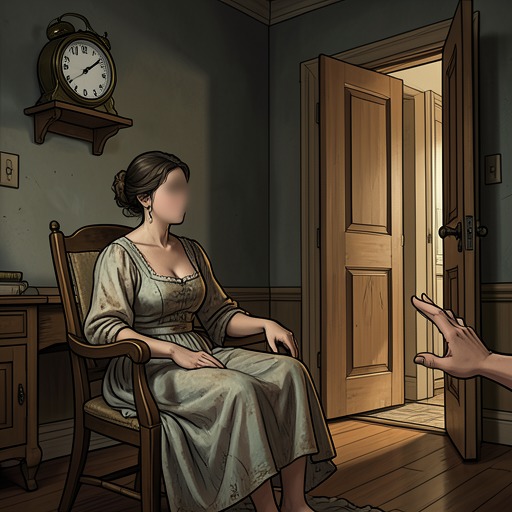
Mother burns father's papers
ErasureAgnes Ellison’s burning of Ben Ellison’s papers is a delayed act of obedience that becomes, in Thelonious Ellison’s account, an unresolved family message. Ben had asked Agnes to destroy papers in a gray box in his study without reading them. She did so only seven years after his death; when Thelonious learns what happened, the smoke in the living room, a blue box on the counter, and Agnes’s shifting description of events make the act more difficult to interpret than its practical purpose suggests.
The Promise and Its Delay
Agnes first explains the burning through a promise: she had told Ben she would burn some of his papers when he died, and, as she puts it, he had died. Lisa Ellison points out the interval—seven years—while Agnes acknowledges that she had only just got around to fulfilling her word. The delay is not explained as forgetfulness or refusal. Agnes says she hates fire, offering a reason for postponement that Thelonious considers reasonable. That fear gives the eventual burning a concrete domestic cost: this is not an easy task she has casually completed, but one she put off despite the promise.
Later, Agnes gives Thelonious a more specific account of the request. Ben spoke to her while he was in the hospital and asked her to burn the papers in the gray box in his study. He also asked her not to read them. Agnes says she agreed, and, when Thelonious asks whether she read them, she says she did not because Ben had asked her not to. The account establishes both the instruction and its limit: the papers were to be destroyed, not examined. Their contents remain undisclosed, and the narrative offers no basis for deciding what Ben hoped to keep private or why he wanted the papers burned.
The Burning and Its Material Traces
By the time Thelonious hears the fuller explanation, Agnes tells him she has finished burning the things. He sees a blue box on the counter and asks whether she is burning its contents too. Agnes answers that those are what she burned, then explains that the living room became smoky because she had not thought about the flue. She adds that the house had never had a fire because she was afraid of fire. The smoke therefore records the act in the space where it took place: the papers are gone, but their destruction has left a visible and inconvenient trace inside a home where Agnes’s fear had long prevented fires.
The box’s description does not settle neatly. Ben’s instruction concerned a gray box in his study; Thelonious sees a blue box on the counter, and Agnes calls it gray while speaking about what she burned. The narrative does not clarify whether the box changed appearance, whether Agnes is confusing details, or whether these are simply different ways of referring to the same object. That discrepancy matters because the event is available to Thelonious only through conversation and observation, not through the papers themselves. Their contents have been removed from reach, while the surviving clues—the box, the smoke, and Agnes’s words—do not yield a firm account of what was destroyed.
A Disclosure Without a Decipherable Message
The scene is shaped by Thelonious’s attention to what Agnes says and what her manner may imply. She mentions the smoky living room twice; she calls the blue box gray; and she quickly gives way on the matter of what she and her companions did at their meetings. Thelonious reads these details together as signs that Agnes is trying to tell him something. Yet he cannot identify what that something is. He reflects that sharing a language within a family does not mean sharing the rules that govern its use, especially when those rules seem to change. Her apparent incoherence does not make her speech meaningless to him; instead, it intensifies his sense that something is being communicated without giving him a reliable key to it.
The papers’ destruction thus has two opposed effects. Agnes has carried out Ben’s explicit request and preserved the secrecy he attached to it by not reading the papers. At the same time, the act creates a new uncertainty for Thelonious: he knows that his mother is trying to convey something, but the evidence available after the burning cannot tell him what the papers contained or what her hints mean. The scene ends not with a recovered secret but with that gap between recognition and understanding. The smoke confirms that the papers were burned; it does not disclose what their loss has concealed.